Home » convergence (Page 26)
Category Archives: convergence
Google Gears Into Offline Applications!
 The line between Microsoft and Google just got fuzzier with the release of Google Gears, a humble browser extension that suddenly allows GMail, Google Reader and other previously web-based applications to work offline! The competition for Microsoft’s cash cow, the Office Suite, just got stronger.
This little tick marks a radical transition for Google…
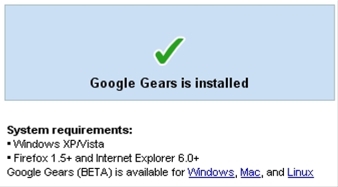
… every one of those brilliant online applications from Google Docs and Spreadsheets to Google Reader just started to mark their way onto your offline desktop. Sure, Google Gears are very in Beta (as opposed to, say, the last 12 months which GMail spent in Beta), but as those kinks are worked out, Microsoft’s competition just got stauncher!
LOL Theorists
In a fit of silliness, I find myself using the LOL CATS builder for terrible, terrible, theorist humour …

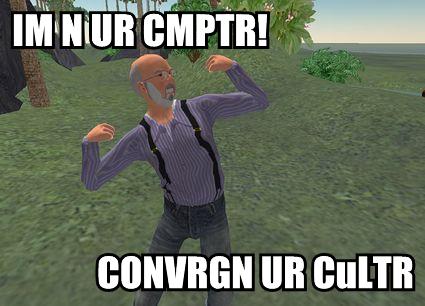


Where did this insanity come from? I blame Jean (Burgess, not Baudrillard!). (More here.)
Update: Henry Jenkins linked to the LOL Theorist mashups of himself! 🙂
The 4400 Goes Viral (Marketing)
The 4400 has taken to viral marketing dramatically in order to build the word before the upcoming fourth season of the TV show. According to AdWeek:
To promote the new season of The 4400 on USA Network, Campfire has created a wide-ranging interactive world consisting of 80 videos that run from 30 seconds to five minutes and six Web sites. […] The 4400 follows 4,400 people who are abducted, taken away and then returned to planet Earth. After their return, many of them discover they have superpowers. As the fourth season begins on June 17, the plot follows the development of a drug called Promicin: it gives the users superpowers, if it doesn’t kill them. Three different factions emerge around the drug: pro, anti- and neutral.
On YouTube, for example, one of the show’s stars, Billy Campbell, appears in character as Jordan Collier, advocating Promicin and the decrying the government’s attempts to ban the drug. Here’s Jordan Collier dispatch #3:
Elsewhere on the net, we can find the Promicin Power website, which argues that Promicin is the key to world peace and a sustainable relationship with nature. Here’s one example that looks like it could be have been a United Colours of Bennetton advertisement in a past life:
At the other extreme, there’s also Promicin Terror which sees the drug as the biggest threat to the US since Al Qaeda. Clearly building on the famous ‘Daisy‘ political ad of the 60s (which was recycled in the US debates about the War with Iraq), this is an example of a clip campaigning to ban the drug:
I quite enjoyed the last season of The 4400 and am heartened to see the show’s producers so actively embracing the potential of video-sharing and online word-of-mouth. The clips are a little over-produced, but given the state of a lot of TV advertising today, I’m sure they could easily be mistaken for the ‘real thing’.
Visualising the User-Driven Web
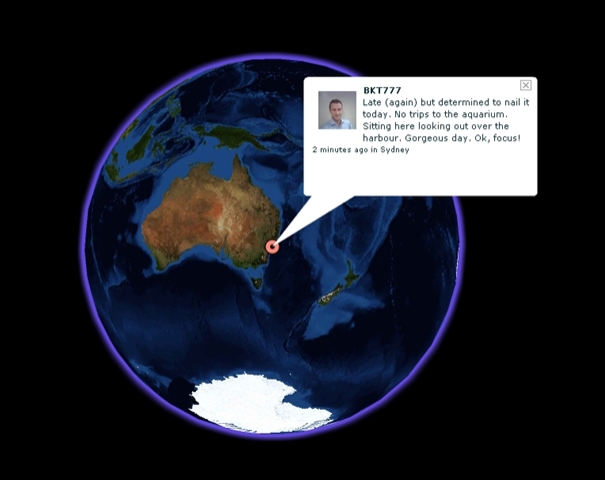
I was just pointed to Flickrvision, and I’m impressed. Flickrvision, and its older sibling, Twittervision, are program mashups by David Troy which combine the visualisation of Google Maps with the user-created data flowing out of Flickr and Twitter. There’s a ‘standard view’ in which individual Tweets or Flickr images are posted on a flat world map, but even more impressive for those visually-minded is the 3D version which inserts Tweets and Flickr photos continually onto a global map (which spins as needs be to show the origin of each post).
An example of Twittervision:
An example of Flickrvision:
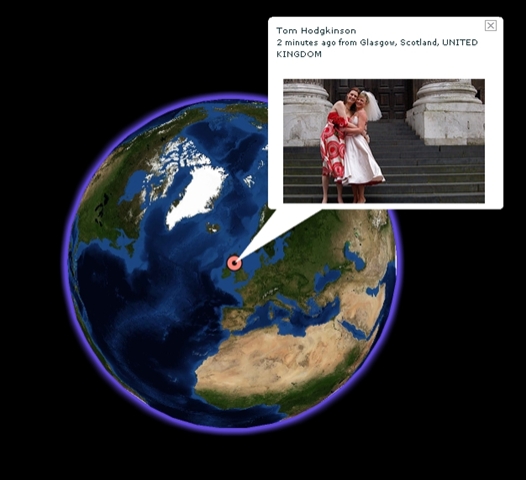
Watching these globes spin, each showing a fragment of life around the world, is incredibly engaging. This is the user-driven web at its most visually enticing. I have to say, were I in charge of a Communications Studies or Media Studies department (which I’m not) and I could find a couple of spare monitors and computers (which, in all fairness, departments probably couldn’t), then I’d leave these running 24/7 in the front foyer; the best advertisement for the studying the user-driven web is watching it happen in all its visual glory, right in front of you!
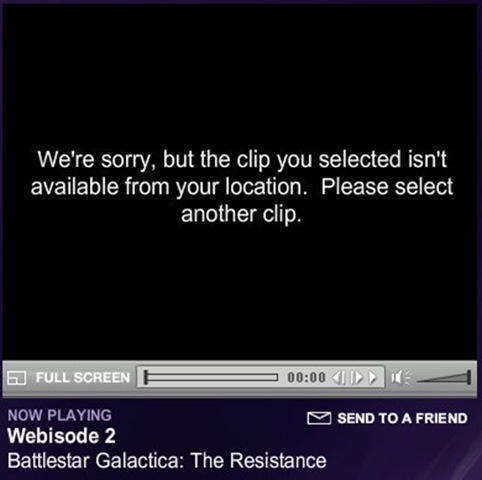
“We’re sorry, but the clip you selected isn’t available from your location:” Watching Battlestar Galactica in Australia and the Tyranny of Digital Distance
I just submitted an abstract for the Media International Australia special issue ‘Beyond Broadcasting: TV for the Twenty-first Century’. Here it is:
“We’re sorry, but the clip you selected isn’t available from your location:” Watching Battlestar Galactica in Australia and the Tyranny of Digital Distance
[Figure 1. Screen-capture from http://www.scifi.com/battlestar/, 11 September 2006]
In the late 1960s, conservative Australian historian Geoffrey Blainey coined the term “the tyranny of distance” to describe how the geographic gap between Australia and the centres of the Western world (US, UK) played a fundamental role is shaping the Australian psyche and character (Geoffrey Blainey, The Tyranny of Distance, Sun Books: Melbourne, 1966). Thirty something years later and the world is far more widely considered a global village; the world wide web, email and a million other applications have made real-time information-heavy communication and commerce the norm. However, while information transfers have made ‘distance’ much less of a concern in a number of ways, many policies, practices and systems of commerce still operate as though they are centred on goods moving at the speed of physical shipping, not allowing for information moving at the speed of light down a copper or optical wire. In an era when ‘the tyranny of distance’ means so much less in many contexts, this paper will argue that in the multimedia markets of contemporary society there is, rather, a prevailing tyranny of digital distance which marks out those areas of communication and commerce in which the potential and, indeed, expectation of synchronous global culture (at least for English-speaking countries) leads to constant state of confusion and annoyance – on both personal and legal levels – when those expectations are not met.
The North American-produced television series Battlestar Galactica, re-imagined for the twenty-first century (from an original 1970s series), has consistently been at the cutting edge of television and cross-media. Executive producer Ronald D. Moore and the Battlestar team utilise not just blogs and production-side video-blogs, but also create episodic commentary podcasts, make deleted scenes available online, and have even put two full episodes online for free for viewing. Likewise, Battlestar was one of the first shows available via Apple’s online iTunes Store. Given the amount of extra online content, and the show’s science fiction genre, Battlestar has a large and very active fan community who consume both the television show itself and the officially produced extra material, as well as actively creating and discussing their own derivative ‘fannish’ works ranging from blog commentaries to fan-created videos. Thus, when the show’s producers launched a series of 3 to 4 minutes ‘webisodes’ to re-build interest in the show prior to the launch of its third season, fans across the (wired) globe were understandably excited. However, when citizens of Australia, the UK, Canada or any other country outside the US tried to view these webisodes, they were met with a notice saying: “We’re sorry, but the clip you selected isn’t available from your location.” The owners of Battlestar (NBC) elected to restrict these webisodes to residents of the US only. This decision upset fans across the global Battlestar audience, with US fans quickly circumventing the restrictions and passing copies of the webisodes to their international fellows. In this paper, I will contend that this moment typifies the tyranny of digital distance, exemplifying the legal, ethical and practical issues raised when a globally-promoted television series ‘centres’ on a single national audience. I outline the difficulties of ‘watching’ Battlestar from Australia, and argue for distribution modes which are more in keeping with the technological (and fan-led) potential of digital distribution.
As you might imagine, this paper will draw together my previous thinking about the tyranny of digital distance which you can read about here and here. I’m also finishing off another Battlestar-related paper that stopped being written for a year, but is now being finished off for a new collection. It’s going to be a busy month, but I’m hopeful both of these will be well polished before Emily and I get married on June 9th (presuming this abstract is accepted). Wish me luck!
Update (8 May 2007): The abstract has been accepted! Thankfully, though, full papers aren’t needed until August 1st so I’ll be writing this after Emily and I return from our honeymoon (in Venice!!) :).
Update 2 (21 September 2007): The full version of this paper has been accepted after peer review, and will appear in Media International Australia issue 126, which is scheduled to be released in February 2008.
Update 3 (26 March, 2008): You final version of this paper has appeared, and you can read it following the link from this post.
Law and Order’s LonelyGirl15 Episode
I’m not a huge Law and Order watcher, and I’ve no idea how far the Australian schedule differs from the US one, but I was fascinated to hear (somewhat after the fact) that in November last year the Criminal Intent version of the tv franchise featured an episode which built directly on hype around LonelyGirl15.
The episode — and the fictional videoblog series — was called ‘Weeping Willow’ (instead of lonelygirl15) and instead of YouTube it was said to feature on ‘YouLenz’. I’d love to see the episode and will hunt it down one day, but what I found really impressive was the fact that the videoblog episodes created for Law and Order (still) appear online; check them out at FreeWillow17.com. These videoblog clips mimic the style and substance of lg15 really well; from the (early) dynamic between Bree and Jonas to the use of a handpuppet and the bedroom set. It was a little odd to see Buffy’s little sister (MichelleTrachtenberg) playing a character called Willow, but these are really well produced clips nevertheless.
If anyone knows when this episode will screen in Australia, please let me know!

Tama Leaver dot Net by Tama Leaver is licensed under a Creative Commons Attribution-NonCommercial-ShareAlike 4.0 International License.