Battlestar Book (and Teaching with Facebook Updates?)
For anyone interesting in the convoluted social world of the soon-to-return Battlestar Galactica, you must check out the hilarious Battlestar Book which tells the tale of BSG in Facebook status updates. A snippet:
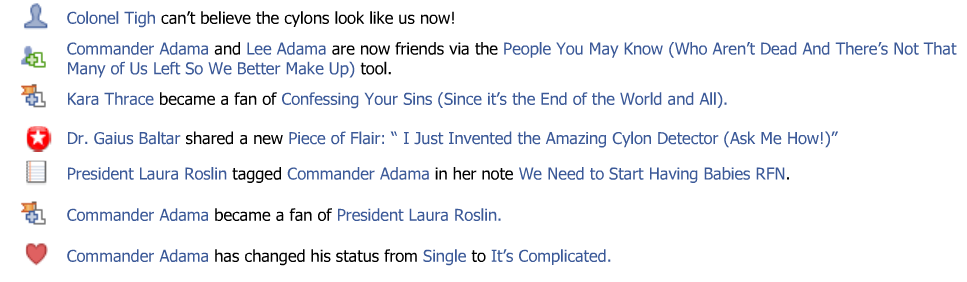
See the full Battlestar Book [Via io9].
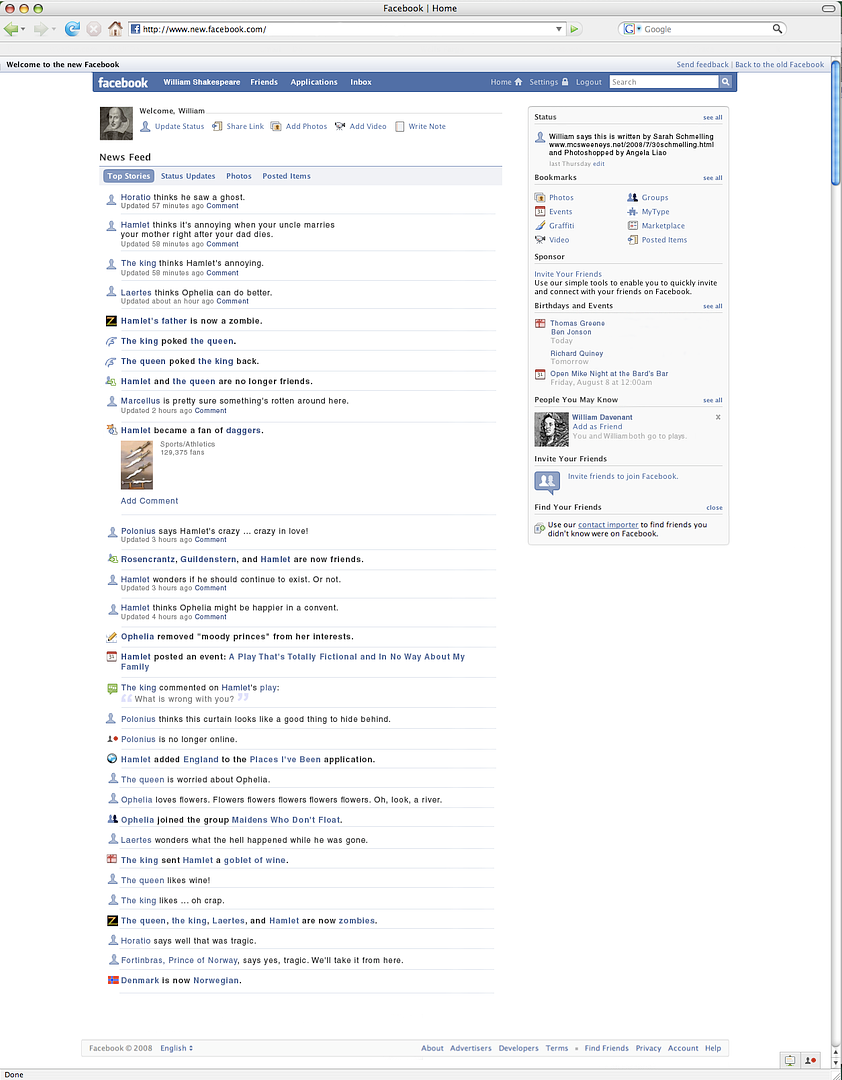
Incidentally, does anyone know of an online generator or tool which can quickly knock out icon-driven status updates like these? After the Battlestar Book and the earlier hilarious Facebook Hamlet, I’m toying with the idea designing a project in which students summarise either a key article or perhaps episode of television using this style. I’m thinking it would get them to think critically about the sort of data Facebook gathers and shares about people while also encouraging students to brush up on their skills in terms of finding the key points and ideas in texts. Or is that nuts?
A Little Bit of History …
Here’s an amusing little bit of personal history: when I was 8 years old, my dad and I were filmed as part of a Channel 7 Perth promotional advertisement series (dad had friends who worked for Channel 7 at the time). I hadn’t seen the clip in more than a decade, but dad recently resurrected it (albeit in very poor quality, as the is a digitisation of a VHS copy from a second-generation BETA copy, with the soundtrack clearly out of sync). The promo is about 30 seconds, but watch around the 18 second mark for my fleeting 2-seconds:
Annotated Digital Culture Links: January 5th 2009
Links for January 3rd 2009 through January 5th 2009:
- Participatory Media Literacy: Why it matters [Digital Ethnography] – Michael Wesch (of The Machine is Us/ing Us fame): “Those of us striving to integrate participatory media literacy practices into our classes often face resistance. Other faculty might argue that we are turning away from the foundations of print literacy, or worse, pandering to our tech-obsessed students. Meanwhile, students might resist too, wondering why they have to learn to use a wiki in an anthropology class. The surprising-to-most-people-fact is that students would prefer less technology in the classroom (especially *participatory* technologies that force them to do something other than sit back and memorize material for a regurgitation exercise). We use social media in the classroom not because our students use it, but because we are afraid that social media might be using them – that they are using social media blindly, without recognition of the new challenges and opportunities they might create.”
- Speeding hoons in Victoria and South Australia goad police with vanity videos on YouTube [PerthNow] – “Furious police are scouring the internet for the irresponsible antics of hoon drivers and have vowed to use covert sting operations to catch them. The warning to exhibitionists who post videos of their potentially deadly stunts on website YouTube has been issued by South Australia’s police Traffic Support Branch Superintendent Mark Fairney.”We’re not taking it, we’ve had enough,” he said. A series of hoon videos made in SA has been posted on YouTube in the past six months. The footage outraged police and the RAA, with both saying innocent motorists were at risk from the stunts. In one video clip, a motor-cyclist was filmed from different angles and can be seen reaching a speed of 210km/h at Eagle on the Hill. The white-knuckle ride was filmed by a bike-mounted camera and several roadside positions. The title of the clip boasts that the rider hit 215km/h. The video, posted in July, included a Google Earth map following the route”
- Homework is fun on an iPod touch [WA Today] – “A pilot program in which teenagers used iPods for school work has increased attendance and increased enthusiasm for homework. A class of year 8 students at Shepparton High School in central Victoria are the first in Australia and among the first in the world to use iPod touches in the classroom for a global “mobile learning” project. The students use the hand-held media players to search the internet, download music, do quizzes, research and submit assignments and collaborate with a school in Singapore. Preliminary research on the program found students were more willing to come to school, did more homework and used their iPods more than laptops or desktop computers.”
- Who on earth is Matt Smith? [BBC NEWS | Entertainment] – “Matt Smith has been named as the actor who will take on the role of TV’s most famous time traveller. He may be the youngest actor to play the Doctor, but Smith has already built up an impressive CV on stage and the small screen. His biggest television role has been in BBC Two’s political drama Party Animals (2007) in which he played parliamentary researcher Danny Foster.” (New Doctor actor is youngest ever. )
- Popeye the Sailor copyright free 70 years after Elzie Segar’s death [Times Online] – ““I yam what I yam,” declared Popeye. And just what that is is likely to become less clear as the copyright expires on the character who generates about £1.5 billion in annual sales. From January 1, the iconic sailor falls into the public domain in Britain under an EU law that restricts the rights of authors to 70 years after their death. Elzie Segar, the Illinois artist who created Popeye, his love interest Olive Oyl and nemesis Bluto, died in 1938. … While the copyright is about to expire inside the EU, the character is protected in the US until 2024. US law protects a work for 95 years after its initial copyright. The Popeye trademark, a separate entity to Segar’s authorial copyright, is owned by King Features, a subsidiary of the Hearst Corporation — the US entertainment giant — which is expected to protect its brand aggressively.”
Annotated Digital Culture Links: January 1st 2009
Links for December 30th 2008 through January 1st 2009:
- Principles for a New Media Literacy by Dan Gillmor, 27 December 2008 [Center for Citizen Media] – “Principles of Media Creation: 1. Do your homework, and then do some more. … 2. Get it right, every time. … 3. Be fair to everyone. … 4. Think independently, especially of your own biases. … 5. Practice and demand transparency.””We are doing a poor job of ensuring that consumers and producers of media in a digital age are equipped for these tasks. This is a job for parents and schools. (Of course, a teacher who teaches critical thinking in much of the United States risks being attacked as a dangerous radical.) Do they have the resources — including time — that they need? But this much is clear: If we really believe that democracy requires an educated populace, we’re starting from a deficit. Are we ready to take the risk of being activist media users, for the right reasons? A lot rides on the answer.”
- Participative Pedagogy for a Literacy of Literacies by Howard Rheingold [Freesouls, ed. Joi Ito] – “Literacy−access to the codes and communities of vernacular video, microblogging, social bookmarking, wiki collaboration−is what is required to use that infrastructure to create a participatory culture. A population with broadband infrastructure and ubiquitous computing could be a captive audience for a cultural monopoly, given enough bad laws and judicial rulings. A population that knows what to do with the tools at hand stands a better chance of resisting enclosure. The more people who know how to use participatory media to learn, inform, persuade, investigate, reveal, advocate and organize, the more likely the future infosphere will allow, enable and encourage liberty and participation. Such literacy can only make action possible, however−it is not in the technology, or even in the knowledge of how to use it, but in the ways people use knowledge and technology to create wealth, secure freedom, resist tyranny.
- How to Do Everything with PDF Files [Adobe PDF Guide] – Pretty much anything you can imagine needing to do with PDF files, without needing to buy Acrobat!
- The 100 Most Popular Photoshop Tutorials 2008 [Photoshop Lady] – Many useful photoshop tutorials from fancy fonts to montages and entirely new creations!
- Israel posts video of Gaza air strikes on YouTube [Australian IT] – THE Israeli military has launched its own channel on video-sharing website YouTube, posting footage of air strikes and other attacks on Hamas militants in the Gaza Strip. The spokesman’s office of the Israel Defense Forces (IDF) said it created the channel — youtube.com/user/idfnadesk — on Monday to “help us bring our message to the world.” The channel currently has more than 2,000 subscribers and hosts 10 videos, some of which have been viewed more than 20,000 times. The black-and-white videos include aerial footage of Israeli Air Force attacks on what are described as rocket launching sites, weapons storage facilities, a Hamas government complex and smuggling tunnels. One video shows what is described as a Hamas patrol boat being destroyed by a rocket fired from an Israeli naval vessel.”
- No terminating the Terminator … ever [ABC News (Australian Broadcasting Corporation)] – “Time will not be allowed to terminate The Terminator, the US Library of Congress said overnight. The low-budget 1984 action film, which spawned the popular catchphrase “I’ll be back”, was one of 25 movies listed for preservation by the library for their cultural, historic or aesthetic significance. Other titles included The Asphalt Jungle (1950), Deliverance (1972), A Face in the Crowd (1957), In Cold Blood (1967) and The Invisible Man (1933). The library said it selected The Terminator for preservation because of Arnold Schwarzenegger’s star-making performance as a cyborg assassin, and because the film stands out in the science fiction genre. “It’s withstood the test of time, like King Kong in a way, a film that endures because it’s so good,” Patrick Loughney, who runs the Library of Congress film vault, said.”
- Webisodes Bridge Gaps in NBC Series [NYTimes.com] – Takes a look at the late 2008/early 2009 webisodes from NBC (particularly for Heroes and Battlestar Galactica) and the way these online stories are used to keep fans engaged with television series (or, really, television-spawned franchises) during breaks.
- Nintendo to offer videos on Wii [WA Today] – “Nintendo will start offering videos through its blockbuster Wii game console, the latest new feature for the Japanese entertainment giant. Nintendo said it would develop original programming which Wii users could access via the internet and watch on their television. It is considering videos for both free and fees. The game giant teamed up with Japan’s leading advertising firm Dentsu to develop the service, which will begin in Japan next year, with an eye on future expansion into foreign markets.”
Final Battlestar Webisodes
As the countdown to the final (half) season of Battlestar Galactica ticks down in the US, SciFi are in the middle of a final run of webisodes (‘The Face of the Enemy’) which, as usual, are getting good press both on their own terms and as models of successful webisode content in relation to existing franchises. The New York Times, for example:
“The Face of the Enemy,” on the other hand, could serve as a model of the Webisode genre. It’s not something you need to watch if you’re not already a “Battlestar Galactica” fan, but those who are will appreciate the serious treatment this minidrama has received, the same kind of care taken with the cult-favorite series itself. The lead writer of “Enemy” was Jane Espenson, a “Galactica” co-executive producer and television veteran with “Gilmore Girls” and “Buffy the Vampire Slayer” on her résumé, and its performers include series regulars like Grace Park, Alessandro Juliani and Michael Hogan.
The Webisodes, which will conclude on Jan. 12, just before the television series returns, are a self-contained murder mystery set aboard a small spacecraft that has been separated from the fleet. But they also expand on the “Galactica” mythology, through flashbacks, and flesh out major characters. Fans who had wondered whether Lieutenant Gaeta (Mr. Juliani) was gay found out in Episode 1 of “Enemy.” Or they thought they did, until his close encounter with a Cylon 8 (Ms. Park) a few episodes later clouded matters.
Along with the regular Webisodes the Sci Fi Channel is providing “enhanced” versions featuring commentary by Ms. Espenson. They’re a revelation in their own right. While commentary tracks on movies or even television episodes tend to get boring or crazy-making long before the show is over, commentary tracks on four- or five-minute Webisodes can actually be entertaining.
Ms. Espenson describes the chaotic, and poignant, circumstances in which the Web serial was filmed: with the television series’s final season already completed, the “Enemy” scenes were often the last things filmed on the “Galactica” sets. After a scene was completed, its set would be torn down for good.
Other tidbits — Ms. Park plays two parts in “Enemy” because the “Galactica” star Tricia Helfer turned out not to be available after the story had already been developed — might seem like too much information to have while the serial is still unfolding. But it’s really just a sign that NBC Universal is getting at least one thing right. In a world where the possibilities for elaborating your shows online are endless, the true fan wants to see and hear everything.
As per usual, the webisodes aren’t accessible for those living on the wrong end of the tyranny of digital distance (outside the US), but other avenues are readily available for those willing to look, and the webisodes certainly aren’t shying away from interesting and timely issues. Until it gets pulled, here’s the first webisode on YouTube:
(You can catch the same webisode with Jane Espenson’s audio commentary, too.)
‘Twas the Night Before Christmas

Have a great festive season, wherever you are, whatever you believe, and however you choose to celebrate!

Tama Leaver dot Net by Tama Leaver is licensed under a Creative Commons Attribution-NonCommercial-ShareAlike 4.0 International License.