Creepy: Educational Tool or Privacy Nightmare?
Like Please Rob Me and I Can Stalk U before it, Creepy is an application which lives up to its name. It’s a recently-released basic desktop application (Windows or Linux) which scrapes Twitter and a bunch of image sharing services, including Flickr, TwitPic and yFrog, and builds a diary and map of someone’s movements and the times these were logged. Now, Creepy only accesses data which is public, data which is shared online but, like Please Rob Me or I Can Stalk U, it presents this data is a way which isn’t conventionally available. More to the point, when confronted with a map of your day-to-day activity, plotted on the basis of social media activity, it can be quite confronting. The tool is described thus on the website:
creepy is an application that allows you to gather geolocation related information about users from social networking platforms and image hosting services. The information is presented in a map inside the application where all the retrieved data is shown accompanied with relevant information (i.e. what was posted from that specific location) to provide context to the presentation.
Additionally, the FAQ adds this detail and rationale:
1) Dude, this app is disturbing , what were you thinking ?
Well, I don’t think that the fact that your geolocation information can be gathered and aggregated is disturbing. The fact that you were publishing it in the first place , is , on the other hand. Just to be clear, the intention behind creating creepy was not to help stalkers or promote/endorse stalking. It was to show exactly how easy it is to aggregate geolocation information and make you think twice next time you opt-in for geolocation features in twitter, or hitting “allow” in the “this application wants to use your current location” dialog on your iphone.
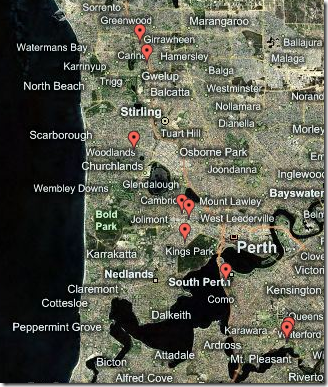
So Creepy does explicitly claim to be an educational tool in the ‘here, look what you’ve already done, now change your habits’ kind of way. Running Creepy just based on my own Twitter information produced a rudimentary map of my logged activity in Perth (clearly Creepy is following data from FourSquare and Flickr images which I posted with my Twitter account):
However, when I zoom in a long way, for example onto my workplace, there’s certainly a quite explicit level of geographic information:
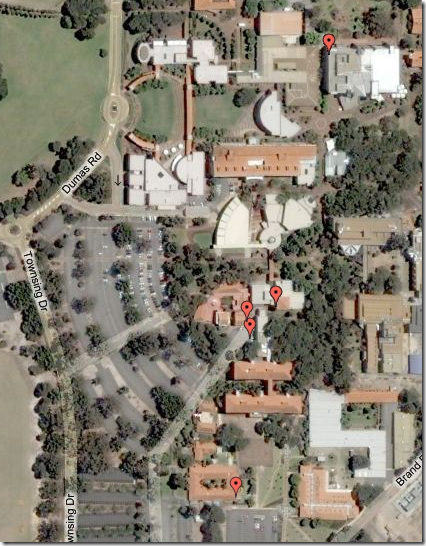
Now, I’m well aware of the data trail my Twitter, FourSquare and Flickr photos generate and acknowledge that if someone wanted to they could aggregate that information and build a reasonable picture of my activity. The point, though, is that many people aren’t that aware of the data trails they are leaving and that’s what Creepy purports to fix: it’s a very visible, confronting and explicit visualized map of the data trail you’re leaving. It’s not a technical privacy violation, but it might feel like an invasion of sorts. If it does feel that way, perhaps it’s time to think a little more about how, when and where you share information about yourself on social media and what data is actually embedded in your photos.
Three Big Pigs: Angry Birds/Disney Middle East Mashup
As Ethan Zuckerman says: “There’s something very 2011 about a Russian video using a soundtrack from American cartoons and characters from a Finnish mobile phone game (based on an English fairytale) to satirize North African politics.”
Digital Culture Links: March 25th 2011
Links for March 21st 2011 through March 25th 2011:
- Record Industry: Limewire Could Owe $75 Trillion – Judge: “Absurd” [Crunch Gear] – “… this is beyond ridiculous. This is… sublime. The record companies suing Limewire were asked to estimate the damages that should be paid by the file-sharing service. Their estimate? $400 Billion on the low end, and at the high end — $75 trillion dollars. That’s more than the GDP of the entire world. The judge, in a refreshing stroke of good sense, deemed these potential damages “absurd” and the plaintiff’s approach “untenable”. The $75tn figure relies on an interpretation of copyright law that provides statutory damages for each instance of copying, and with the numbers of downloads and individual songs the industry is alleging, the money adds up quickly. Even the $400bn figure is certainly grossly inflated, however “conservative” it may appear to Virgin, Atlantic, Sony, and so on. It was decided that an interpretation of copyright law enabling the music industry to sue for more money than they’ve made in the history of recorded music was necessarily wrong…”
- Troll jailed for posting child porn on tribute pages for dead children [News.com.au] – A MAN charged over Facebook vandalism for plastering child pornography over sites set up to pay tribute to two slain schoolchildren has been jailed. The Brisbane District Court was told Bradley Paul Hampson, 29, posted offensive messages and photographs on Facebook “RIP tribute” pages for a 12-year-old boy stabbed at a Brisbane school and a nine-year-old Bundaberg girl abducted and murdered in February last year. Hampson, of Tarragindi, on Brisbane’s southside, today pleaded guilty to two counts using a carriage service, the internet, to cause offence and one each of distributing and possessing child exploitation material between February 14 and June 4 last year. […] Judge Kerry O’Brien jailed Hamspon for three years, but ordered he be released after serving 12 months. Judge O’Brien ordered Hampson be placed on a two-year probation order upon his release from jail.”
- Tweeting with the telly on [BBC News] – Twitter TV – it can be more than just #qanda! “The days of families reverentially gathered around the box may be long gone but the doom-mongers who said that on-demand would kill linear TV completely may also be somewhat off the mark. A new generation of viewers is watching what has been dubbed social TV – a synthesis between TV and social networking. A recent study from marketing agency Digital Clarity found that 80% of under-25s used a second screen to communicate with friends while watching TV and 72% used Twitter, Facebook or a mobile app to comment on shows. Currently it is little more sophisticated than watching TV with one eye on Twitter or Facebook, but that is beginning to change as TV executives start to experiment with greater social networking integration. In New Zealand, TVNZ has just launched a new youth channel which sees Facebook heavily integrated to create an interactive entertainment and music show.”
- Amazon Appstore: what does it mean for developers? [guardian.co.uk] – Amazon launch their new Android App store. Testimony to the choice available on an open system. However, launching it US-only seems ridiculous. Rovio’s ‘Angry Birds Rio’ is free for the first day of Amazon’s App Store, but no one in the US can ‘buy’ it (ie download it) at all. Not a terribly auspicious start. (Oh, and Apple are going to sue them for use of ‘App’ in the name of their App Store.)
- Piracy: are we being conned? [The Age] – A thoroughly research article which rebukes some of the ridiculous claims in several recent industry-backed “piracy” scare reports: “This month, a new lobbying group, the Australian Content Industry Group (ACIG), released new statistics to The Age, which claimed piracy was costing Australian content industries $900 million a year and 8000 jobs. The report claims 4.7 million Australian internet users engaged in illegal downloading and this was set to increase to 8 million by 2016. By that time, the claimed losses to piracy would jump to $5.2 billion a year and 40,000 jobs. But the report, which is just 12 pages long, is fundamentally flawed. It takes a model provided by an earlier European piracy study (which itself has been thoroughly debunked) and attempts to shoe-horn in extrapolated Australian figures that are at best highly questionable and at worst just made up.”
- Google accuses China of interfering with Gmail email system [The Guardian] – Google vs China, round two: “Google has accused the Chinese government of interfering with its popular Gmail email system. The move follows extensive attempts by the Chinese authorities to crack down on the “jasmine revolution” – an online dissident movement inspired by events in the Middle East. According to the search giant, Chinese customers and advertisers have increasingly been complaining about their Gmail service in the past month. Attempts by users to send messages, mark messages as unread and use other services have generated problems for Gmail customers. In the wake of the catastrophic earthquake in Japan, Google set up an application to help people find relatives and friends lost in the disaster. This service too seems to have been compromised. “Relating to Google there is no issue on our side. We have checked extensively. This is a government blockage carefully designed to look like the problem is with Gmail,” said a Google spokesman.”
Understanding Creative Commons for Education
Late last year I was interviewed about online teaching by the team UNSW’s COFA team for their Learning to Teach Online project which aims to build a rich library of resources for teachers working online in various forms. You can find my talking head peppered throughout a number of their video episodes, but the main one, and one I’m really pleased to see up, is all about Understanding Creative Commons for education. I’ve embedded the video below, but you can also get a printable resources hand-out over and the Learning to Teaching Online page.
Incidentally, it’s worth mentioning that this video is about both how teachers and use Creative Commons licenses, but also, and quite importantly, about how students can use CC licenses when producing their own worth, be that text, photos, video or other combinations of media. If you’re an educator interested in this area, you might also enjoy the short paper I wrote a few years ago called ‘The Creative Commons: An Overview for Educators’.
Chatroulette Love Song
While it’s hard to look away from the many disasters still devastating Japan, sometimes we all need a lift, and this little Chatroulette Love Song certainly fits the bill for four minutes:
It’s all rather reminiscent of Merton’s Piano Improv, but that doesn’t mean it won’t warm your heart.

Tama Leaver dot Net by Tama Leaver is licensed under a Creative Commons Attribution-NonCommercial-ShareAlike 4.0 International License.