Obama: The Future of Government and Participatory Culture
Like so many people both in the United States and around the globe, I was heartened by Barack Obama’s inauguration address which was filled with hope, but tempered by reiteration of the work ahead but more than anything Obama’s eloquence and oratory skill reminded us all that the disastrous and embarrassing era of George W Bush is finally over.
In terms of digital culture, Obama’s inauguration was a truly online event, from live-streaming from news services and even inside Facebook, to the active engagement and discussion by the people formerly know as the audience on a multitude of many platforms, with micro-blogging sites like Twitter seeing more than five times their normal load.
Obama’s government had already shown commitment to open access and a meaningful engagement with the public across the internet, something highlighted with Obama’s transitional Change.gov using a Creative Commons license.
So, it was incredibly heartening to see these early signs impressively built upon in the first day of Obama’s government. As the official website Whitehouse.gov shifted to the new administration, the first blog post promised a new era of participation and transparency, built on three simple principles:
Communication — Americans are eager for information about the state of the economy, national security and a host of other issues. This site will feature timely and in-depth content meant to keep everyone up-to-date and educated. Check out the briefing room, keep tabs on the blog (RSS feed) and take a moment to sign up for e-mail updates from the President and his administration so you can be sure to know about major announcements and decisions.
Transparency — President Obama has committed to making his administration the most open and transparent in history, and WhiteHouse.gov will play a major role in delivering on that promise. The President’s executive orders and proclamations will be published for everyone to review, and that’s just the beginning of our efforts to provide a window for all Americans into the business of the government. You can also learn about some of the senior leadership in the new administration and about the President’s policy priorities.
Participation — President Obama started his career as a community organizer on the South Side of Chicago, where he saw firsthand what people can do when they come together for a common cause. Citizen participation will be a priority for the Administration, and the internet will play an important role in that. One significant addition to WhiteHouse.gov reflects a campaign promise from the President: we will publish all non-emergency legislation to the website for five days, and allow the public to review and comment before the President signs it.
At the same time, the new WhiteHouse.gov copyright statement reinforces these ideas, affirming the law which sees Federal government material placed here automatically in the public domain (not a new law, I should add), while third-party material (such as people’s comments, etc) will adhere to a Creative Commons Attribution license:
Pursuant to federal law, government-produced materials appearing on this site are not copyright protected. The United States Government may receive and hold copyrights transferred to it by assignment, bequest, or otherwise.
Except where otherwise noted, third-party content on this site is licensed under a Creative Commons Attribution 3.0 License. Visitors to this website agree to grant a non-exclusive, irrevocable, royalty-free license to the rest of the world for their submissions to Whitehouse.gov under the Creative Commons Attribution 3.0 License.
This symbolic gesture has been celebrated by the Creative Commons team and Creative Commons CEo Joi Ito alike.
Indeed, as Jason Kottke observes, even the robot.txt file on Whitehouse.gov (the file which tells search engine what they can, and what they can’t index) has gone from over 2400 restrictions under the Bush administration to only one restriction under Obama.
On a more grassroots level, Nancy Baym over at Online Fandom notes “One thing I love about my new President is that he inspires his followers to create in ways that erase the boundaries between politics and fandom”. Indeed, I’d go so far as to say, borrowing from Larry Lessig, Obama may very well be the Remix President. (If you want an easy way to join in, and don’t mind being a little tacky, you can always create your own pictures and photos in the style of Obama’s Hope Poster over at Obamicon.) Given all these positive changes, it seems only fitting to end this post with the Obama remix video, Fire it Up 2.0 from RX:
While there is a lot to do and huge expectations to live up to, I have very high hopes for Obama and his administration. On the digital front, I hope that the early promise of participation lasts the length of Obama’s presidency and beyond, something Australia’s initially internet-savvy Rudd government has largely failed to do. Change: it’s a message that really does work when it includes everybody for the long haul.
Annotated Digital Culture Links: January 20th 2009
Links for January 19th 2009 through January 20th 2009:
- “Taken Out of Context: American Teen Sociality in Networked Publics” by danah boyd (Phd Thesis, 2.1Mb PDF) – “Abstract: As social network sites like MySpace and Facebook emerged, American teenagers began adopting them as spaces to mark identity and socialize with peers. Teens leveraged these sites for a wide array of everyday social practices – gossiping, flirting, joking around, sharing information, and simply hanging out. While social network sites were predominantly used by teens as a peer-based social outlet, the unchartered nature of these sites generated fear among adults. This dissertation documents my 2.5-year ethnographic study of American teens’ engagement with social network sites and the ways in which their participation supported and complicated three practices – self-presentation, peer sociality, and negotiating adult society.”
- Facebook irked by ‘burger for friends’ campaign [The Age] – “Burger King said Friday that pressure from Facebook has caused it to yank an application that gave members of the hot social networking website a Whopper for every 10 friends they dumped. Before the Whopper Sacrifice Campaign was halted, 233,906 friends were “sacrificed” by Facebook users more interested in relationships with the global fast-food chain’s specialty hamburgers, according to Burger King. … Changes sought by Facebook reportedly included ditching an application feature that sent deleted friends messages informing them that an online pal preferred a hamburger over them.”
- The Boxxy Story – From the 4chan meme factory, the story of Boxxy, whose hyperactive YouTube antics caused a hormone-driven civil war, taking her from a micro-meme to the Queen /b/
Annotated Digital Culture Links: January 18th 2009
Links for January 16th 2009 through January 18th 2009:
- At First, Funny Videos. Now, a Reference Tool [NYTimes.com] – YouTube as #2 search engine? Googlopoly clearly progressing according to plan: “The explosion of all types of video content on YouTube and other sites is quickly transforming online video from a medium strictly for entertainment and news into one that is also a reference tool. As a result, video search, on YouTube and across other sites, is rapidly morphing into a new entry point into the Web, one that could rival mainstream search for many types of queries. … And now YouTube, conceived as a video hosting and sharing site, has become a bona fide search tool. Searches on it in the United States recently edged out those on Yahoo, which had long been the No. 2 search engine, behind Google. (Google, incidentally, owns YouTube.) In November, Americans conducted nearly 2.8 billion searches on YouTube, about 200 million more than on Yahoo, according to comScore.”
- Hudson River plane crash [Kottke] – Detailed wrapu-up of the citizen journalist (and some mainstream media) responses to teh Hudson River plan crash. Twitter and Flickr excel. [Via BBoing]
- U.S. Airways Crash Rescue Picture: Citizen Journalism, Twitter At Work [Slicon Valley Insider] – Twitter as a citizen journalism platform: “Janis Krums from Sarasota, Florida posts the first photo of U.S. Airways flight 1549 on Twitter from his iPhone. Thirty-four minutes after Janis posted his photo, MSNBC interviewed him live on TV as a witness …”
Selling Cinderella on YouTube
Sure, it’s a jacket, not a glass slipper, and this time the one that got away is a guy, but “Heidi’s” Cinderella story is clocking up hits rapidly on YouTube:
It’s a romantic tale, of one girl looking for the guy whole stole her heart after a brief exchange in a cafe … he left his jacket behind, but stole her heart. Now, using YouTube, she’s reaching out to try and find him. As stories go, it’s got pretty much everything, but it’s just a little too cute. Indeed, “Heidi” has already managed to cobble together a website to promote her quest and it’s a bit too professional; these photos are more about showing off Heidi and the jacket than about trying to genuinely connect with someone. In the post-LonelgGirl15 era, people that tend to be too good to be true tend to raise an eyebrow, and The Daily Telegraph seems to have found the likely viral marketing engine under the hood of this tale:
The Sydney protagonist is 24-year-old Elizabeth Bay shop assistant Heidi, who is adamant the incident was absolutely real and says she is desperate to find her mystery man with the laptop. With the help of a graphic-designer friend, she recorded a video for YouTube titled: "Are you my man in the jacket?” Within four days, more than 60,000 people had watched the pretty blonde put her heart on the line and plead for the handsome stranger to come forward. … The problem with this story is that the label on the jacket is linked to a mainstream fashion house. And it’s a label that doesn’t exist. At least not yet. The Sunday Telegraph has learned that the Australian company is on the verge of launching its first menswear line. Heidi swears she is not involved in a guerrilla marketing campaign. "I just picked up the jacket,” she insisted.
Could a new line of jackets called Heidi but about to hit the market? 😛
Update: It’s been confirmed that this was indeed a viral marketing video.
Marvel Vs Image … over Obama?
Consider these two comic book covers for a moment:
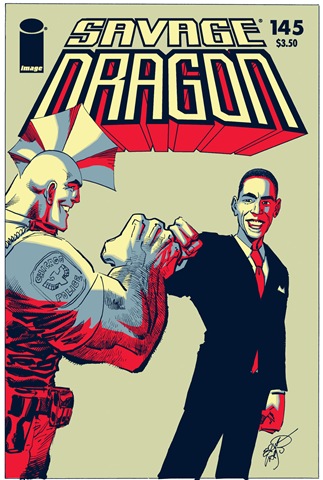
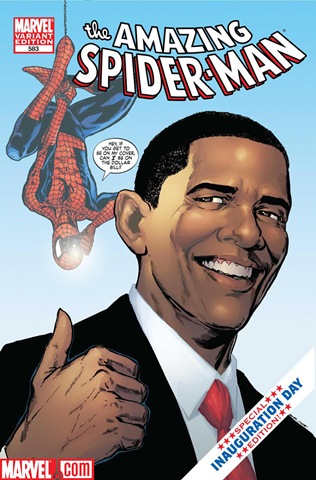
Sure, they both shamelessly cash in on Barack Obama’s Inauguration. To be honest, the Savage Dragon cover seems a bit more tasteful than the Amazing Spider-Man one; I’ve not read the Savage Dragon issue, but the ‘bonus’ story in Amazing Spider-Man which justifies that cover is unexciting to say the least.
It’s not just the stories that are catching headlines, though, as a war of words seems to have erupted over who had the idea for an Obama tribute first. Apparently Erik Larsen, the owner/creator of Savage Dragon over at Image (and former Marvel penciller who was part of the original Image exodus in the 90s … and one of the few in that group not to head back to the Marvel/DC fold) is miffed that after his Obama issue was announced, Marvel announced their own and beat Larsen’s comic to the comic book stands and newsagents. While it may very well be the case that Marvel got their idea from Larsen’s Savage Dragon, it’s a shame to see these tribute issues brawled over, making the shameless cash-in even more juvenile. And the less said about the truly shameful use of Obama to try and restart the tragically hollow Rob Liefeld Youngblood series the better.

Tama Leaver dot Net by Tama Leaver is licensed under a Creative Commons Attribution-NonCommercial-ShareAlike 4.0 International License.