You Should Be Reading: Art of the Title Sequence
Since I tend to post as many links as I do write more substantial posts these days, I thought I’d meet myself half way and start making posts about blogs I find useful and enjoyable and that you might like, too. For the first of these ‘you should be reading’ posts, I’d like to draw your attention to the Art of the Title Sequence. This blog is very focused, looking exclusively at the opening sequences of films and, occasionally, of television shows. Opening titles can often be very boring, but when done well they can be amazing works combining graphics, sound, symbolism and energy. Sure, the Bond films have made a cgi-artform out of their attempts to one-up the previous entry in the franchise (and I love the vector graphic cards from Casino Royale) but so many films have wonderful but woefully underappreciated title sequences, well worth examination on their own right. I know one of my favourite bits of my doctoral thesis was a look at the title sequences of the first two Spider-Man films. So, the Art of the Title Sequence brings a focused critical eye on the best (and primarily on the best; it’s too easy to pick apart weak titles) opening sequences out there. As a sample, here’s an excerpt from a recent post on The Mummy 3 (of which the titles are far and away the best bit):
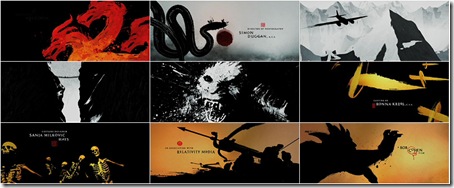
What immediately comes to mind upon viewing these end titles as a stand alone consideration, is that there is great discipline in the master calligrapher’s graceful yet contrasting Chinese brush strokes. His magic carpet ride reminds one of Masaki Kobayashi’s “Hoichi the Earless”; only here the Chinese characters -and Kanji, respectively- become life-taking daggers rather than a life-saving shield. Too, I am reminded of splattered ink at the point of impact and the panning flight of a classic aircraft -both seen in the aforeposted “El Don,” in addition to owing an incalculable debt to the “3OO” end titles and, in a true sense, to Frank Miller.
Fairfax Vs PerthNorg … sort of, anyway!
As Axel and Mark have noted, Brisbane will get its turn to debate the The Future of Journalism this Saturday at a one-day symposium bringing journos, media makers, academics, students and more together to debate the issues. If only it wasn’t 3,500kms away … I’d love to be there, and I doubt the Future of Journalism roadshow will be stopping in Perth any time soon. That said, I’m delighted that Perth citizen journalist and citizen media advocate Bronwen Clune will be presenting on Saturday, bring a little perspective from the West coast. In anticipation of that even, I thought it worth pointing out that earlier this month, in the wake of the news Fairfax was axing more than 500 of their staff, Bronwen (who is the creator of PerthNorg) wrote a provocative post entitled ‘A Letter to Love-Stricken Fairfax Journalists’ which asked whether Fairfax was actually the best place for committed journalists today:
If you are one of the journalists standing in a picket line outside The Age and SMH, I have to ask – do you realise how pathetic you look? … David Kirk has made you an offer and is calling for volunteers before compulsory redundancies. Your relationship is clearly strained and here he is giving you a dignified out and you choose to beg him to take you back? Where is your backbone, your fire, your passion for news? Has Fairfax got you so wrapped around its finger that you think the only way you can be a good journalist is to stay with it? Guess what – people produce good news outside of news corporations everyday. And you can too. Take the divorce settlement and learn to stand on your own feet again. You are better off investing in a relationship with your audience – you’ll find it infinitely more rewarding.
Clearly Bronwen wasn’t pulling her punches, and in the heated discussion which ensued the full spectrum of opinions were heard, from those in total agreement to those who completely disagree (with the oft-heard but fair question: where is the business model for citizen journalism?). However, for my money, the most interesting thread was when Fairfax journalist Nick Miller joined in. Miller, also originally from Perth, didn’t bring a knee-jerk reaction, but instead pointed out that journalists are well aware of what’s happening in the industry, but they still need jobs! An excerpt from Nick’s argument:
I get it. You’re on the forefront of digital journalism. You reckon everyone else should be here. Um… they’re not. Yet. And we’re yet to see any proof that this medium can financially support the extent of investigative journalism that mainstream media currently supports. … I challenge you to go through Perthnorg and remove every link to, and every reference to, a story that originated or was sourced in a Fairfax or WAN or News Ltd report (or wire story, which are paid for by mainstream media). Then see what you’ve got left. A lot of gossip, sure. And gossip is often the start of a news story. But it’s not news.
And:
I am passionate for news. And at Fairfax I have found an organisation that backs my quest for good investigative journalism with all the resources that that requires. Time, money, opportunity, logistical support, etc. The luxury of being able to say ”I didn’t file a thing today, but you should see what I’m working on”. I don’t see any online organisation in Australia that will support that kind of journalism – beyond simply giving it a place to be published. Therefore, I think it is the right thing to fight Fairfax in its attempt to reduce that support. I suggest the Norg concept is just as likely to be an online evolutionary dead end as Fairfax’s. We file for The Age online, too, after all. … The medium isn’t the issue. It’s the search for commercial support for the often highly uncommercial occupation of journalism.
While I agree that a lot of what appears on PerthNorg is more like a Digg-style take on other news sources, there is some original content in there (probably around the 10-15% mark, I’d estimate) but Nick does beg the big question of how any citizen journalism portal can support journalists financially (sure, there’s embedded advertising, but that’s more likely to pay the hosting bills and give a modest income to the site’s creator rather than anyone else creating content). Also noteworthy was the point made by another commentator that people employed by Fairfax Digital are not subject to the rights and conditions afforded even normal Fairfax Journalists, suggesting that even the digital portals for big media companies are becoming the cyber-sweatshops of the twenty-first century. There are, of course, a lot more issues at hand so I’m looking forward to hearing reports from the The Future of Journalism in Brisbane … I hope there are some optimistic answers about citizen journalism and mainstream media working together … and at least some people getting paid!
Presidential Presentation Zen
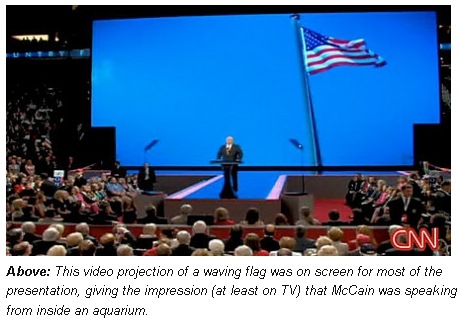
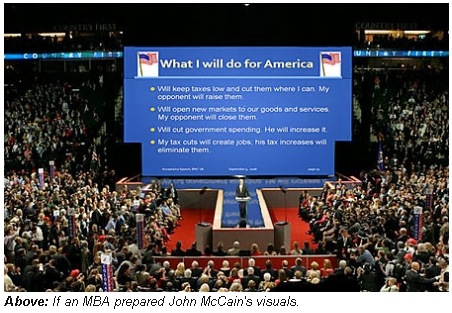
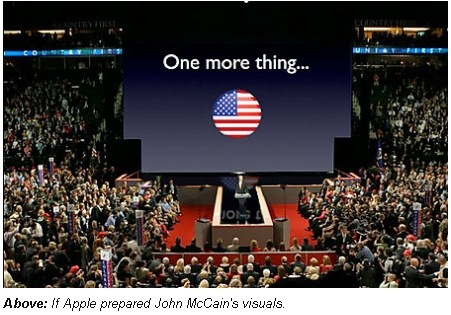
Those who’ve heard my thoughts on presentations in general (most are bad … including most of mine), you’ll also know I think Garr Reynolds’ Presentation Zen (the blog and the book) is the most insightful guide to contemporary presentation design currently available. Thus, I was fascinated by Garr’s take on the differences between Barack Obama and John McCain’s national convention speeches and the graphic elements which accompanied them. The short version: Obama presents like a deity, while McCain bombed in visual terms. In terms of teaching presentation, though, Garr did mock-ups of how McCain’s talk would have looked in different styles which really get you thinking. Here’s the difference between an MBA and Steve Jobs presenting so you can see what I mean (and why this would be useful when trying to get others to think through presentation in visual terms):
Annotated Links of Interest: September 10th 2008
Links of interest for September 9th 2008 through September 10th 2008:
- Pirates become canon keepers [The Australian] – “Some commentators have suggested that it’s simply easier for studios to replace the entire score than to investigate music rights. In any case, an unannounced modern alteration is cultural vandalism, even if you don’t think the original work was any good. As a result the DVD is useless as a piece of cultural history and as a representation of an original work. With the internet full of sellers (often fans themselves) willing to provide the copies of this and other series taken from unedited broadcasts, the studio has taken a huge step towards legitimising piracy as a means of cultural preservation.” (A fantastic, if rather sarcastic, article by Kit MacFarlane arguing that piracy may be the only course open to preserve tv texts in the face of minor – and major – alterations made by studios and distributors on the way to dvd releases and more. )
- BATTLESTAR GALACTICA returns to iTunes…in HD [GALACTICA SITREP] – Battlestar Galactica and other NBC shows return to iTunes (US). If you’re logged into the US store right now you can get 4×03 (He That Believeth in Me) in HD for free (logged in to the US store, I say, not necessarily in the US!).
- Australia rated foot of developed world on school funding [PerthNow] – “Australia’s government spending on public education is the second lowest among developed nations, a new report has found. Turkey, Portugal, Mexico and Iceland all spend more money on public education institutions than Australia. … Federal Education Minister Julia Gillard says the new OECD Education at a Glance report highlights the need for the Rudd Government’s much-hyped “education revolution”.” (Yes, but WHEN is this much-vaunted education revolution actually going to start? It’s close to unforgivable that the once ‘clever country’ is so far behind in global terms.)
- Google Turns 20 (fiction) – “This month, September 2018, marks the 20th anniversary of Google as a business…” A provocative little piece of speculation fiction looking back from 2018 at the rise, and fall, of Google. A few ideas are a bit far-fetched (Windows Free?) but most are plausible; all beg interesting questions about current trends, from software design, to monopolistic practices, to (really) participatory culture!
- John McCain Gets BarackRoll’d [YouTube] – John McCain gets rickrolled by the all-singing, all-dancing Barack Obama show! LMAO!
Annotated Links of Interest: September 8th 2008
Links of interest for September 5th 2008 through September 8th 2008:
- BigPond backs down on Uluru adverts [The Age] – “Telstra BigPond has come under fire for placing advertising billboards on its Second Life island right in front of a virtual model of Uluru. The company has since removed the billboards, which contained BigPond logos, after online communities expert Laurel Papworth complained in a blog post titled “Bigpond brands uluru”. She claimed the telco was being insensitive to indigenous Australians.” (Seems like a pretty valid complaint to me!)
- Silence is Golden: Gay Olympic Champion Matthew Mitcham, Outside of Discourse by Alexander Cho [FLOW, 8.07. 2008] – A look at the media coverage – or, more importantly, lack of media coverage, especially in the US – of Australian Matthew Mitcham’s historic win (and highest scoring dive in Olympic history) at the diving in Beijing. Cho looks at the way the media avoided any shots of Mitcham celebrating with his mother and boyfriend or the award ceremony, arguing that Mitcham’s status as the only openly gay male Olympian worked against him in NBC’s eyes (and in other national media).
- Hey, hey, ho, ho – Video-game censorship has got to go Aaron Delwiche / Trinity University [FLOW, 8.07. 2008] – A fascinating article looking initially at the protests which occured after the recruitment game America’s Army was ported to a the XBOX360 and marketed to younger teenagers. The main argument: “Rather than sticking labels on games like America’s Army, we should be teaching students to think critically about the messages embedded in all video-games.”

Tama Leaver dot Net by Tama Leaver is licensed under a Creative Commons Attribution-NonCommercial-ShareAlike 4.0 International License.