Home » Twitter (Page 19)
Category Archives: Twitter
Digital Culture Links: January 1st 2010
A bunch of links to see in the New Year (Happy 2010!):
- it’s too late, it’s too soon [the kleptones] – A new Kleptones remix album to see in 2010. Nice.
- Social media terms are Words Of The Year 2009 [Computerworld] – “Words from the world of technology and social media are among those identified as the “Words of the Year 2009” in a list commissioned by Oxford University Press. The New Oxford American Dictionary had already announced the verb ‘unfriend’ (“To remove someone as a ‘friend’ on a social networking site such as Facebook”) as its word of the year, confirming the social-networking term’s ubiquity. […] Also derived from Twitter is the word “Hastag” – meaning the # [hash] sign added to a word or phrase that enables Twitter users to search for tweets that contain similarly tagged items. “Tag cloud” (a visual depiction of the word content of a website, or of user-generated tags attached to online content) was also picked out as one of the words of the year.”
- In 2009, Social Media Overtook Web 2.0 – GRAPHS [Mashable] – “Web 2.0. A few years ago, it was the hottest buzzword around. It refers to the second generation of web apps following the Internet bubble that devastated not only Silicon Valley, but our economy in general. Social Media. While its definition is not yet etched in stone, most believe it describes a new type of media and communication that creates a world conversation and dialogue. Instead of being fed news (a one-to-many dissemination approach), everyone is welcomed to be a content creator and to generate a debate around that content. While its focus is the web, it goes beyond it as well. Web 2.0 is a term that has been around since 2004. And as this graph of Google search volume indicates, it reached its peak in 2007 and 2008. But while the term is less frequently used and is in many ways outdated, its been a far more well-known and popular term than social media — until now.”
- Location, Location, Location: 5 Big Predictions for 2010 [Mashable] – Will location be the next big thing in social media? Where did you update your Facebook status from … and did you really want to share it? “GPS-aware mobile devices have become commonplace, which means connecting the dots between what you’re doing and where you’re doing it is easier than ever. In 2009, location-sharing applications finally emerged in user-friendly formats, altering the way we think about where we are and helping us understand more of the meaning behind the data in aggregate. Technology early adopters showed a predilection towards mobile location-based games, discovering that check-ins could mean something and that being the mayor of a venue might earn them a free drink. Now that businesses are actively exploring the opportunities that these location-aware services provide, we’ll see location matter more than ever in 2010. 1. Facebook Status Updates Will Become Location-Aware […] 5. Location Will Be Both Media Darling and Cautionary Tale”
- [MLA 09] “Blogging, Scholarship, and the Networked Public Sphere” Draft [The Chutry Experiment ] – Chuck Tryon takes a fresh look at scholarly blogging from the 2009 MLA: “… the most notable aspect of blogging may be the temporal orientation that encourages daily or semi-daily publication. Although writing frequently may seem to discourage the deeper reflection privileged in academic essays, writing often, for a large audience, also provides the opportunity not only to benefit from the expertise of a wide range of readers–whether scholars or industry professionals–but also to build a well-developed, cross-referenced archive that can serve as a kind of history of the present. In this sense, it is worthwhile to return to Shambu’s comments about what he values about blogging: blogs allow us to educate ourselves in public, to learn collectively about pertinent issues, as we seek to make sense of our current moment of media transition.”
- Race and Social Network Sites: Putting Facebook’s Data in Context [apophenia] – danah boyd takes a hard look at race in relation to social networks: “A few weeks ago, Facebook’s data team released a set of data addressing a simple but complex question: How Diverse is Facebook? Given my own work over the last two years concerning the intersection of race/ethnicity/class and social network sites, I feel the need to respond. And, with pleasure, I’m going to respond by sharing a draft of a new paper. […] access is important. But I’m much more concerned about how racist and classist attitudes are shaping digital media, how technology reinforces inequality, and how our habit of assuming that everyone uses social media just like we do reinforces social divisions that we prefer to ignore.”
- United State of Pop 2009: Blame It on the Pop [DJ Earworm – Music Mashups] – DJ Earworm mixes the top 25 US billboard chart singles into a single mashup. The source material isn’t exactly inspiring, but there’s a lot of art getting all of this into a single song. (For my money, the United States of Pop 2008 was probably better, but that might just be because I knew at least some of those songs!) The video’s on YouTube, too.
- The Absent Presence: Today’s Faculty [Brian Croxall] – Brian Croxall’s MLA paper (presented in absentia) which clearly elucidates the casualisation of US academia (like Australia and elsewhere, too): “… having a faculty majority comprised of contingent faculty means a lot more than just conferences being less and less attended. In my case, it means that my students cannot easily meet with me for office hours since contingent faculty don’t really have offices. It means that they do not get effective, personal mentoring because I have too many students. It means that I cannot give the small and frequent assignments that I believe teach them more than a “3-paper class” because I do not have time to grade 90 students’ small and frequent assignments. It means that the courses they can take from me will not be updated as frequently as I think is ideal because I will be spending all of my spare time looking for more secure employment—or working a part-time job.”
- HP camera ‘can’t see’ black faces [BBC News] – A very clear way to explain how race is still an issue in software and hardware design – it’s the presumption of a ‘normal user’ which is so often white: “A YouTube video suggesting that face recognition cameras installed in HP laptops cannot detect black faces has had over one million views. The short movie, uploaded earlier this month, features “Black Desi” and his colleague “White Wanda”. When Wanda, a white woman, is in front of the screen, the camera zooms to her face and moves as she moves. But when Desi, a black man, does the same, the camera does not respond by tracking him. The clip is light-hearted in tone but is titled “HP computers are racist”.” The video:
- Avatar To Sink Titanic at Box Office [WA Today] – In Australian movie theatres: “Avatar has raced to almost $36 million in its first 13 days. Helped by higher ticket prices for 3-D, giant screen and premium cinema sessions, the science-fiction epic is expected to become one of the country’s top 10 highest-grossing movies by today or tomorrow. The general manager of film for the Greater Union chain, Peter Cody, predicted yesterday that Avatar would top Titanic after an ”outstanding” opening fortnight. ”There’s every likelihood it will go on to gross north of $60 million,” he said. ”Even if the film drops 50 per cent in week three – and I don’t think it will – that’s $50 million.’ […] Despite the financial downturn and the popularity of home cinema, the Australian box office is expected to break the $1 billion mark for the first time this year. Given it was up 15 per cent to the end of November, the annual tally is expected to easily top last year’s record $945.4 million.”
- UK Government Report Shows That Digital Economy Bill Will Cost More Than Highest ‘Piracy’ Estimates, Drive 40,000 Offline [Techdirt] – Even just on the economic side this seems rather silly: “As the UK considers Peter Mandelson’s Digital Economy Bill, a UK government report that looks into the likely impact of the law is incredibly damning. It finds that the plans to send threat letters to users and eventually kick them offline based on accusations (not convictions) would cost consumers in the neighborhood of £500 million. Note, of course, that the music industry itself claims that £200 million worth of music is downloaded in the UK per year (and, of course, that’s only “losses” if you use the ridiculous and obviously incorrect calculation that each download is a “lost sale”).”
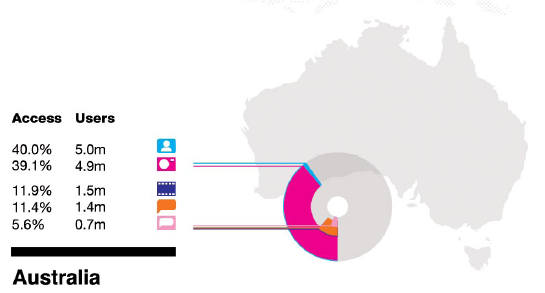
Global Map of Social Web
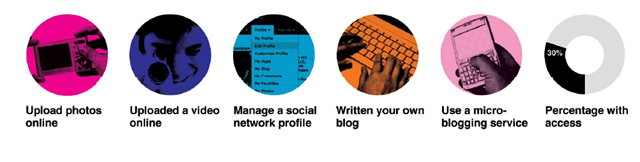
Trendstream have released a really interesting comparative Global Map of Social Media use; China emerges as the biggest user in number terms (but that’s always relatively to population), but Australia’s not looking too shy, either:
A Day in the Internet
Some useful comparisons for teaching about teh Interwebs …

Created by OnlineEducation.net [Via Jill]
Google gets real-time, but is real actually good?
In yesterday’s massive Google product roll-out, the big drawcard was the release of real-time search into their standard search results. Real-time search initially includes Twitter tweets, but will soon include Facebook status updates (from public profiles) and MySpace statuses, too. As The Guardian quite rightly notes, the release of real-time search quashes talk about Twitter or Facebook becoming major challengers to Google’s search dominance:
Some critics have posited that websites like Facebook and Twitter could eventually rival Google, thanks to their ability to tap into millions of public messages being sent constantly between individuals. That threat comes in addition to more traditional search engines like Microsoft‘s Bing.com have threatened to forge exclusive deals with some content providers as a way to claw back market share. Instead, Google has acted to bring those services into the fold, though it would neither confirm nor deny whether there was a financial relationship behinds its links with social networking sites.
Indeed, in the New York Times, Twitter co-founder Biz Stone suggests that the relationship between Twitter and Google is an ideal partnership, with Google’s advanced search technologies making Twitter searching more meaningful to users:
Twitter makes a search tool available on its own site. But Biz Stone, a Twitter co-founder, said that Google would be better able to serve up Tweets that are relevant to a particular user’s questions. “Were not good at relevancy right now, and they are,” he said. “More people will get more value out of Twitter because we are doing this with Google.”
Real-time search will appear in a live-updating box at the top of relevant search results; here’s Google’s real-time search video to explain:
Real-time search is being rolled out across the globe in the coming days, but to see it in action now, head over to Google Trends and click on any of the popular searches; the results will include real-time search results.
Of course, it’s worth mentioning that just because social media statuses and tweets are being generated in ‘real-time’ it doesn’t necessarily make them worth reading. On any given topic, the speed with which Twitter fills up with spam tweets is pretty rapid, so this is a whole new spam arena, with the real prize being the top spots on Google’s most valuable real-estate: the main search pages. More to the point, while other results are ranked in various ways, real-time just means it’s happening now, which is no indication of quality whatsoever. Real-time is a whole new game in some ways, and it’ll be interesting to see what happens. Naturally, for people who still haven’t thought through their privacy in terms of Twitter or Facebook should really think about it now; do you want your status updates appearing at the top of Google’s search results? A question especially important when Google’s CEO is happy to state on the record: “If you have something that you don’t want anyone to know, maybe you shouldn’t be doing it in the first place.”
Oh, and in another Google product launch which got a lot less attention, Google’s mobile phone OS, android, now has a really promising image recognition app: Google Goggles; just take a picture and let Google Goggles figure out what it is, and take you to an appropriate reference! Goggles don’t do facial recognition, yet, but there’s a future worth thinking through, too!
Digital Culture Links: December 6th 2009
Links for December 3rd 2009 through December 6th 2009:
- Panic Attack and YouTube Discovery [The Chutry Experiment] – Great post from Chuck Tryon about Fede Alvarez’s sudden appearance on the Hollywood radar thanks to his YouTube short “Ataque de Pánico,” (Panic Attack!), 4 minute special effects driven extravagnaza in which a city is destroyed and a career created: “One of the underlying narratives associated with Hollywood mythology is the “discovery story,” the idea that a talented newcomer emerges by chance, out of nowhere, to become a Hollywood “star.” Lana Turner was discovered, so the legend goes, on a barstool at Schwab’s drugstore. Now, as the tools of filmmaking and film distribution have been democratized, those discovery stories have expanded to filmmakers as well. And although it is the case that such stories can be read ideologically, it is also true that YouTube and other video sharing sites still offer us the opportunity to be astonished by the talents of an aspiring filmmaker.”
- Memories of a paywall pioneer | Media | guardian.co.uk – Scott Rosenberg reflects on Salon’s experiments with a paywall, suggesting it’s not the model for future news media: “I’m not hostile to the notion of people paying for online content. I do so myself. I’m glad people stepped up and paid for Salon. But the value of stuff online is usually tied to how deeply it is woven into the network. So locking your stuff away in order to charge for it means that you are usually making it less valuable at the moment that you are asking people to pay for it. And that’s why people so often respond with: “No thanks.””
- Vampire Politics by Lisa Nakamura et al [Flow TV, 11.03, 2009] – “True Blood is socially conservative, gesturing towards a radical politics (or any social movement based politics) that it cannot (or will not) deliver. Likewise, the form of the medium itself is conservative. Like its vampires, True Blood is a relic – it airs on television, not the Internet, and it is broadcast rather than streamed. Though HBO claims “it’s not television, it’s HBO,” we know better. Like the credit sequence’s time-delayed decayed foxes and possums, True Blood is a memento mori – to the Civil Rights South, to broadcast television, to civil rights organizing and “unsexy” rights-based movements. True Blood pursues vampire politics, which are all about sexy self fashioning. Were it not for the exquisite Godric’s self-immolation in season two, the program’s credo might be “survival of the sexiest.””
- Networking Families: Battlestar Galactica and the Values of Quality by Jordan Lavender-Smith [Flow TV, 11.03, 2009] – “Galactica’s interrogation of post-nuclear family mechanics and what it means to be human was potentially groundbreaking, but by the show’s end the reconstitution of the family breaks down, and a thick line is drawn between the natural and artificial, delivering an outmoded humanism through posthuman technologies.”
- Identity Wars: Google & Yahoo! Bow to Facebook & Twitter [RW Web] – “Yahoo! announced this morning that it is adding Facebook Connect across many of its properties. This afternoon Google Friend Connect announced the inclusion of Twitter as a top-level log-in option. These moves will be convenient for users, but may not be good for the future of the web.” (This is a really interesting article looking at what happens when Facebook and Twitter become default identity authentication systems – so much power then resides in these systems, and what happens to attempts at standards like OpenID?)
Digital Culture Links: November 10th 2009
Links for November 5th 2009 through November 10th 2009:
- Murdoch may block Google searches [BBC NEWS | Business] – Murdoch plans to pull News Corps stories from Google. And apparently he thinks he can do away with fair dealing, too. I fear the old tiger is roaring his last roars: “Rupert Murdoch has said he will try to block Google from using news content from his companies. The billionaire told Sky News Australia he will explore ways to remove stories from Google’s search indexes, including Google News. Mr Murdoch’s News Corp had previously said it would start charging online customers across all its websites. He believes that search engines cannot legally use headlines and paragraphs of news stories as search results. “There’s a doctrine called ‘fair use’, which we believe to be challenged in the courts and would bar it altogether,” Mr Murdoch told the TV channel. “But we’ll take that slowly.””
- Journalists are the audience formerly known as the media [bronwen clune] – Bronwen Clune’s Media 140 talk in which she makes some very sensible noises about journalists on Twitter: “Participatory media doesn’t mean you letting your audience participate in the creation of news, it about acknowledging that you participate in news creation along with your audience. … We’ve heard Jay Rosen’s quote here a few times today about “the people formerly known as the audience.” To which I’d like to add: Journalists are the audience formerly known as the media.”
- Iran, Twitter and the new media world. [Off Air] – Mark Colvin’s thoughtful and detailed look at the Twitter Revolution in Iran, looking at the ethics and practice of getting information via Twitter, some sensible methods for gauging accuracy of tweets, the danger in distorting figures on both sides, and the fact that, at the end of the day, Iran’s Twitter Revolution failed … but there were seeds of hope: “The first victory is that for millions of people around the world, Iranians were not faceless Middle Easterners …You cannot bomb a regime without bombing its people … The second victory is that they saw themselves as we saw them, and they saw us cheering them on. They saw ordinary people in countries like America – which the ayatollahs call The Great Satan – and Britain – The Little Satan – coming out in support of their hopes and fears. For once that couldn’t be censored by State media.”

Tama Leaver dot Net by Tama Leaver is licensed under a Creative Commons Attribution-NonCommercial-ShareAlike 4.0 International License.