Home » Posts tagged 'law'
Tag Archives: law
Digital Culture Links: January 16th
Links through to January 16th:
- Beatles’ First Single Enters Public Domain — In Europe [Techdirt] – The Beatles remain the iconic pop group, so news on VVN/Music that their very first single has now entered the public domain is something of a landmark moment in music:
The Beatles first single, Love Me Do / P.S. I Love You, has entered the public domain in Europe and small labels are already taking advantage of the situation.The European copyright laws grant ownership of a recorded track for fifty years, which Love Me Do just passed. That means that, starting January 1 of 2013, anyone who wants to put out the track is free to do so.
Unfortunately, if you’re in the US, you’ll probably have to wait until 2049 or so. And things are about to get worse in Europe too. As Techdirt reported, back in 2011 the European Union agreed to increase the copyright term for sound recordings by 20 years, - App Store Tops 40 Billion Downloads with Almost Half in 2012 [Apple – Press Info] – Apple passes 40 billion app downloads: “Apple® today announced that customers have downloaded over 40 billion apps*, with nearly 20 billion in 2012 alone. The App Storeâ„ has over 500 million active accounts and had a record-breaking December with over two billion downloads during the month. Apple’s incredible developer community has created over 775,000 apps for iPhone®, iPad® and iPod touch® users worldwide, and developers have been paid over seven billion dollars by Apple.”
- World Map of Social Networks [Vincos Blog] –
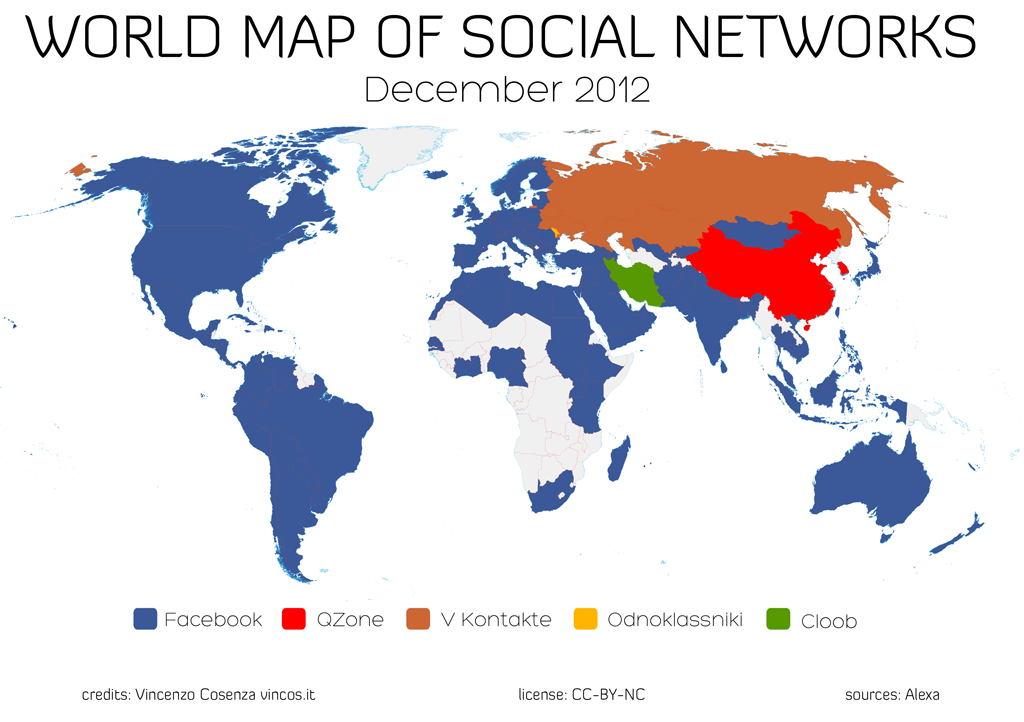 “December 2012, a new edition of my World Map of Social Networks, showing the most popular social networking sites by country, according to Alexa traffic data (Google Trends for Websites was shut down on September 2012). Facebook with 1 billion active users has established its leadership position in 127 out of 137 countries analyzed. One of the drivers of its growth is Asia that with 278 million users, surpassed Europe, 251 million, as the largest continent on Facebook. North America has 243 million users, South America 142 million. Africa, almost 52 million, and Oceania just 15 million (source: Facebook Ads Platform). In the latest months Zuckerberg’s Army conquered Armenia, Kyrgyzstan, Latvia and Vietnam.”
 - Over 8 million game downloads on Christmas Day! [Rovio Entertainment Ltd] – Rovio’s big Christmas download haul: “Wow, what a year! We released four critically-acclaimed bestselling mobile games, developed two top-rated Facebook games, and reached more than a billion downloads — all before our 3rd “Birdday”! Angry Birds Star Wars and Bad Piggies in particular have dominated the app charts, with Angry Birds Star Wars holding the #1 position on the US iPhone chart ever since its release! To top it all off, we had 30 million downloads during Christmas week (December 22-29) and, on Christmas Day, over 8 million downloads in 24 hours alone!”
- R18+ game rating comes into effect [ABC News (Australian Broadcasting Corporation)] – Finally: “An R18+ video game rating has come into effect across Australia after a deal between the states and the Commonwealth last year. The change means some games that were previously unavailable to adults can go on sale, whereas others that could be accessed by children will become restricted. The issue had divided interest groups, with some claiming the new classification would protect children but others feared it would expose them to more violent games. Legislation to approve the rating was passed by the Senate in June. Under the previous classification regime, the highest rating for computer games was MA15+, meaning overseas adults-only games were either banned in Australia or given a lower classification, allowing children to obtain them.”
- Two billion YouTube music video views disappear … or just migrate? [Technology | guardian.co.uk] – Despite rumours of massive cuts to major record labels’ YouTube channel counts, the explanation is rather more banal: “Universal and Sony have, since 2009, been moving their music videos away from their YouTube channels and over to Vevo, the music industry site the two companies own with some investors from Abu Dhabi. YouTube, meanwhile, thinks that is only right to count channel video views for videos that are still actually present on the channels – which means that whenever YouTube got round to reviewing the music majors’ channels on its site, a massive cut was always going to be in order.”
Digital Culture Links: November 29th
Links for November 25th through November 29th:
- Aussie viral video, ‘Dumb Ways to Die’, lives on [The Age]– “Australia’s fastest-spreading viral video, “Dumb Ways to Die”, has taken on a life of its own, inspiring more than 65 cover versions, 85 parodies and 170 re-posts on YouTube. The original clip, made to promote safety on Melbourne Metro Trains, has amassed more than 28 million views on YouTube since it was posted on November 14. Its creator, ad agency McCann Worldgroup Australia, said its “conservative” estimate was that the campaign had generated $50 million in “global-earned media value” so far, in addition to more than 700 press hits. A new parody clip by Seattle-based creative team Cinesaurus about the Curiosity Mars mission, dubbed “Cool Things to Find“, joins dozens of other parodies and covers including a classic rock version, a Russian cover … “It’s entered popular culture,” said John Mescall, executive creative director of McCann Worldgroup Australia.”
- Google is publisher according to Australian court [David Banks | Law | guardian.co.uk] – “Google will have to be quicker to remove defamatory content, at least in Australia, after it lost a $200,000 libel action there. [“¦] the tale of Australia’s most successful libel litigant may give Google and other search engines pause for thought. Milorad Trkulja, a music promoter, took action against Google over material online, which linked him with criminal figures in Melbourne. Trkulja has never been involved in any criminal activity, but was unfortunate enough to have been shot in a restaurant in 2004. His lawyers wrote to Google in October 2009 asking for the offending material, which included a number of images, to be removed, but received a reply saying that in line with Google’s policies on content removal he should contact the owners of the website concerned instead. Trkulja sued Google and the jury concluded that the search engine was the publisher of images of Trkjulja and related information which suggested he was involved in crime … “
- The one-way street to digital lock-in [The Age] – A simple but very important reminder from Hayley Tsukayama that when you buy a mobile device, you’re not just buying a device – you’re committing to a cloud ecosystem and a provider of apps and content that you’ll be locked into for a long time, and probably can’t easily transfer between devices. iPhone apps won’t ever work on a Nexus tablet, nor will Google Play books end up being read on iPads any time soon.
- PSY Passes Bieber; ‘Gangnam Style’ New Most-Viewed Video of All Time [YouTube Trends] – “Today, global sensation PSY and his wildly popular “Gangnam Style” music video surpassed Justin Bieber’s “Baby” as the most viewed music video (and overall video) of all time on YouTube. As of noon on Saturday (24 Nov 2012), the viewcounts stood at 805 million to 803 million.”
Digital Culture Links: March 30th
Links for March 26th through March 30th:
- The Dark Knight Rises Trailer 2: IN LEGO [YouTube] – Beautifully put together Lego version of the new Dark Knight trailer. “LEGO Dark Knight Rises Movie Trailer By ParanickFilmz. http://paranickfilmz.co.nr/ Thanks to Adviceversas for the mouth animation and JediMasterSoda for the CGI. Movie (2012) HD.”
- CBS Blocks Use of Unused ‘Star Trek’ Script by Spinrad [NYTimes.com] – “For “Star Trek” fans it was like finding a lost Shakespeare play “” only to have it snatched away by the playwright’s heirs.Last fall an unused script for the cult 1960s television show turned up after being forgotten for years. Its author, the science-fiction writer Norman Spinrad, announced that it would become an episode of a popular Web series, “Star Trek New Voyages: Phase II,” which features amateur actors in the classic roles of Capt. James T. Kirk, Mr. Spock and other crew members of the starship Enterprise. But then another player stepped in: CBS, which said it owned the script and blocked a planned Web production of it. Trekkies were appalled. “These executives should be phasered on heavy stun,” said Harmon Fields of Manhattan, who called himself “a ‘Star Trek’ fan of galactic proportions.” … By all indications CBS is within its rights. In the entertainment industry the paid writer of a teleplay generally cedes the rights to the material, even if it remains unproduced.”
- Shitter: Social Media has never been so disposable – Online service that prints a twitter feed onto toilet paper. I suppose such a thing was inevitable.
- Pay TV piracy hits News [AFR] – A detailed investigative report accuses NewsCorp of actively promoting and facilitating the piracy of competitors pay TV network content: ” A secret unit within Rupert Murdoch’s News Corporation promoted a wave of high-tech piracy in Australia that damaged Austar, Optus and Foxtel at a time when News was moving to take control of the Australian pay TV industry.” These are hugely important accusations both in terms of NewsCorp but also in terms of how piracy is framed and understood.
- What book publishers should learn from Harry Potter “” Tech News and Analysis – Useful post detailing the DRM-free release of the Harry Potter ebooks and audio books for sale on J K Rowling’s Pottermore website. The lesson here is that DRM really isn’t necessary, and you’re more likely to reach a wider audience without it. Admittedly Rowling has unprecedented clout in managing her own books in electronic form, and has already made so much money off these books there’s no real risk involved, but the strategy is an important one nevertheless.
- Angry Birds Space gets 10m downloads in three days [BBC] – The latest version of the Angry Birds game notched up 10 million download in its first three days of release, says its developer Rovio. Angry Birds Space only came out on 22 March, but in a tweet on Monday Rovio announced the game’s swift success. … The new Angry Birds instalment features 60 initial levels and six new characters and has what Rovio calls a “unique twist in a variable gravity environment”. As well as Google Android and Apple iOS devices, last week also saw the game released simultaneously on PC and Mac. Nasa was also involved in promoting the game, posting a video showing an astronaut on the International Space Station explaining the laws of physics using Angry Bird characters.
The space agency called it “an exciting way to get people engaged with Nasa’s missions of exploration and discover”. - Google ordered to suspend autocomplete function over cyber-harassment [The Japan Times Online] – “The Tokyo District Court approved a petition demanding that Google Inc. suspend its autocomplete search feature for Internet browsers after a man alleged that it breached his privacy and got him fired, his lawyer said Sunday. Google is refusing to suspend the feature, saying that its headquarters in the United States will not be regulated by Japanese law and that the case does not warrant deleting the autocomplete suggestions related to the petition under its in-house privacy policy, lawyer Hiroyuki Tomita said. The case, which was adjudicated on March 19, is believed to be the first to order the suspension of the Web search feature, which attempts to instantly anticipate and list the words or phrases a person will type into a browser’s search box, Tomita said. [..] The man discovered that when people type his name into Google’s search engine, words suggesting criminal acts, which he is unfamiliar with, appear.”
- Facebook Asserts Trademark on Word ‘Book’ in New User Agreement [Threat Level | Wired.com] – “Facebook is trying to expand its trademark rights over the word “book” by adding the claim to a newly revised version of its “Statement of Rights and Responsibilities,” the agreement all users implicitly consent to by using or accessing Facebook.”
Digital Culture Links: January 5th 2011
Links for January 5th 2011:
- Billionaires take a turn at initiating ‘brand’ damage [SMH] – The Australian retail industry has jumped the shark. In an effort to ‘combat’ consumers getting better deals online, the retail giants have banded together to lobby the government to remove an exclusion that means purchases for overseas goods totally under $1000 don’t have the GST added. Customers, in turn, have pointed out very loudly that they shop online because of the terrible state of retail shops in Australia. Whoever thought up a PR campaign that basically tells consumers that the rich retail giants want consumers to be taxed more because they’re becoming too savvy and demanding better choice clearly failed Marketing 101!
- How iTunes buyers are ripped off [Perth Now] – Australians are sick of the tyranny of digital distance: “Australian music fans are forging foreign iTunes accounts to make big savings on their purchases. The practice, which is a direct breach to iTunes terms and conditions, has exposed the inflated price that Australians pay to access songs off the popular music and entertainment site. By creating an American iTunes account through the use of a US credit card or gift card, users are saving up to 80c per song and $7 per album. The recently released Beatles box set collection can be bought with a saving of more than $A100. […] Numerous forums have surfaced on the net explaining the details of how to access the store which include creating a fake American billing address. Some have even used the address of the Apple corporation in the US to gain access.”
- Facebook Users Uploaded A Record 750 Million Photos Over New Year’s [Tech Crunch] – “It doesn’t come as a huge surprise, but it’s still staggering to think about: over the New Year’s weekend, Facebook saw 750 million photo uploads from its users. That’s a lot of celebrating, and it sets a new Facebook record. The stat was just tweeted by Facebook marketing director Randi Zuckerberg (who is also founder Mark Zuckerberg’s sister). We’ve reached out to Facebook to ask what the last record was, but I’m guessing it was set over Halloween, which has historically been the biggest day for Facebook Photos. To give some context to that number, in July Facebook said that more than 100 million photos get uploaded every day (that average is higher now, obviously).”
- Angry Birds launch for Sony’s Playstation 3 and PSP [BBC – Newsbeat] – Angry Birds makes the jump from mobile gaming to the consoles: “Sony has announced that Angry Birds is going to be released on its PlayStation 3 and PSP consoles. The game was originally developed for smart phones and proved a huge success with iPhone and Android users. Since being released in late 2009 it’s been downloaded nearly 40 million times. But with the Japanese entertainment giant now firmly on board developers Rovio have high hopes about bringing the game to a new audience. Released on January 5th it will be available to download for £2.49. “
- What Could Have Been Entering the Public Domain on January 1, 2011? [Center for the Study of the Public Domain] – “Waiting for . . . Waiting for Godot and Lord of the Flies, The Doors of Perception, Rear Window, Seven Samurai, Creature from the Black Lagoon, the first issues of Sports Illustrated, Horton Hears a Who! . . . . Current US law extends copyright protections for 70 years from the date of the author’s death. (Corporate “works-for-hire” are copyrighted for 95 years.) But prior to the 1976 Copyright Act (which became effective in 1978), the maximum copyright term was 56 years (an initial term of 28 years, renewable for another 28 years). Under those laws, works published in 1954 would be passing into the public domain on January 1, 2011. What might you be able to read or print online, quote as much as you want, or translate, republish or make a play or a movie from? How about William Golding’s Lord of the Flies?”
- You might do a job on yourself [The Age] – Recruiters and interview panels are increasingly examining web presences: “Thank twice before uploading another photo or status update if you are about to have a job interview – employers are watching you. In an age of oversharing online, with a third of the Australian population on Facebook, many recruiters and companies cannot resist the temptation to screen potential candidates via social media. US employers have taken screening one step further, asking some job candidates to log in to their Facebook pages during the interview. There is no sign of this happening in Australia, recruiters say. But employers were interested in looking beyond a person’s resumé, said Kate Kendall, who specialises in recruitment via social media. “Companies are more interested in a holistic view of who they are hiring,” she said. “You can’t really try to hide.–
- Instagram Quickly Passes 1 Million Users [NYTimes.com] – “Instagram, a social photo-sharing company that opened its shutters to iPhone owners just two months ago, announced Tuesday that it passed a major milestone of 1 million registered users. The company began offering its simple photo service in mid-October that allows people to share images from a mobile phone and then add unique and fun filters. Since then, Instagram has quickly become the talk of the tech community as people have flocked to the service even with stiff competition from a number of well-financed competitors, including PicPlz, Flickr and Path.”
Digital Culture Links: December 13th 2010
Links for December 7th 2010 through December 13th 2010:
- The state, the press and a hyperdemocracy [Unleashed (Australian Broadcasting Corporation)] – Mark Pesce provokes a much larger debate about Wikileaks … is it really ‘the press’? “WikiLeaks is the press, but not the press as we have known it. This is the press of the 21st century, the press that comes after we’re all connected. Suddenly, all of the friendliest computers have become the deadliest weapons, and we are fenced in, encircled by threats – which are also opportunities. This threat is two-sided, Janus-faced. The state finds its ability to maintain the smooth functioning of power short-circuited by the exposure of its secrets. That is a fundamental, existential threat. In the same moment, the press recognises that its ability to act has been constrained at every point: servers get shut down, domain names fail to resolve, bank accounts freeze. These are the new selection pressures on both sides, a sudden quickening of culture’s two-step.”
- The Atlantic Turns a Profit, With an Eye on the Web [NYTimes.com] – The Atlantic turns a profit by thinking digitally, and employing bloggers: “How did a 153-year-old magazine “” one that first published the “Battle Hymn of the Republic” and gave voice to the abolitionist and transcendentalist movements “” reinvent itself for the 21st century? By pretending it was a Silicon Valley start-up that needed to kill itself to survive. The Atlantic, the intellectual’s monthly that always seemed more comfortable as an academic exercise than a business, is on track to turn a tidy profit of $1.8 million this year. That would be the first time in at least a decade that it had not lost money. Getting there took a cultural transfusion, a dose of counterintuition and a lot of digital advertising revenue. “We imagined ourselves as a venture-capital-backed start-up in Silicon Valley whose mission was to attack and disrupt The Atlantic,” […] “In essence, we brainstormed the question, ‘What would we do if the goal was to aggressively cannibalize ourselves?'””
- Angry Birds, Flocking to Cellphones Everywhere [NYTimes.com] – “It sounds like a tough sell: a game that involves catapulting birds at elaborate fortresses constructed by evil pigs. But Angry Birds, a hit game by Rovio, a small Finnish company, is one of the unlikeliest pop-culture crazes of the year “” and perhaps the first to make the leap from cellphone screens to the mainstream. Angry Birds, in which the birds seek revenge on the egg-stealing pigs, is meant to be easily played in the checkout line and during other short windows of downtime “” but some players have trouble stopping. Rovio says people around the world rack up 200 million minutes of game play each day. (Put another way, that is 16 human-years of bird-throwing every hour.) The game has inspired parodies, homages and fervent testimonials. Homemade Angry Birds costumes were big hits on Halloween. Conan O’Brien demonstrated the game in a YouTube video promoting his new show, and a sketch from an Israeli TV show about a birds-and-pigs peace treaty was popular online ….”
- Assange And WikiLeaks Have Parallels With Spycatcher [SMH] – Malcolm Turnbull on Wikileaks: “Governments and politicians should be careful not to make a martyr of Assange and fools of themselves. Julia Gillard’s claim that Assange had broken Australian laws, when it is clear he has not, demonstrates how out of her depth she is. One may well ask whether her denunciations would be so shrill if the documents had been handed to a powerful newspaper group – if the contents were being dribbled out by The Australian, would she be accusing Rupert Murdoch of high crimes and misdemeanours? Assange is an Australian citizen. No matter how much the government disapproves of his actions, it should make it clear that he is entitled to return to Australia if he wishes and to receive consular assistance if the charges of sexual assault proceed in Sweden.”
- Wikileaks and the Long Haul [Clay Shirky] – Some thoughts from Clay Shiry regarding Wikileaks which are well worth reading: “Over the long haul, we will need new checks and balances for newly increased transparency “” Wikileaks shouldn’t be able to operate as a law unto itself anymore than the US should be able to. In the short haul, though, Wikileaks is our Amsterdam. Whatever restrictions we eventually end up enacting, we need to keep Wikileaks alive today, while we work through the process democracies always go through to react to change. If it’s OK for a democracy to just decide to run someone off the internet for doing something they wouldn’t prosecute a newspaper for doing, the idea of an internet that further democratizes the public sphere will have taken a mortal blow.”
Digital Culture Links: November 5th 2010
Links for November 2nd 2010 through November 5th 2010:
- Digital Primetime Arrives Just in Time to Crush the Net [The Steve Rubel Stream] – Will the massive increasing in demand for, and quality of, streaming online video create a ‘digital primetime’ which the current internet infrastructure is unable to cope with? Interesting question!
- Woman to pay $1.5m for downloading music [ABC News (Australian Broadcasting Corporation)] – “A US jury has ordered a Minnesota woman to pay $US1.5 million for illegally downloading 24 songs in a high-profile digital piracy case. Jammie Thomas-Rasset, a single mother of four, was found liable by a jury on Wednesday (local time) of copyright infringement for using Kazaa, a peer-to-peer file-sharing network, to download the songs from the internet. She has been ordered to pay $US62,500 for each of the 24 songs – a total of $US1.5 million. The verdict is the third in the long-running case and it has been welcomed by the Recording Industry Association of America (RIAA).[…] In December 2008, the RIAA said it would stop suing people who download music illegally and focus instead on getting internet service providers to take action.”
- The Cooks Source Scandal: How a Magazine Profits on Theft [Edward Champion’s Reluctant Habits] – The very sad and nasty story of Cooks Source Magazine, which appears to have been ripping large amounts of stories, photos and recipes off the internet, claiming the internet is entirely public domain, and ignoring all copyright on these works. Understandably, a number of people are upset, and the magazine’s editor has a lot of explaining to do.
- iBookstore Australia Launch: iBookstore Opens In Australia [SMH] – “Australians can now use ther iPhone, iPad or iPod Touch as a serious e-book reader after Apple opened the doors to its iBookstore today. It’s taken the company five months since the iPad’s launch to get the store up and running but it has succeeded in signing up a wide range of book publishers including Macmillan, Hachette, HarperCollins, Hardie Grant, Murdoch Publishers and Wiley. Previously, Australians viewing the iBookstore could only access old out-of-copyright books but now there is a range of new release titles on offer. The exact number is unclear but an Apple spokeswoman said they numbered in the “thousands”.”
- Children and ultra-violent video games: court to decide [SHM] – Wow: the ‘do violent videogames hurt kids’ debate rolls into the US Supreme Court: “The US Supreme Court has expressed sympathy for a California law that aims to keep children from buying ultra-violent video games in which players maim, kill or sexually assault images of people. But several justices said the law faces a high constitutional hurdle before going into effect. The high court has been reluctant to carve out exceptions to the First Amendment, striking down a ban on so-called “crush videos” that showed actual deaths of animals earlier this year. California officials argue that they should be allowed to limit minors’ ability to pick up violent video games on their own at retailers because of the purported damage they cause.”
- Google gaining on booming smartphone market [The Age] – “Google’s Android software platform rose to the number two spot globally on the booming smartphone market in the third quarter, research firm Canalys said this week. Nokia’s Symbian continued to lead the market with a 37 per cent share, while Android had 17 per cent of the market. It has surpassed Research In Motion, Apple and Microsoft this year. Growing popularity of Android phones – made by companies including Motorola, HTC and Samsung Electronics – puts Google in a good position as handsets look set to surpass computers for browsing the web. Google chief executive Eric Schmidt said in September he expects mobile searches to generate most of the firm’s revenue eventually, but it could take a long time, despite growing at a rapid clip.”
- Facebook posting boasting led to sack [WA Today] – Be ye not so stupid: “A West Australian schoolgirl who was sacked over Facebook for comments she made on the popular social network has had her dismissal upheld by the national workplace watchdog. The 15-year-old was fired after it was claimed she had written to a possible competitor of her employer, despite being told not to. In a peculiar twist, her employer then fired her via Facebook. The sacking has since been upheld by Fair Work Australia after the girl, who cannot be named, took too long to file a complaint. The case marks something of an increasing trend of workplace folly that has come from misuse of the social networking site. There have been at least five cases before Fair Work Australia where employees have been sacked after something they wrote or did was recorded on Facebook. There are likely to be many more dismissals that went unchallenged and never reached the tribunal.”

Tama Leaver dot Net by Tama Leaver is licensed under a Creative Commons Attribution-NonCommercial-ShareAlike 4.0 International License.