Home » Posts tagged 'synthespian'
Tag Archives: synthespian
Academy Awards for Performing Animals?
Here’s a little piece I had in today’s Conversation …
Oscars for animals? Andy Serkis should be beating his chest
By Tama Leaver, Curtin University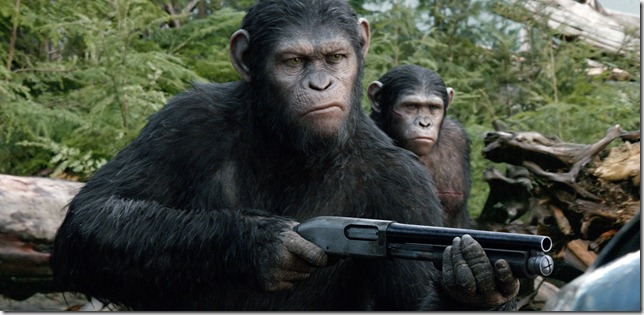
The notion that a chimpanzee could win an Academy Award for acting (or anything else) seems farcical at first glance but, of course, it’s not an actual chimpanzee being discussed in the case of the latest role by Andy Serkis.
Rather, it’s an incredibly sophisticated amalgam of the actor and the very latest computational visualisation techniques from Weta Digital.
Serkis’ performance as Caesar, the leader of the fledgling ape society in the recently-released Dawn of the Planet of the Apes (2014) once again has Hollywood commentators pondering the possibility of an Oscar nod for a synthespian – a synthetic thespian or virtual actor – but this is far from the first time this question has been raised.

Andy Serkis has been behind some of the most memorable cinematic faces of the last decade, but it’s not quite his face. Rather, Serkis has held pioneering roles utilising performance capture technology.
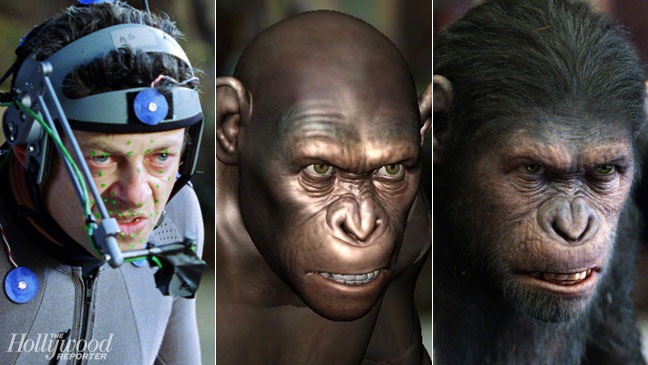
Performance capture features the real-time recording and digitisation of an actor’s movements, which are then used to drive a complex digital model.
With the digital powerhouse of Weta Digital behind him, Serkis’ performances have driven Gollum from The Lord of the Rings (2001, 2002, 2003) (and now The Hobbit – 2012, 2013, 2014) films, the titular ape in Peter Jackson’s King Kong (2005), and the role of Caesar in Rise of the Planet of the Apes (2011) and the new sequel, Dawn.
For many, the question of where the acting ends and the computer-generated imagery begins, undermines the authenticity of a performance captured role as a performance, but no performance exists in a vacuum. Every actor’s appearance is constructed through costume, make-up and lighting, their dialogue taken from a script, the eventual role on screen painstakingly led by a director, and carefully filtered and refined during the editing process.
Performance capture is similar in many ways, but with the additional digital processing to translate the motion and facial expressions of an actor onto an often non-human character.
In a brief promotional featurette, Serkis explains how the performance capture technology has developed, with scenes now able to be shot outdoors where once they had to be on a soundstage against a green screen.
Most significantly though, for Serkis, is the fidelity with which the performance capture cameras and software can directly map an actors’ face and performance onto the digital character they are playing.
And given that technology has always been part of acting, the authenticity of performance captured roles speaks to the symbiotic relationship between fleshy, embodied actors and the informatic machines that enhance and facilitate those performances.
Early industry fears that synthespians might replace “real” actors reveals an insecurity about the relationship between people and technology. If a character can simply be created by a computer, the millions of dollars spent on A-list stars might just seem a little unnecessary.
The reality of performance capture, though, shows the opposite to be true: its takes a huge team to bring a single performance capture character to screen, with the actor remaining integral, filmed in excruciating detail, but also then combining software engineers, digital artists, and a range of other digital effects personnel to keep the best of the performance and use it to drive a state-of-the-art digital model.

Yet every director and crew who have worked with Serkis since his days as Gollum, as well as Serkis himself, have spent over a decade arguing for the legitimacy of performance capture as “real” acting.
After the pivotal role of Serkis in The Lord of the Rings: The Two Towers (2002), New Line Cinema and director Peter Jackson led the first attempt to get a role driven by performance capture acknowledged at the Academy Awards.
In his first outing as Caesar, Serkis was widely applauded, with 20th Century Fox mounting a campaign for a best actor nomination. Co-star James Franco was particularly vocal in arguing that Serkis’ performance was integral to the character, worthy of critical attention and praise.
And with the success of Dawn, the director and co-stars are once again lining up to applaud Serkis’ performance.
In terms of literally performing animals, Serkis and the team playing the various apes in the film do a remarkable job in evoking empathy without sacrificing the specificities of chimpanzees and other apes.
It is noteworthy that Rise received a specific commendation from PETA (People for the Ethical Treatment of Animals) about the way animals were portrayed and filmed. Having a human actor behind the animal performances not only guarantees no animals will be harmed on set, but at a deeper level also begs the question about the relationships between humans and animals.
Such questions are at the heart of Dawn, wherein the similarities between apes and humans drive the plot rather than intrinsic differences.
Andy Serkis’ role as Caesar is central to Dawn, and as numerous online features emphasise, this is his acting, and his performance. Whether this is the year that such a digital performance is captured by the Oscars or not remains to be seen.

Tama Leaver receives funding from the Australian Research Council (ARC).
This article was originally published on The Conversation. Read the original article.
Digital Culture Links: November 17th
Links for November 12th through November 17th:
- An Oscar for Andy? by Tama Leaver [Antenna] – My first Antenna post looks at the possibility of a synthespian in the running for an acting Oscar: “On the back of the unexpected success of Rise of the Planet of the Apes, the big news isn’t a planned sequel but rather a “a healthy seven-figure deal for Andy Serkis to reprise his role as lead ape Caesar” along with the announcement that 20th Century Fox will be mounting an Oscar campaign aimed at getting Serkis a long overdue nod for Best Supporting Actor. It’s significant, too, because we never see Andy Serkis directly in Rise; rather, Caesar was created by the meshing of Serkis’s visceral, physical acting and the state-of-the-art computer wizardry from Weta Digital. Whether you prefer the term virtual actor, synthespian (‘synthetic thespian’) or just performance capture, an Academy Award for Serkis would demonstrate a widening understanding of what ‘acting’ actually means.”
- Google Music is open for business [Official Google Blog] – Google’s competitor to Apple’s iTunes has gone live, cleverly basing itself in the Android store. Of course, it’s not yet available in Australia.
- Salman Rushdie claims victory in Facebook name battle [BBC News ] – “Author Salman Rushdie says he has won a battle with Facebook over what to call himself on his profile page on the social network. Rushdie’s dispute with Facebook began after he asked to be allowed to use his middle name Salman – the one he is known by across the world. But Facebook, which has strict real name policies, had insisted on Ahmed – the novelist’s first name. Rushdie says Facebook has “buckled” after he began tweeting about the row. “Victory! #Facebook has buckled! I’m Salman Rushdie again. I feel SO much better. An identity crisis at my age is no fun. Thank you Twitter!” wrote the British Indian author, who is known as SalmanRushdie on Twitter. “Just received an apology from The #Facebook Team. All is sweetness and light.–
- Aussie expat’s TV torrent site shut down as The Slap producers intervene [SMH] – “The producers of ABC1 drama The Slap have succeeded in shutting down a Netherlands-based piracy website that over 40,000 Australian and New Zealand expats use to illegally watch local shows. The site, diwana.org, is run by an Australian expat who started the site over five years ago and is popular with expats and others based overseas who are looking to access Australia and New Zealand TV content, which is often difficult to access internationally.[…] Despite the shutdown of Diwana.org, The Slap is still widely available on other pirate websites.”
- Exfoliate for Facebook [Android Market] – Android app to delete unwanted Facebook history: “Exfoliate automates the removal of old, forgotten, content from Facebook(tm). Old content on social networking sites is a threat to your privacy. Removing this old content by hand is tedious, and practically impossible. On your wall, Exfoliate can remove any post, comment, or like, whether made by you or by others, older than a time you specify. Exfoliate can remove your own posts, comments, and likes, from your friends’ walls too. You can choose the age of items you wish removed, and Exfoliate will remove any items that are at least as old as your selection from any of your selected content areas. It is important, though, to understand that Exfoliate truly deletes the content. It is not backed up and it is not recoverable – well, that’s kinda the point. […] Exfoliate is a network and battery hog, and there’s simply no way around this. To manage the impact, you can stop Exfoliate at any time, and restart Exfoliate later.”
- Jailbreak the Patriarchy: my first Chrome extension [Danielle Sucher] – Clever: “I just released my first Chrome extension! It’s called Jailbreak the Patriarchy, and if you’re running Chrome, you can head over here to install it. What does it do? Jailbreak the Patriarchy genderswaps the world for you. When it’s installed, everything you read in Chrome (except for gmail, so far) loads with pronouns and a reasonably thorough set of other gendered words swapped. For example: “he loved his mother very much” would read as “she loved her father very much”, “the patriarchy also hurts men” would read as “the matriarchy also hurts women”, that sort of thing. This makes reading stuff on the internet a pretty fascinating and eye-opening experience, I must say. What would the world be like if we reversed the way we speak about women and men? Well, now you can find out!”
Performing Animals: Synthespians, Primates and Cinematic Sympathy
Having let this blog become more link digests than anything else, I promised myself I’d write a bit more about my research activities, so with that in mind, I’m looking down a new research path and thought I’d share my very first thoughts. As usual, it has taken a deadline to galvanise any writing, but the Call for Papers for the Green Planets: Ecology and Science Fiction sounded enticing so, below is the chapter abstract I submitted today. (There’s no guarentee it’ll be accepted, of course, but this chapter will get written one way or another as it has definitely fired my imagination). Feedback or thoughts are welcome, of course!
Performing Animals: Synthespians, Primates and Cinematic Sympathy
Chapter abstract.
Virtual actors, or synthespians (‘synthetic thespians’), simultaneously expand what ‘acting’ actually entails whilst also asking film viewers to sympathise with often non-human entities in contexts which strive for verisimilitude. Initial industry responses to synthespians centred on fears that unpaid virtual actors could replace human beings but Dan North argues that rather than making actors superfluous, synthespians actually illustrate ‘an interdependence between the human and the machine, the digital and the analogue, the real and the simulated’ (2008, p. 183). The performance capture technologies behind synthespians facilitate a complex symbiosis between the visceral, physical performance of actors and the informatic and computational artistry of cutting edge digital media. While scholarly attention has been paid to virtual actors portraying fictional creatures or aliens – such as Jar Jar Binks in Star Wars: Episode I – The Phantom Menace (1999), Gollum in The Lord of the Rings trilogy (2001, 2002, 2003) or the Na’vi in Avatar (2009) – this chapter instead examines synthespians who are performing (as) animals.
Focusing on Kong from Peter Jackson’s King Kong (2005) and Caesar from Rupert Wyatt’s Rise of the Planet of the Apes (2011), both of whom are performed by actor Andy Serkis and the special effects team at WETA Digital, this chapter will argue that primate synthespians complicate and challenge the boundaries between people and animals, between natural and technological, and between the computational and ecological (amongst others). To provide historical and cultural context, I will draw on antecedents from the Kong and Planet of the Apes franchises as well as contemporary texts, such as the documentary Project Nim (2011) which details a 1970s experiment scrutinising the nature/nurture divide in which a chimpanzee was raised as a human child. The strong critical and commercial success of Rise of the Planet of the Apes suggests audiences can readily sympathise with a primate protagonist, while Barbara Creed has similarly argued that Jackson’s Kong is ‘a screen animal who holds our sympathies throughout the film’ (2009, p. 191). Indeed, recognising its role in promoting animal rights, People for the Ethical Treatment of Animals (PETA) has actually given Rise of the Planet of the Apes their official approval. Ultimately, this chapter will explore the way these films generate sympathetic digital primates, the inherent contradictions in provoking sympathy by replacing animals with actors performing animals, and how these films and audience reactions may serve as a focal point for broader consideration of the relationships between people, primates, nature and technology.
References
Creed, B. (2009). Darwin’s Screens: Evolutionary Aesthetics, Time and Sexual Display in the Cinema. Melbourne: Melbourne University Press.
North, D. (2008). Performing Illusions: Cinema, Special Effects and the Virtual Actor. London & New York: Wallflower Press.
[Image Source: The Hollywood Reporter]
Links for August 25th 2008
Interesting links for August 23rd 2008 through August 25th 2008:
- Drilling Down – Preferring the Web Over Watching TV [ NYTimes.com] – “For children ages 10 to 14 who use the Internet, the computer is a bigger draw than the TV set, according to a study recently released by DoubleClick Performics, a search marketing company. The study found that 83 percent of Internet users in that age bracket spent an hour or more online a day, but only 68 percent devoted that much time to television. The study found that the children often did research online before making a purchase (or bugging their parents to make one). The big exception to this rule was apparel: like many grown-ups, the children said they preferred to choose their clothes at a store.”
- Film Studies For Free [Catherine Grant on Blogger] – “Film Studies For Free actively espouses the ethos of Open Access to digital scholarly material. It aims to promote good quality, online, film and moving-image studies resources by commenting on them, and by linking to them. These resources will include published scholarship or research in various forms: from film and media weblogs, through online peer-reviewed journals, to other forms of web-based scholarly writing, as well as online works of film/moving-image research by practice. Film Studies For Free readers are invited to bring relevant items to the blog’s attention; please use the comments option or this email link to do so.”
- “A Few Lives Left” for Poor Research into Virtual Worlds [PERSONALIZE MEDIA] – A substantial, well-research and convincing rebuttal of this article from the SMH on Second Life and Virtual Worlds. This rebuttal contains many stats and figures which cast Asher Moses’ piece in a pretty poor light.
- Hollywood losing its grip on television content [Darknet] – JD Lasica interviews Eric B Kim (an Intel VP and general manager of its Digital Home Group) and Patrick Barry (VP of TV for Yahoo) about the coming trend of getting TV properly on the net: “Kim’s quote that most stuck out for me was this: “We’re bringing television to the internet.” Notice what Kim didn’t say: We’re bringing the Internet to television, which has been the approach of the big movie studios until now. (Or, until recently, We’re preventing the Internet from coming to TV.) I don’t know whether Kim’s turn of phrase was intentional or not “” I suspect so “” but the difference is a significant one. “
- Video: Lifelike animation heralds new era for computer games [Times Online] – “Extraordinarily lifelike characters are to begin appearing in films and computer games thanks to a new type of animation technology. Emily – the woman in the above animation – was produced using a new modelling technology that enables the most minute details of a facial expression to be captured and recreated. She is considered to be one of the first animations to have overleapt a long-standing barrier known as ‘uncanny valley’ – which refers to the perception that animation looks less realistic as it approaches human likeness. Researchers at a Californian company (Image Metrics) which makes computer-generated imagery for Hollywood films started with a video of an employee talking. They then broke down down the facial movements down into dozens of smaller movements, each of which was given a ‘control system’.” [Via io9]
- The dawn of intelligent machines [BBC NEWS | Technology] – “The idea may scare some, but Intel predicts that by 2050 machines could surpass the peak of human intelligence. So predicted Justin Rattner, chief technology officer at the chip maker, in a presentation at the Intel Developer Forum which examined how technology is expected to bridge the gap between man and machine. The vision included sensitive robots and shape-shifting materials. “There is no question that one of the most likely things that will happen in the next 40 years is that machine and human intelligence will come much closer together,” Mr Rattner told the BBC. “The ability of humans to communicate with machines and for machines to communicate with humans will get so much better.–

Tama Leaver dot Net by Tama Leaver is licensed under a Creative Commons Attribution-NonCommercial-ShareAlike 4.0 International License.