Home » Posts tagged 'search'
Tag Archives: search
Digital Culture Links: Last Links for 2012.

Happy New Year, originally uploaded by Tama Leaver.
End of year links:
- Best Memes of 2012: Editorial Choices [Know Your Meme] – The best memes of 2012, according to Know Your Meme:
#10: Sh*t People Say
#9: What People Think I Do
#8: Overly Attached Girlfriend
#7: Ehrmagerd
#6: Ridiculously Photogenic Guy
#5: Somebody That I Used to Know
#4: Kony 2012
#3: Call Me Maybe
#2: Grumpy Cat
#1: Gangnam Style
Personally, I’d add Texts from Hillary, McKayla is Not Impressed and Binders Full of Women to the list! - Posterous Spaces backup tool available now [The Official Posterous Space] – Posterous adds the ability for users to download their entire Posterous sites as a zip file, complete with images and a usable (if dull) html interface. There hasn’t been a lot of movement with Posterous since the team were bought out by Twitter, so this new tool may signal the beginning of the end of the end for Posterous, which is a real shame since it’s still a more robust tool than Tumblr in a number of ways.
- App sales soar in 2012 [Technology | The Guardian] – “Shiny new tablets and smartphones given as presents make Christmas Day and Boxing Day the two most lucrative days of the year for app sales. Yet in the apps economy, turkeys are a year-round phenomenon. Thousands of new apps are released every week for devices running Apple’s iOS and Google’s Android, but most sink without trace. With an estimated 1bn apps released so far on those two platforms alone, there are relatively few winners and many losers. This month, industry analyst Canalys claimed that in the first 20 days of November, Apple’s US App Store generated $120m (£75m) of app revenues, with just 25 publishers accounting for half of that. And 24 of those 25 companies make games, including the likes of Zynga, Electronic Arts and Angry Birds publisher Rovio. But analysts suggested in August that two-thirds of Apple store apps had never been downloaded – a lifeless long tail of more than 400,000 unwanted apps.”
- 2012’s Most Popular Locations on Instagram [Instagram Blog] – “What was the most-Instagrammed place in the world this past year? The answer may surprise you. Out of anywhere else in the world, Bangkok’s Suvarnabhumi Airport tops the list. Over 100,000 photos were taken there last year! What other locations were popular in 2012? From Asia to Europe to North America, Instagrammers shared their view of the world. Read on for the full list:
* Suvarnabhumi Airport (BKK) ท่าà¸à¸²à¸à¸²à¸¨à¸¢à¸²à¸™à¸ªà¸¸à¸§à¸£à¸£à¸“ภูมิ in Bangkok, Thailand
* Siam Paragon (สยามพาราà¸à¸à¸™) shopping mall in Bangkok, Thailand
* Disneyland Park in Anaheim, California
* Times Square in New York City
* AT&T; Park in San Francisco
* Los Angeles International Airport (LAX)
* Dodger Stadium in Los Angeles
* Eiffel Tower in Paris
* Staples Center in Los Angeles
* Santa Monica Pier in Los Angeles” - Wikipedia’s most searched articles of the year revealed [BBC News] – “A study of 2012’s most read Wikipedia articles reveals striking differences in what proved popular across the different language versions of the online encyclopaedia. Facebook topped the English edition while an entry for adult video actresses did best in Japan. Hua Shan – a Chinese mountain featuring “the world’s deadliest hiking trail” – topped the Dutch list. By contrast, cul-de-sacs were the German site’s most clicked entry. … Lower entries on the lists also proved revealing. While articles about Iran, its capital city Tehran and the country’s New Year celebrations topped the Persian list, entries about sex, female circumcision and homosexuality also made its top 10. …
English language most viewed
1. Facebook
2. Wiki
3. Deaths in 2012
4. One Direction
5. The Avengers
6. Fifty Shades of Grey
7. 2012 phenomenon
8. The Dark Knight Rises
9. Google
10. The Hunger Games” - Bug reveals ‘erased’ Snapchat videos [BBC News] – Using a simple file browser tool, users are able to find and save files sent via Snapchat, an app that’s meant to share and then erase photos, messages and video. Not surprisingly really, since all communication online is, essentially, copying files of some sort or another.
- Web tools whitewash students online [The Australian] – Universities offering web presence washing at graduation. Perhaps teaching grads to manage their own would be better.
“Samantha Grossman wasn’t always thrilled with the impression that emerged when people Googled her name. “It wasn’t anything too horrible,” she said. “I just have a common name. There would be pictures, college partying pictures, that weren’t of me, things I wouldn’t want associated with me.” So before she graduated from Syracuse University last spring, the school provided her with a tool that allowed her to put her best web foot forward. Now when people Google her, they go straight to a positive image – professional photo, cum laude degree and credentials – that she credits with helping her land a digital advertising job in New York. “I wanted to make sure people would find the actual me and not these other people,” she said. Syracuse, Rochester and Johns Hopkins in Baltimore are among the universities that offer such online tools to their students free of charge …” - Mark Zuckerberg’s sister learns life lesson after Facebook photo flap [Technology | The Guardian] – A photo from Randi Zuckerberg’s Facebook page gets taken out of context and reposted on Twitter and she complains, then goes overtly moral, tweeting: “Digital etiquette: always ask permission before posting a friend’s photo publicly. It’s not about privacy settings, it’s about human decency”The Guardian’s take: “But what’s most odious about the episode is the high-handedness of Zuckerberg’s response. Facebook makes money when users surrender their privacy. The company has made it the user’s job to defend personal information, which otherwise might be made public by default. Got a problem with that? The company’s answer always has been that users should read the privacy settings, closely, no matter how often they change. … Eva Galperin said that while Facebook has made amendments to their privacy settings, they still remain confusing to a large number of people. “Even Randi Zuckerberg can get it wrong,” she said. “That’s an illustration of how confusing they can be.”
- Twitter and Facebook get on the school timetable in anti-libel lessons [Media | The Guardian] – Some private schools in the UK are now embedding social media literacies into their curriculum, especially how to avoid defamation of others, and, I guess, how not to get sued. While it’d be nice to hear about more well-rounded literacies – like managing your identity online in its early forms – this is nevertheless a step in the right direction. I fear, though, a new digital divide might appear if social media literacies are embedded for some, not all.
- Top Tweets of 2012: Golden Tweets – Twitter’s official list of top 2012 tweets, led by Barack Obama’s “Four more years” and in second place … Justin Bieber.
- Facebook’s Poke App Is a Head-Scratcher [NYTimes.com] – Ephemeral Mobile Media: “.. it’s hard to grasp what the point of the Facebook Poke app really is. Poke, which came out last week, is a clone of Snapchat, an app popular among teenagers. Many have labeled Snapchat a “sexting” app “” a messaging platform ideally suited for people who want to send short-lived photos and videos of you-know-what to get each other feeling lusty. The files self-destruct in a few seconds, ideally relieving you of any shame or consequence, unless, of course, the recipient snaps a screen shot. (Poke and Snapchat alert you if a screen shot has been taken.) It’s a bit of a head-scratcher for adults, like me and my Facebook friends, who aren’t inclined to sext with one another. We’re more used to uploading photos of pets, food, babies and concerts, which aren’t nearly as provocative. The most interesting aspect of Poke is that you can send photos and videos only of what you’re doing at that moment; you cannot send people a nice photo saved in your library …”
- Game of Thrones tops TV show internet piracy chart [BBC News] – Game of Thrones has emerged as the most-pirated TV show over the internet this year, according to news site Torrentfreak’s latest annual survey. It said one episode of the series had racked up 4,280,000 illegal global downloads – slightly more than than its estimated US television audience. … Despite all the closures, one episode of of Game of Thrones racked up 4,280,000 illegal global downloads, according to Torrentfreak. That was slightly more than than its estimated US television audience. The level of piracy may be linked to the fact that the TV company behind it – HBO – does not allow Netflix, Hulu, Amazon Prime or other US streaming services access to its programmes. It instead restricts them to its own HBO Go online product, which is only available to its cable subscribers. Outside the US, Torrentfreak noted that Australia was responsible for a disproportionate amount of illegal copies of Game of Thrones…”
Digital Culture Links: October 7th
Links for September 25th through October 7th:
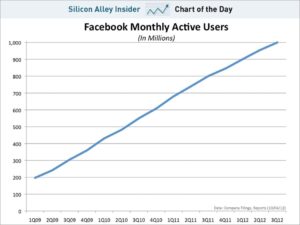 Facebook surpasses one billion users as it tempts new markets [BBC News] – "Facebook now has more than one billion people using it every month, the company has said. The passing of the milestone was announced by founder Mark Zuckerberg on US television on Thursday. The company said that those billion users were to date responsible for 1.13 trillion "likes", 219 billion photos and 17 billion location check-ins. The site, which was launched in 2004, is now looking towards emerging markets to build its user base further. "If you're reading this: thank you for giving me and my little team the honor of serving you," Mr Zuckerberg wrote in a status update. "Helping a billion people connect is amazing, humbling and by far the thing I am most proud of in my life." Statistics released to coincide with the announcement revealed there were now 600 million users accessing the site via a mobile device – up 48 million from 552 million in June this year." [Chart Source]
- Jill Meagher | Trial by Social Media A Worry, Experts Say [The Age] – "The case of Jill Meagher has had the country talking, particularly on social media, but now that someone has been charged it's time to stop being specific, experts say. Jill Meagher was mentioned on social media, both Twitter and Facebook, every 11 seconds early this morning. And the CCTV footage which showed her walking on Sydney Road on the morning she disappeared was shared on the same platforms about 7500 times within two hours … .A Facebook hate group against the accused in the Meagher case has already attracted almost 18,000 "likes". Victoria Police has posted a message on its Facebook page this morning warning users of their legal responsibilities in posting and reminding that "it is inappropriate to post speculation or comments about matters before the courts Thomas Meagher, Jill's husband, today urged people to consider what they posted on Twitter and Facebook."
- Your YouTube original videos now available in Google Takeout [Google Data Liberation] – YouTube just became a lot more interesting as a storage space for video, not just a distribution platform: "Your Takeout menu is growing. Today's entrée: YouTube videos. Previously, you've been able to download individual transcoded videos from your YouTube Video Manager. But starting today, you also have a more efficient way to download your videos from YouTube. With Google Takeout, you can download all of the original videos that you have uploaded in a few simple clicks. No transcoding or transformation — you’ll get exactly the same videos that you first uploaded. Your videos in. Your videos out."
- Rupert Murdoch backs down in war with ‘parasite’ Google – Telegraph – "News Corporation plans to reverse an earlier decision to stop articles from its quality papers, such as The Times and The Sunday Times, from featuring in Google’s listings. The effort to stop users from accessing content for free will be watered down, with Google featuring stories in search rankings from next month. The move comes amid fears that the newspapers’ exclusion is limiting their influence and driving down advertising revenues. Sources claim the change was a “marketing exercise”. In the past, Mr Murdoch has lambasted Google as a “parasite” and a “content kleptomaniac” because it only allows companies to feature in search rankings if users are able to click through to at least one page without paying."
- Google Play hits 25 billion downloads [Official Android Blog] – Google announces that the Google Play store now offers over 675,000 apps and games and that there have been over 25 billion individual app installations to date. (September 2012).
- Facebook raises fears with ad tracking [CNN.com] – "Facebook is working with a controversial data company called Datalogix that can track whether people who see ads on the social networking site end up buying those products in stores.
Amid growing pressure for the social networking site to prove the value of its advertising, Facebook is gradually wading into new techniques for tracking and using data about users that raise concerns among privacy advocates.[…] Datalogix has purchasing data from about 70m American households largely drawn from loyalty cards and programmes at more than 1,000 retailers, including grocers and drug stores. By matching email addresses or other identifying information associated with those cards against emails or information used to establish Facebook accounts, Datalogix can track whether people bought a product in a store after seeing an ad on Facebook. The emails and other identifying information are made anonymous and collected into groups of people who saw an ad and people who did not." - Facebook Is Now Recording Everyone You Stalk [Gizmodo Australia] – Facebook has announced that they will now record your Facebook search history; every time you search for someone's name, that information will be stored, accessible as part of your 'Activity Log'. The search entries are individually delectable and only visible to you (and Facebook) but the existence of a Facebook search history is a sure sign that Facebook sees real value in recording – and thus data crunching and somehow monetizing – your search history.
Digital Culture Links: May 11th through May 21st
Links for May 11th through May 21st:
- It’s YouTube’s 7th birthday… and you’ve outdone yourselves, again [YouTube Blog]– On YouTube’s 7th birthday, they annouce 72 HOURS of video are being UPLOADED EVERY MINUTE!”Today 72 hours of video are uploaded to the site every minute. Like many 7 year olds around the world, we’re growing up so fast! In other words, every single minute you now upload three whole days worth of video instead of two. That’s 61 Royal Wedding Ceremonies, 841 Bad Romances, and 1,194 Nyan Cats.”
- Introducing the Knowledge Graph: things, not strings [Official Google Blog]– Google diversifies the sort of search results returned (initially in the US, but other countries to follow) along the lines of what they’re calling the ‘knowledge graph’ which appears to be an initial foray into indexing using semantics.
- The LEGO Gender Gap: A Historical Perspective [Thinking Brickly] – A detailed and thoughtful historical overview of gendered figures and advertising from LEGO. Well worth a read.
- How Yahoo Killed Flickr and Lost the Internet [Gizmodo] – The sad tale of Flickr’s purchase by Yahoo and decline from the greatest photo sharing community online in the world to whatever status it still has. A failure to embrace the mobile web (and a terrible app) along with a buy-out by a company that fundamentally doesn’t understand community are highlighted as the main culprits.
- COMPETITION: Thanking all our fans for 1 billion downloads [Rovio Entertainment Ltd] – Rovio announce that there have been one billion downloads of the Angry Birds games. That’s a lot!
Digital Culture Links: March 30th
Links for March 26th through March 30th:
- The Dark Knight Rises Trailer 2: IN LEGO [YouTube] – Beautifully put together Lego version of the new Dark Knight trailer. “LEGO Dark Knight Rises Movie Trailer By ParanickFilmz. http://paranickfilmz.co.nr/ Thanks to Adviceversas for the mouth animation and JediMasterSoda for the CGI. Movie (2012) HD.”
- CBS Blocks Use of Unused ‘Star Trek’ Script by Spinrad [NYTimes.com] – “For “Star Trek” fans it was like finding a lost Shakespeare play “” only to have it snatched away by the playwright’s heirs.Last fall an unused script for the cult 1960s television show turned up after being forgotten for years. Its author, the science-fiction writer Norman Spinrad, announced that it would become an episode of a popular Web series, “Star Trek New Voyages: Phase II,” which features amateur actors in the classic roles of Capt. James T. Kirk, Mr. Spock and other crew members of the starship Enterprise. But then another player stepped in: CBS, which said it owned the script and blocked a planned Web production of it. Trekkies were appalled. “These executives should be phasered on heavy stun,” said Harmon Fields of Manhattan, who called himself “a ‘Star Trek’ fan of galactic proportions.” … By all indications CBS is within its rights. In the entertainment industry the paid writer of a teleplay generally cedes the rights to the material, even if it remains unproduced.”
- Shitter: Social Media has never been so disposable – Online service that prints a twitter feed onto toilet paper. I suppose such a thing was inevitable.
- Pay TV piracy hits News [AFR] – A detailed investigative report accuses NewsCorp of actively promoting and facilitating the piracy of competitors pay TV network content: ” A secret unit within Rupert Murdoch’s News Corporation promoted a wave of high-tech piracy in Australia that damaged Austar, Optus and Foxtel at a time when News was moving to take control of the Australian pay TV industry.” These are hugely important accusations both in terms of NewsCorp but also in terms of how piracy is framed and understood.
- What book publishers should learn from Harry Potter “” Tech News and Analysis – Useful post detailing the DRM-free release of the Harry Potter ebooks and audio books for sale on J K Rowling’s Pottermore website. The lesson here is that DRM really isn’t necessary, and you’re more likely to reach a wider audience without it. Admittedly Rowling has unprecedented clout in managing her own books in electronic form, and has already made so much money off these books there’s no real risk involved, but the strategy is an important one nevertheless.
- Angry Birds Space gets 10m downloads in three days [BBC] – The latest version of the Angry Birds game notched up 10 million download in its first three days of release, says its developer Rovio. Angry Birds Space only came out on 22 March, but in a tweet on Monday Rovio announced the game’s swift success. … The new Angry Birds instalment features 60 initial levels and six new characters and has what Rovio calls a “unique twist in a variable gravity environment”. As well as Google Android and Apple iOS devices, last week also saw the game released simultaneously on PC and Mac. Nasa was also involved in promoting the game, posting a video showing an astronaut on the International Space Station explaining the laws of physics using Angry Bird characters.
The space agency called it “an exciting way to get people engaged with Nasa’s missions of exploration and discover”. - Google ordered to suspend autocomplete function over cyber-harassment [The Japan Times Online] – “The Tokyo District Court approved a petition demanding that Google Inc. suspend its autocomplete search feature for Internet browsers after a man alleged that it breached his privacy and got him fired, his lawyer said Sunday. Google is refusing to suspend the feature, saying that its headquarters in the United States will not be regulated by Japanese law and that the case does not warrant deleting the autocomplete suggestions related to the petition under its in-house privacy policy, lawyer Hiroyuki Tomita said. The case, which was adjudicated on March 19, is believed to be the first to order the suspension of the Web search feature, which attempts to instantly anticipate and list the words or phrases a person will type into a browser’s search box, Tomita said. [..] The man discovered that when people type his name into Google’s search engine, words suggesting criminal acts, which he is unfamiliar with, appear.”
- Facebook Asserts Trademark on Word ‘Book’ in New User Agreement [Threat Level | Wired.com] – “Facebook is trying to expand its trademark rights over the word “book” by adding the claim to a newly revised version of its “Statement of Rights and Responsibilities,” the agreement all users implicitly consent to by using or accessing Facebook.”
Digital Culture Links: January 12th
Links for January 1st through January 12th:
- Amazon Launches iPad Kindle Store to Dodge Apple’s Restrictions [RWW] – Amazon launches even further into Apple’s regulated home turf: “Amazon has launched a more touch-friendly, Web-based iPad Kindle Store. A tablet-optimized Kindle store was available through the HTML5 Kindle Cloud Reader Amazon launched last August, but the new iPad Kindle Store is a standalone Web app. Upon visiting amazon.com/iPadKindleStore from Safari, a pop-up prompts the user to add it to the home screen. This is the most seamless way for Kindle users to buy books on the iPad. Apple’s in-app purchasing rules prevent e-book sellers from offering stores in their native apps (without giving Apple a 30% cut). The route around that was to include a link to the Web store inside the native reader app. Last July, Apple forced Amazon and other e-reader apps to remove this link, so users of e-book platforms other than Apple’s iBooks must buy their books in the browser, in a separate place from where they read.”
- Search, plus Your World [Inside Google Search]– Google adds more personalisation with “Search, plus Your World” which heavily (but OPTIONALLY) integrates Google+ and other social search results into the first page results when searching Google (if signed in to Google+).Twitter (and presumably Facebook) are unhappy since this competes with their social search roles, but Google have responded that this seems a bit rich since Twitter refused to let Google pay to index Twitter in realtime.
- Angry Birds named most downloaded paid app [Think Digit] – “Rovio’s Angry Birds has been named the most downloaded paid app for the smartphones and tablets in 2011. According to research firm Distimo, Angry Birds was downloaded more than any other application across all major operating systems including Android, iOS, Windows Phone and others. The only platform missing out on the list is BlackBerry. However, the game was recently made available on the BlackBerry’s App World. Angry Birds was followed by Fruit Ninja, while another variant of Angry Birds, Angry Birds Season grabbed the third spot on the list of the paid apps for the year 2011. Among the free apps, Facebook grabbed the top spot, while Pandora Radio followed at the second spot. The free versions of Word with Friends and Angry Birds remained on third and fourth position respectively. The Distimo report covers data collected from January to November 2011. The report has various notable findings such as Apple App Store has four times more revenue than Google’s Android Market.”
- Digital Music Sales Surpass Physical Music Sales For the First Time Ever [Moneyland | TIME.com] – “Last year, for the first time in history, digital music sales exceeded physical sales, according to a newly released Nielsen/Billboard report cited by CNNMoney. In 2011, digital music sales climbed past physical sales to take a 50.3% market share of all music purchases. In a continuation of a multi-year trend, digital sales increased by 8.4% from 2010, while physical sales declined 5%.
In the decade since Apple launched its iTunes music store, a host of digital music ventures have appeared, with varying degrees of success. iTunes remains the market leader but faces increasing competition from upstarts like Rdio, Spotify and Pandora, which went public earlier this year.” - Angry Birds bags 6.5m Christmas Day downloads [guardian.co.uk] – Rovio Mobile says its three Angry Birds games generated 6.5m downloads on Christmas Day alone. The company’s vice president of franchise development Ville Heijari revealed the milestone to All Things Digital, while promising new games in the year ahead. “We’re really excited to have such a massive number of new people get acquainted with Angry Birds over the holidays – we have exciting new releases lined up for 2012, and can’t wait to introduce them to the public,” said Heijari. He did not break down the 6.5m figure by game – Angry Birds, Angry Birds Seasons and Angry Birds Rio are the three available titles – nor did he split them out by platform. While the lion’s share are likely to have come from iOS and Android, Angry Birds is also available on Windows Phone, while all three games are available for Nokia handsets and RIM’s BlackBerry PlayBook tablet.” Angry Birds was downloaded more than 600 million times in 2011, with over a million branded toy and shirt sales each month.
- Facebook Blamed For a Third of British Divorces [MediaCity] – “So Facebook is again at the other end of the blame-hammer, this time for precipitating about a third of divorces in Britain. The stats come from a website- the UK’s Divorce-Online, and cull stats from 5,000 divorce petitions. The same stats were pulled in 2009, and at that time, Facebook made an appearance in 20% of the petitions. Infidelity-related complaints were a forerunner, along with using Facebook walls to make nasty comments about soon to be exes.”
- The PostSecret App is Now Closed [PostSecret] – The PostSecret App (iPhone/iPad) closes after anonymous posts and comments prove unmanageable as part of a confessional community. (The closed app is now dubbed an “experimental community” that failed. Despite being a paid app, there is no mention, or apology, to those who paid for it in good faith.) From the PostSecret blog: “Like the PostSecret Blog, the App was designed so each secret was absolutely anonymous. Unfortunately, that absolute anonymity made it very challenging to permanently remove determined users with malicious intent. 99% of the secrets created were in the spirit of PostSecret. Unfortunately, the scale of secrets was so large that even 1% of bad content was overwhelming for our dedicated team of volunteer moderators who worked 24 hours a day 7 days a week removing content that was not just pornographic but also gruesome and at times threatening.”
- Year in Review: 2011 in Numbers [Instagram] – “We’ve seen the Instagram community grow from 1 million to over 15 million users in 2011. To celebrate, we’re recapping the year’s activity in our Year in Review series.
Accounts
1 million: The number of accounts on Jan 1, 2011.
15 million (and counting): The number of accounts on Jan 1, 2012.
Photos
3: The average number of photos uploaded per second, one year ago.
60: The average number of photos uploaded per second, today.
400 million: The total number of photos shared on Instagram so far.”
Digital Culture Links: July 26th 2011
Links for July 21st 2011 through July 26th 2011:
- Bradley Horowitz – Google+ – Google addresses a number of the concerns arising from the ‘real names’ policy in Google+. Not all the issues are resolved by a long shot, but Google+ is in trial mode and many solutions seems forthcoming. Also: “MYTH: Not abiding by the Google+ common name policy can lead to wholesale suspension of one’s entire Google account. When an account is suspended for violating the Google+ common name standards, access to Gmail or other products that don’t require a Google+ profile are not removed. Please help get the word out: if your Google+ Profile is suspended for not using a common name, you won’t be able to use Google services that require a Google+ Profile, but you’ll still be able to use Gmail, Docs, Calendar, Blogger, and so on. (Of course there are other Google-wide policies (e.g. egregious spamming, illegal activity, etc) that do apply to all Google products, and violations of these policies could in fact lead to a Google-wide suspension.)”
- iPad Book Apps Hobbled: Only Existing Account-Holders Can Use The Apps, Google Books Booted [TechCrunch] – Apple takes 30%, or your app dies: “At the beginning of the year, Apple said it wanted 30% of everything sold through the iPad platform. You could sell almost anything – books, downloadable content, magazines, pictures of kittens – but, according to their subscription rules, everything had to go through Apple itself and you could not, in short, go out to a web page to complete the transaction. That promise – to shut down external web stores on the iPad – has been fulfilled and the Nook, Kindle, Kobo, and Google Books apps have just been either drastically changed or removed from the App Store entirely. Nook, Kindle, and Kobo now have no access to the web-based bookstore and you can no longer create accounts in the app.”
- Not rocket science – Angry Birds boss puffs his chest at Fortune tech conference [News.com.au] – Convergence in action: “Peter Vesterbacka, the chief marketing officer of Angry Birds creator Rovio, outlined the company’s ambitions last week at the Fortune Brainstorm Tech conference at a Colorado ski resort. … downloads of the addictive Angry Birds game had hit 300 million. Angry Birds involves catapulting cartoonish birds into fortresses built by egg-stealing green pigs but Mr Vesterbacka said Rovio was “not a games company”. “What we are building is a next generation entertainment franchise,” he said. “I think we’re the fastest growing consumer franchise ever.” Mr Vesterbacka said Rovio had acquired an animation studio and started producing two-minute animated Angry Birds shorts, and a full-length movie was two or three years away. “We’re working on new Angry Birds experiences,” he said. “We’ll expose a bit more of the Angry Birds story.” The Rovio executive said the company’s next project was its first book. “It’s the Angry Birds cookbook,” he said.”
- Does Google+ hate women? [Bug Girl’s Blog] – As Google’s new social network Google+ matches Facebook in demanding that users only use their real (legal) names, a host of issues emerge for people who have good and legitimate reasons to use anonymity or pseudonymity online (including those who wish to address hate, abuse and other crimes without explicitly naming names or having that cemented to their online selves).
Importantly, too, as Google+ is linked to Google in general, declaring a real name (or your age) on Google+ can end up forfitting other Google services, such as GMail, which can be a much larger issue. - NYU Prof Vows Never to Probe Cheating Again””and Faces a Backlash [The Chronicle of Higher Education] – “A New York University professor’s blog post is opening a rare public window on the painful classroom consequences of using plagiarism-detection software to aggressively police cheating students. And the post, by Panagiotis Ipeirotis, raises questions about whether the incentives in higher education are set up to reward such vigilance. But after the candid personal tale went viral online this week, drawing hundreds of thousands of readers, the professor took it down on NYU’s advice. As Mr. Ipeirotis understands it, a faculty member from another university sent NYU a cease-and-desist letter saying his blog post violated a federal law protecting students’ privacy.”
- Start-Up Handles Social Media Background Checks [NYTimes.com] – “Companies have long used criminal background checks, credit reports and even searches on Google and LinkedIn to probe the previous lives of prospective employees. Now, some companies are requiring job candidates to also pass a social media background check. A year-old start-up, Social Intelligence, scrapes the Internet for everything prospective employees may have said or done online in the past seven years. Then it assembles a dossier with examples of professional honors and charitable work, along with negative information that meets specific criteria: online evidence of racist remarks; references to drugs; sexually explicit photos, text messages or videos; flagrant displays of weapons or bombs and clearly identifiable violent activity. “We are not detectives,” said Max Drucker, chief executive of the company, which is based in Santa Barbara, Calif. “All we assemble is what is publicly available on the Internet today.””

Tama Leaver dot Net by Tama Leaver is licensed under a Creative Commons Attribution-NonCommercial-ShareAlike 4.0 International License.