Home » Posts tagged 'regulation'
Tag Archives: regulation
Digital Culture Links: January 16th
Links through to January 16th:
- Beatles’ First Single Enters Public Domain — In Europe [Techdirt] – The Beatles remain the iconic pop group, so news on VVN/Music that their very first single has now entered the public domain is something of a landmark moment in music:
The Beatles first single, Love Me Do / P.S. I Love You, has entered the public domain in Europe and small labels are already taking advantage of the situation.The European copyright laws grant ownership of a recorded track for fifty years, which Love Me Do just passed. That means that, starting January 1 of 2013, anyone who wants to put out the track is free to do so.
Unfortunately, if you’re in the US, you’ll probably have to wait until 2049 or so. And things are about to get worse in Europe too. As Techdirt reported, back in 2011 the European Union agreed to increase the copyright term for sound recordings by 20 years, - App Store Tops 40 Billion Downloads with Almost Half in 2012 [Apple – Press Info] – Apple passes 40 billion app downloads: “Apple® today announced that customers have downloaded over 40 billion apps*, with nearly 20 billion in 2012 alone. The App Storeâ„ has over 500 million active accounts and had a record-breaking December with over two billion downloads during the month. Apple’s incredible developer community has created over 775,000 apps for iPhone®, iPad® and iPod touch® users worldwide, and developers have been paid over seven billion dollars by Apple.”
- World Map of Social Networks [Vincos Blog] –
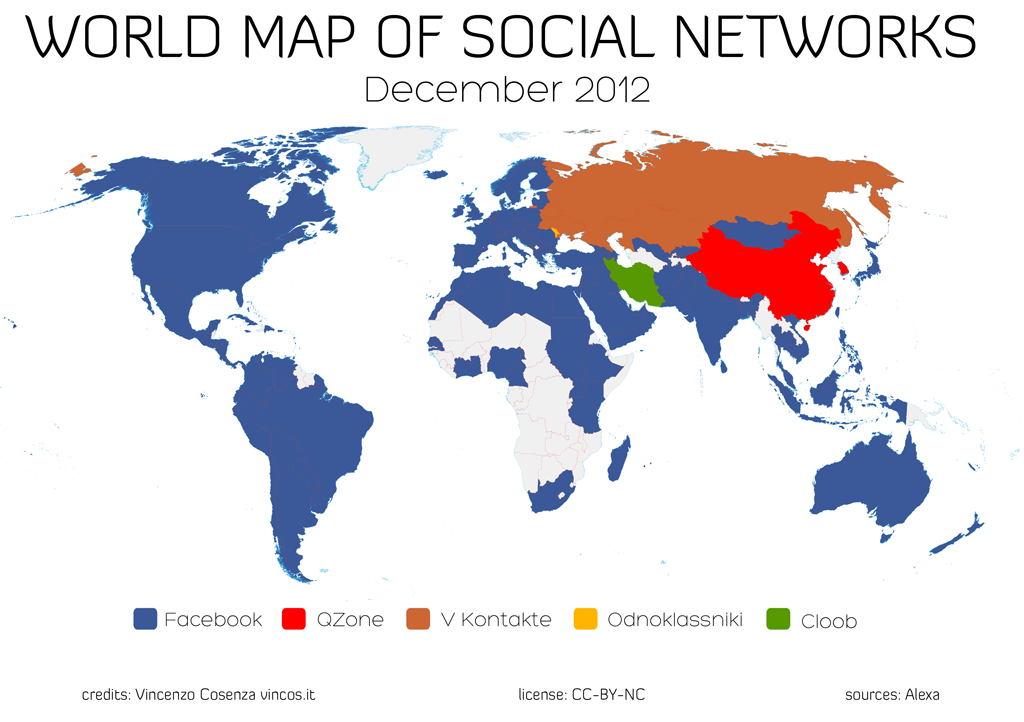 “December 2012, a new edition of my World Map of Social Networks, showing the most popular social networking sites by country, according to Alexa traffic data (Google Trends for Websites was shut down on September 2012). Facebook with 1 billion active users has established its leadership position in 127 out of 137 countries analyzed. One of the drivers of its growth is Asia that with 278 million users, surpassed Europe, 251 million, as the largest continent on Facebook. North America has 243 million users, South America 142 million. Africa, almost 52 million, and Oceania just 15 million (source: Facebook Ads Platform). In the latest months Zuckerberg’s Army conquered Armenia, Kyrgyzstan, Latvia and Vietnam.”
 - Over 8 million game downloads on Christmas Day! [Rovio Entertainment Ltd] – Rovio’s big Christmas download haul: “Wow, what a year! We released four critically-acclaimed bestselling mobile games, developed two top-rated Facebook games, and reached more than a billion downloads — all before our 3rd “Birdday”! Angry Birds Star Wars and Bad Piggies in particular have dominated the app charts, with Angry Birds Star Wars holding the #1 position on the US iPhone chart ever since its release! To top it all off, we had 30 million downloads during Christmas week (December 22-29) and, on Christmas Day, over 8 million downloads in 24 hours alone!”
- R18+ game rating comes into effect [ABC News (Australian Broadcasting Corporation)] – Finally: “An R18+ video game rating has come into effect across Australia after a deal between the states and the Commonwealth last year. The change means some games that were previously unavailable to adults can go on sale, whereas others that could be accessed by children will become restricted. The issue had divided interest groups, with some claiming the new classification would protect children but others feared it would expose them to more violent games. Legislation to approve the rating was passed by the Senate in June. Under the previous classification regime, the highest rating for computer games was MA15+, meaning overseas adults-only games were either banned in Australia or given a lower classification, allowing children to obtain them.”
- Two billion YouTube music video views disappear … or just migrate? [Technology | guardian.co.uk] – Despite rumours of massive cuts to major record labels’ YouTube channel counts, the explanation is rather more banal: “Universal and Sony have, since 2009, been moving their music videos away from their YouTube channels and over to Vevo, the music industry site the two companies own with some investors from Abu Dhabi. YouTube, meanwhile, thinks that is only right to count channel video views for videos that are still actually present on the channels – which means that whenever YouTube got round to reviewing the music majors’ channels on its site, a massive cut was always going to be in order.”
Digital Culture Links: September 15th 2010
Links for September 10th 2010 through September 15th 2010:
- Myths of the NBN myths [ABC The Drum Unleashed] – Stilgherrian rebukes the common myths associated with the National Broadband Network, showing their false logic and short-sightedness. A good read.
- The Rise of Apps Culture [Pew Research Center’s Internet & American Life Project] – New Pew study shows Apps are emerging, but far from ubiquitous just yet: “Some 35% of U.S. adults have software applications or “apps” on their phones, yet only 24% of adults use those apps. Many adults who have apps on their phones, particularly older adults, do not use them, and 11% of cell owners are not sure if their phone is equipped with apps. Among cell phone owners, 29% have downloaded apps to their phone and 13% have paid to download apps. “An apps culture is clearly emerging among some cell phone users, particularly men and young adults,” said Kristen Purcell, Associate Director for Research at the Pew Internet Project. “Still, it is clear that this is the early stage of adoption when many cell owners do not know what their phone can do. The apps market seems somewhat ahead of a majority of adult cell phone users.””
- The Agnostic Cartographer – John Gravois [Washington Monthly] – Interesting article looking at the politics behind all maps, but especially Google Maps – trying to create one definitive map for the world, when so many maps are bound to particular nations, politics and cultures, means a lot of diplomacy or a lot of disputes (both are currently happening).
- musing on child naming and the Internet [danah boyd | apophenia] – (Unborn) kids and digital footprints: “I am of the age where many of my friends are having kids and so I’ve been exposed to more conversations about what to name one’s child than I ever could’ve imagined. I’m sure people have always had long contested discussions with their partners and friends about naming, but I can’t help but laugh at the role that the Internet is playing in these conversations today. I clearly live in a tech-centric world so it shouldn’t be surprising that SEO and domain name availability are part of the conversation. But I’m intrigued by the implicit assumption in all of this”¦ namely, that it’s beneficial for all individuals to be easily findable online and, thus, securing a fetus’ unique digital identity is a tremendous gift.”
- ‘That is so gay!’ [ABC The Drum Unleashed] – Matthew Sini on Stephanie Rice’s recent Twitter controversy: “A certain tweeting swimmer used the word faggot recently in a haphazard, inelegant and wholly unconscious way the other day. As many Rice-lovers have vocally pointed out, the intention behind the word choice was clearly not to insult. But that is the point. When you can use this sort of language in such a casual way, you have displayed an ignorance of very material prejudice and a history of oppression and suffering. Both Stephanie Rice, and me and my friends, make light of this history of suffering, but the difference is Rice does not acknowledge it when making light. She can only be accused of ignorance. In the same way that many ‘kids today’ use the phrase ‘that’s so gay’ or some cognate of it to describe something that is undesirable.”
- FarmVille – Facebook application metrics from AppData Facebook Application Metrics [AppData] – Statistics for Farmville use in terms of the Facebook plugin. 83,755,953 all-time high for monthly users to date.
- App Store Review Guidelines [Apple – App Store Resource Center] – Apple releases their guidelines for reviewing Apps for the Apple App store. Finally, developers can figure out exactly what they need to do to ensure their Apps are accepted, and critics can evaluate how Apple wield their power in policing the iWalled Garden.
Digital Culture Links: May 26th 2010
Links for May 24th 2010 through May 26th 2010:
- Facebook ‘hindering the police’ [WA Today] – The Australian Federal Police take on Facebook: “Facebook’s woeful relationship with law enforcement bodies is hampering police investigations and putting lives at risk, the Australian Federal Police says. The AFP’s assistant commissioner and head of high tech crime operations, Neil Gaughan, will fly to Washington DC today for a meeting convened by the US Department of Justice in which senior law enforcement officials from around the world will discuss their concerns with the social networking website. State and federal police have told the Herald’s sister paper, the Age, the company has been unwilling to provide police with the intelligence they need for investigations. They want Facebook to appoint a dedicated law enforcement liaison in Australia who can, for example, match user accounts to physical internet addresses.”
- Facebook told to set up warning system after new sex scam [The Age] – Just what Facebook needs, its own viruses: “A major computer security firm urged Facebook to set up an early-warning system after hundreds of thousands of users were hit by a new wave of fake sex-video attacks. British-based virus fighter Sophos warned users of the world’s biggest social networking site to be on guard against any posting entitled “distracting beach babes”, which contains a movie thumbnail of a bikini-clad woman. In a press statement, Sophos said the malicious posts appear as if they are coming from Facebook users’ friends, but it urged recipients not to click on the thumbnail. By clicking on it, users are taken to a rogue Facebook application informing them that they do not have the right player software installed, Sophos said. It tricks users into installing adware, a software package that automatically plays, displays or downloads advertisements to their computer, and the video link is spread further across the network.”
- Lady Gaga Says No Problem If People Download Her Music; The Money Is In Touring [Techdirt] – “… Lady Gaga admits she’s fine with people downloading her music in unauthorized forms because she makes it up in touring revenue:
She explains she doesn’t mind about people downloading her music for free, “because you know how much you can earn off touring, right? Big artists can make anywhere from $40 million [£28 million] for one cycle of two years’ touring. Giant artists make upwards of $100 million. Make music — then tour. It’s just the way it is today.”
Similarly, she knocks bands that don’t really try to work hard to please the fans, and who just expect them to automatically buy each album:
“I hate big acts that just throw an album out against the wall, like ‘BUY IT! F*** YOU!’ It’s mean to fans. You should go out and tour it to your fans in India, Japan, the UK. I don’t believe in how the music industry is today. I believe in how it was in 1982.”
- The Twitter Platform [Twitter Blog] – Twitter makes clear, that they will control advertising on Twitter, and no one else will: ” … aside from Promoted Tweets, we will not allow any third party to inject paid tweets into a timeline on any service that leverages the Twitter API. We are updating our Terms of Service to articulate clearly what we mean by this statement, and we encourage you to read the updated API Terms of Service to be released shortly.” (Their logic, while motivated by finances as much as anything else, does actually make sense in terms of user experience.)
- How The Australian fell in love with the iPad [mUmBRELLA] – Is The Australian an Apple customer or commentator? “While it’s fair to say that the world’s media has been pretty excited about Apple’s iPad, The Australian appears to be on the verge of spontaneously combusting over the device’s official arrival Down Under this Friday. Clearly the newspaper’s plans to launch its own paid-for iPad app are unrelated to that. Indeed, if it sells as many apps as it has written stories about the iPad, it will be well on the way to securing a digital future for itself. […] I’d love to bring you every article The Australian’s carried about the iPad. But Google tells me there are 4,790 of them. So I’d better stop there. Did I mention that The Australian’s got an iPad app?”
- Quitting Facebook is pointless; challenging them to do better is not [danah boyd | apophenia] – boyd’s discussion points:
“1. I do not believe that people will (or should) leave Facebook because of privacy issues.
2. I do not believe that the tech elites who are publicly leaving Facebook will affect on the company’s numbers; they are unrepresentative and were not central users in the first place.
3. I do not believe that an alternative will emerge in the next 2-5 years that will “replace” Facebook in any meaningful sense.
4. I believe that Facebook will get regulated and I would like to see an open discussion of what this means and what form this takes.
5. I believe that a significant minority of users are at risk because of decisions Facebook has made and I think that those of us who aren’t owe it to those who are to work through these issues.
6. I believe that Facebook needs to start a public dialogue with users and those who are concerned ASAP (and Elliot Schrage’s Q&A doesn’t count).”
Digital Culture Links: November 5th 2009
Links for November 3rd 2009 through November 5th 2009:
- The ABC of social media use [ABC News (Australian Broadcasting Corporation)] – How bizzare: social media use guidelines in a major corporation which actually make sense! “ABC managing director Mark Scott has announced new social media guidelines, which the national broadcaster’s journalists and staff must abide by. […] In an email sent to ABC staff this morning, the new Use of Social Media policy gives four standards which staff and contractors must follow when using both work and personal social media interaction:
1. Do not mix the professional and the personal in ways likely to bring the ABC into disrepute.
2. Do not undermine your effectiveness at work.
3. Do not imply ABC endorsement of your personal views.
4. Do not disclose confidential information obtained through work.” - The temporary web [BuzzMachine] – Jeff Jarvis articulates some important concerns about the way Twitter and other social services are contributing to a more temporary, less archivable (or, at least, less searchable in the long term) web: “…search is turning social and our search results are becoming personalized, thus we don’t all share the same search results and it becomes tougher to manage them through SEO. Put these factors together – the social stream – and relationships matter more than pages (but then, they always have). “
- Internet piracy [Background Briefing – 1 November 2009] – Australia’s Radio National programme Backgroud Briefing takes a look at copyright in the digital age, featuring the big arguments and comments from everyone from AFACT to Lessig and Girl Talk. Segment by Oscar McLaren.
Digital Culture Links: July 30th 2009
Links for July 24th 2009 through July 30th 2009:
- Law 2.0 – Law 2.0: The Challenge of User-generated and Peer-produced Networks, Content & Culture [Peter Black’s Freedom to Differ] – Peter Black’s primer on the changing legal landscape in the ‘Web 2.0’ era. Pitched at legal educators, but a really useful overview for anyone interested. [Talk on Vimeo] [Powerpoint Slides]
- Microsoft and Yahoo Reach Search Agreement [NYTimes.com] – “Microsoft and Yahoo announced a partnership in Internet search and advertising on Wednesday morning intended to create a stronger rival to the industry powerhouse Google. Under the pact, Microsoft will provide the underlying search technology on Yahoo’s popular Web sites. The deal provides a lift for Microsoft’s recent overhaul of its search engine, renamed Bing, which has won praise and favorable reviews, after years of falling further and further behind Google. Running such a search system proves expensive, and Microsoft can now filter more searches through the Bing technology infrastructure. It expects to deliver better answers to search queries over time as well by learning from more peoples’ queries.” Yacrosoft or Mihoo! ?
- Would the real social network please stand up? [apophenia] – Some useful thoughts about social networks and their differences from danah boyd and Bernie Hogan: “The truth of the matter is that there is no “real” social network. It all depends on what you’re trying to measure, what you’re trying to do with those measurements. We do ourselves an intellectual disservice when we assume that these different types of networks are interchangeable or that studying one automatically tells us about another. Most scholars get this, even when they’re quoted out of context by journalists to suggest otherwise (see Cameron Marlow). But I get the sense that a lot of journalists, marketers, advertisers, politicians, and everyday folks don’t. This is a problem.”
- China now has 338m internet users [News.com.au] – “The number of internet users in China is now greater than the entire population of the United States, after rising to 338 million by the end of June, state media reported today. China’s online population, the largest in the world, rose by 40 million in the first six months of 2009, the official Xinhua news agency reported, citing a report by the China Internet Network Information Centre. The number of broadband internet connections rose by 10 million to 93.5 million in the first half of the year, the report said.”
- 6 Gorgeous Twitter Visualizations [Mashable] – Cool visualisation tools for Twitter – useful for explaining the potentially global conversations going on.
- Movie studios try to harness Twitter effect | Technology [Internet | Reuters] – “Box office watchers say Twitter, a micro-blogging service that allows anyone to post on-the-fly wisecracks for all the world to see, is the latest weapon in an arsenal of cell phones and computers that audiences use to critique films quickly, often when they are still sitting in theaters. Such word-of-mouth publicity from fan to fan can boost, or bomb, ticket sales. “Has everything speeded up? The answer is yes,” said Adam Fogelson, Universal’s president of marketing and distribution. “Depending on how big your opening day audience is, word-of-mouth starts playing a factor immediately,” he said.”

Tama Leaver dot Net by Tama Leaver is licensed under a Creative Commons Attribution-NonCommercial-ShareAlike 4.0 International License.