Home » Posts tagged 'publication'
Tag Archives: publication
Artificial Culture out in paperback!
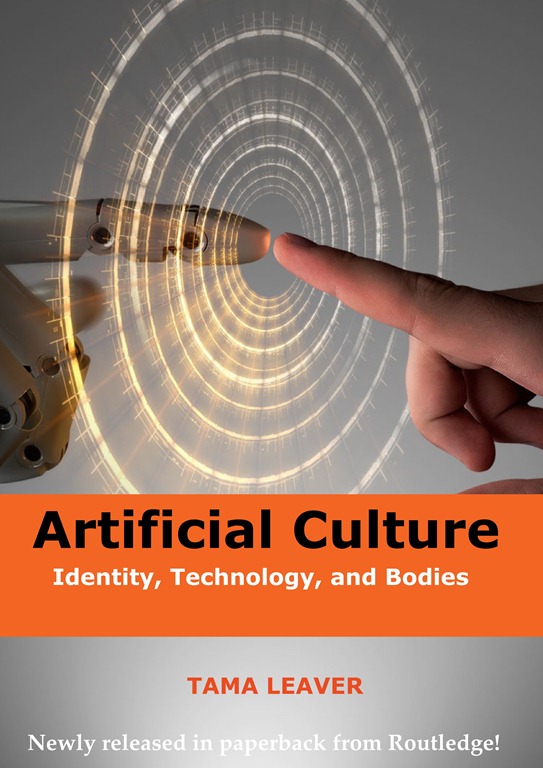 Routledge released my first book, Artificial Culture, in paperback today. While a paperback might not seem that big a deal, I’m actually quite excited. When Artificial Culture first came out, while I was delighted, I was also pretty embarrassed by the $140 price tag. I never really expected anyone but libraries would ever be able to afford it, and I treated my 5 author copies as if they were gold (all given away now, except one). I never had a book launch because I didn’t want anyone to feel obliged to try and buy the book.
I was actually quite relieved to discover that quite a few libraries (and maybe a few humans, too) actually bought a copy. Enough that Routledge have been willing to actually do a paperback run; this was helped immensely by Professor Veronica Hollinger’s kind review in which she asked:
I am seriously considering reading some of Artificial Culture with the students in my senior-year seminar on ‘Science Fiction and Technoculture’, and it would also be an appropriate text to include in graduate courses. Routledge, where’s my paperback?
Thankfully, I can now answer: the paperback’s available widely, and for (really!) $100 less than the hardback, for $US45 (or $39 on Amazon currently
The cover, I should add, is the same as the hardback, but the poster above is what I fancifully imagine cover art might have looked like if a bespoke design had been possible (I know it’s a bit silly; maybe that’s why I didn’t get to do cover art!).
If you’re curious about the book, the opening material and first chapter can be read for free online. Oh, and anyone going to see the new Alan Turing biopic The Imitation Game might want to read pages 7 to 9 for my take on Turing’s work and life (I’m a big fan!).
Facebook in Education: Special Issue of Digital Culture & Education
I’m pleased to announced that the special themed issue of Digital Culture and Education on Facebook in Education, edited by Mike Kent and I, has been released. The issue features an introductory article by Mike and I, ‘Facebook in Education: Lessons Learnt’ in which we may have some opinions about whether the hype around MOOCs and disruptive online education ignores the very long history of learning online (hint: it does). As something of a corrective to that hype, this issue explores different aspects of the complicated relationship between Facebook as a platform and learning and teaching in higher education.
This issue features ‘”Face to face” Learning from others in Facebook Groups‘ by Eleanor Sandry, ‘Exploiting fluencies: Educational expropriation of social networking site consumer training‘ by Lucinda Rush and D.E. Wittkower, ‘Learning or Liking: Educational architecture and the efficacy of attention‘ by Leanne McRae, and ‘Separating Work and Play: Privacy, Anonymity and the Politics of Interactive Pedagogy in Deploying Facebook in Learning and Teaching’ by Rob Cover.
Also, watch this space in about a month for the related and slightly larger related work in the same area.
Digital Culture Links: November 29th
Links for November 25th through November 29th:
- Aussie viral video, ‘Dumb Ways to Die’, lives on [The Age]– “Australia’s fastest-spreading viral video, “Dumb Ways to Die”, has taken on a life of its own, inspiring more than 65 cover versions, 85 parodies and 170 re-posts on YouTube. The original clip, made to promote safety on Melbourne Metro Trains, has amassed more than 28 million views on YouTube since it was posted on November 14. Its creator, ad agency McCann Worldgroup Australia, said its “conservative” estimate was that the campaign had generated $50 million in “global-earned media value” so far, in addition to more than 700 press hits. A new parody clip by Seattle-based creative team Cinesaurus about the Curiosity Mars mission, dubbed “Cool Things to Find“, joins dozens of other parodies and covers including a classic rock version, a Russian cover … “It’s entered popular culture,” said John Mescall, executive creative director of McCann Worldgroup Australia.”
- Google is publisher according to Australian court [David Banks | Law | guardian.co.uk] – “Google will have to be quicker to remove defamatory content, at least in Australia, after it lost a $200,000 libel action there. [“¦] the tale of Australia’s most successful libel litigant may give Google and other search engines pause for thought. Milorad Trkulja, a music promoter, took action against Google over material online, which linked him with criminal figures in Melbourne. Trkulja has never been involved in any criminal activity, but was unfortunate enough to have been shot in a restaurant in 2004. His lawyers wrote to Google in October 2009 asking for the offending material, which included a number of images, to be removed, but received a reply saying that in line with Google’s policies on content removal he should contact the owners of the website concerned instead. Trkulja sued Google and the jury concluded that the search engine was the publisher of images of Trkjulja and related information which suggested he was involved in crime … “
- The one-way street to digital lock-in [The Age] – A simple but very important reminder from Hayley Tsukayama that when you buy a mobile device, you’re not just buying a device – you’re committing to a cloud ecosystem and a provider of apps and content that you’ll be locked into for a long time, and probably can’t easily transfer between devices. iPhone apps won’t ever work on a Nexus tablet, nor will Google Play books end up being read on iPads any time soon.
- PSY Passes Bieber; ‘Gangnam Style’ New Most-Viewed Video of All Time [YouTube Trends] – “Today, global sensation PSY and his wildly popular “Gangnam Style” music video surpassed Justin Bieber’s “Baby” as the most viewed music video (and overall video) of all time on YouTube. As of noon on Saturday (24 Nov 2012), the viewcounts stood at 805 million to 803 million.”
Digital Culture Links: June 3rd 2010
Links for May 31st 2010 through June 3rd 2010:
- Anatomy of an Unpublished Chapter [Just TV] – Jason Mittell’s insightful post about academic publishing in general, and the challenges of balancing copyright, readership and academic reputation. I admire Jason’s decision to give up publishing a chapter in a collected edition due to the inflexible copyright demands of the publisher (including a requirement for him to remove a pre-print version on his blog); that said, at this stage of my academic career, I’m definitely not established enough to be this brave!
- Did Twitter censor the #flotilla hashtag following the Israel attack? [Technology | guardian.co.uk] – The #flotilla hashtag disappeared from Twitter’s trending topics briefly – cries of censorship erupted – but it soon returned and it appears that the disappearance was due to automated spam filtering (the hashtag had been active earlier in the week relating to another story).
- Terminating employees for their conduct on social media sites – Malcolm Burrows (B.Bus.,MBA.,LL.B.,GDLP.,MQLS Associate) offers some useful advice and tips about social media and the law in Australia, especially as to whether it’s legal to fire someone for social media comments made outside of work time (short answer: mostly no, but with some important exceptions).
- When Facebook Says – You Have Too Many Friends [NYTimes.com] – 5000 Facebook friends: that’s your limit.
“anthropologist and Oxford professor Robin Dunbar has posed a theory that the number of individuals with whom a stable interpersonal relationship can be maintained (read: friends) is limited by the size of the human brain, specifically the neocortex. “Dunbar’s number,” as this hypothesis has become known, is 150. Facebook begs to differ. […] Facebook famously co-opted the word “friend” and created a new verb. Friending “sustains an illusion of closeness in a complex world of continuous partial attention,” said Roger Fransecky, a clinical psychologist and executive coach in New York (2,894 friends). “We get captured by Facebook’s algorithms. […] Facebook discourages adding strangers as friends, adding that only a tiny fraction of its 400 million users have reached the 5,000 threshold, at which point Facebook wags its digital finger and says: That’s enough.” - Facebook, you’ve been sent a message . . . Angry users quit over privacy fears [The Australian] – “Tens of thousands of other disaffected former Facebook fans are also due to commit mass account suicide today, which has been declared “Quit Facebook Day” in a grassroots campaign started by two tech guys, Joseph Dee and Matthew Milan. Motivating them in part are the increasing privacy concerns surrounding the world’s most popular networking site. As of yesterday afternoon, about 24,000 Facebook users had committed to leaving, according to the tally on QuitFacebookDay.com. That’s about 0.006 per cent of the site’s approximately 400 million active users. However, surveys show growing dissatisfaction with the site, with users complaining settings make it too hard to restrict who can view their personal information and too easy for them to inadvertently share details with third-party websites, which mainly use the information to better target them for advertising.”
Annotated Digital Culture Links: January 6th 2009
Links for January 6th 2009:
- Digital guru Clay Shirky’s media forecast and predictions for 2009 [Media | The Guardian] – “The question is who figures out the business model that says it’s better to have 6 million passionate fans than 7 million bored ones? That is going to be the transformation because what you see with these user groups, whether it’s for reality TV or science fiction, is that people love the conversation around the shows. The renaissance of quality television is an indicator of what an increased number of distribution channels can do. It is no accident that this started with cable. And the BBC iPlayer? That’s a debacle. The digital rights management thing …let’s just pretend that it was a dream like on Dallas and start from scratch. The iPlayer is a back-to-the-future business model. It’s a total subversion of Reithian values in favour of trying to create what had been an accidental monopoly as a kind of robust business model. The idea that the old geographical segmenting of terrestrial broadcasts is recreatable is a fantasy and a waste of time.”
- NIN’s CC-Licensed Best-Selling MP3 Album [Creative Commons] – ” … Ghosts I-IV is ranked the best selling MP3 album of 2008 on Amazon’s MP3 store.Take a moment and think about that.
NIN fans could have gone to any file sharing network to download the entire CC-BY-NC-SA album legally. Many did, and thousands will continue to do so. So why would fans bother buying files that were identical to the ones on the file sharing networks? One explanation is the convenience and ease of use of NIN and Amazon’s MP3 stores. But another is that fans understood that purchasing MP3s would directly support the music and career of a musician they liked. The next time someone tries to convince you that releasing music under CC will cannibalize digital sales, remember that Ghosts I-IV broke that rule, and point them here.”
- Twitter accounts of Obama, Britney Spears hacked [ABC News (Australian Broadcasting Corporation)] – “The Twitter accounts of US president-elect Barack Obama, singer Britney Spears and other prominent figures were hacked on Monday (US time) and fake messages sent out in their names on the micro-blogging service. Twitter founder Biz Stone, in a post on the official company blog, said a total of 33 Twitter accounts had been hacked including those of president-elect Obama and Rick Sanchez, a CNN television anchor with tens of thousands of followers. “We immediately locked down the accounts and investigated the issue,” Mr Stone said. … Twitter, which allows users to post real-time updates of 140 characters or less, has an estimated 4-5 million users according to a recent study. Launched in August 2006, it has been embraced by a number of celebrities including president-elect Obama, who has more than 150,000 followers, and four-time NBA champion Shaquille O’Neal of the Phoenix Suns.”
- How Windschuttle swallowed a hoax to publish a fake story in Quadrant (Margaret Simmons, 6 Jan 09) [Crikey] – “Keith Windschuttle, the editor of the conservative magazine Quadrant, has been taken in by a hoax intended to show that he will print outrageous propositions. This month’s edition of Quadrant contains a hoax article purporting to be by “Sharon Gould”, a Brisbane based New York biotechnologist. But in the tradition of Ern Malley – the famous literary hoax perpetrated by Quadrant’s first editor, James McAuley – the Sharon Gould persona is entirely fictitious and the article is studded with false science, logical leaps, outrageous claims and a mixture of genuine and bogus footnotes.” [Margaret Simmons’ Further Blogged Thoughts] [Windschuttle’s Response]
- Facebook under fire for racist rants [The Age] – “Facebook has come under fire from Australian users for ignoring racial vilification on the site and failing to remove blatantly racist groups even though they have been flagged as offensive. Sydney-based Facebook user Alex Gollan, who has campaigned against the racist groups, has been threatened with violence and fears the site could be used to rally people if another incident such as the Cronulla riots flares up. The site permanently banned one offender this week but only after the issue of racism on Facebook came under the spotlight following revelations that Scots College and Kambala students had created anti-Semitic groups on the site.”

Tama Leaver dot Net by Tama Leaver is licensed under a Creative Commons Attribution-NonCommercial-ShareAlike 4.0 International License.