Home » Posts tagged 'net303' (Page 2)
Tag Archives: net303
Digital Culture Links: October 17th 2011
Links for October 5th 2011 through October 17th 2011 (catching up on a backlog of good links!):
- New YouTube features for music artists [YouTube Blog] – YouTube gets even further on the disintermediation bandwagon (ie cutting out the middle people), letting bands and music partners offer merchandising, concert tickets and link to digital sales (including iTunes) from their music videos. It’s all about the integration!
- Amazon Rewrites the Rules of Book Publishing [NYTimes.com] – “Amazon.com has taught readers that they do not need bookstores. Now it is encouraging writers to cast aside their publishers. Amazon will publish 122 books this fall in an array of genres, in both physical and e-book form. It is a striking acceleration of the retailer’s fledging publishing program that will place Amazon squarely in competition with the New York houses that are also its most prominent suppliers. It has set up a flagship line run by a publishing veteran, Laurence Kirshbaum, to bring out brand-name fiction and nonfiction. It signed its first deal with the self-help author Tim Ferriss. Last week it announced a memoir by the actress and director Penny Marshall, for which it paid $800,000, a person with direct knowledge of the deal said. Publishers say Amazon is aggressively wooing some of their top authors. And the company is gnawing away at the services that publishers, critics and agents used to provide.”
- Buyers dodge court’s Samsung tablet ban [The Age] – Surprising no one: “Australians are making a mockery of a Federal Court injunction banning the sale of Samsung Galaxy Tab 10.1 tablets in Australia by ordering them from online stores. Meanwhile, in the US, Samsung’s own lawyers were left red-faced after being unable to differentiate between Samsung’s and Apple’s tablets in court. Samsung has been forbidden by Federal Court Justice Annabelle Bennett from selling or marketing the device in Australia until a full hearing in its patent infringement case with Apple, which isn’t expected to take place until next year. Justice Bennett said Apple had a prima facie case that Samsung infringed two of its patents. But online sellers on eBay, and web stores such as MobiCity.com.au, Expansys, Techrific and dMavo, are bypassing Samsung Australia and obtaining stock from other countries, such as Hong Kong.”
- Google Announces Third Quarter 2011 Financial Results (GooglePlus = 40 million+) [Google Investor Relations] – In their third quarter financial resuts, Larry Page announces that Goole+ has passed 40 million users.
- Lady Gaga bans Lady Goo Goo song [BBC News] – Given Lady Gaga’s rhetoric about respecting her fans ignoring (her) copyright and that this effort seems like parody to me, I’ll be interested to see how this is justified: “Lady Gaga has won an injunction at London’s High Court to stop animated character Lady Goo Goo from releasing a single, its makers have said. Lady Goo Goo, a baby with a long blonde fringe from the Moshi Monsters online game – owned by UK firm Mind Candy – released The Moshi Dance on YouTube. But Lady Gaga’s injunction has stopped its full release, Mind Candy said. Law firm Mishcon de Reya confirmed it had represented Lady Gaga but said it could not comment further.”
- A fall sweep [Official Google Blog] – Google is killing off a number of poorly performing products. Google Buzz is the most notable closure. Hopefully Google learnt a lot from Buzz, especially about privacy.
- Felicia Day turns to Hangouts to promote new show [NewTeeVee – Online Video News] – “Web series veteran Felicia Day will promote her new online show Dragon Age: Redemption with a unique twist on Google+ Hangouts: The actress will be experimenting with something she dubbed Hangout Housecalls this coming Tuesday. Day is promising to visit as many Hangouts of her fans within a three-hour window as possible. She announced the house calls on Google+, where she explained: I’ll answer questions about the show and we can even pose for a photo that you can screencap and post later! Cool? Cool. The Dragon Age: Redemption house calls will kick off with a post on Day’s Google+ profile on Tuesday at 10 a.m. PST that will ask viewers to post links to their Hangouts in the comments. Day will then click through those links, visiting one Hangout after another.”
- The Guild turns product placement into merchandising gold [NewTeeVee – Online Video News] – Good wrap-up of the many, many different types of merchandise now available surrounding Felicia Day’s web series The Guild. Also interesting are both the careful deals – finding merchandise options which don’t threaten existing sponsorship from Microsoft and Sprint – but also how a lot of merchandise was strategically linked to Comic Conventions so that, eventually, they could be integrated into Season Five of The Guild which is largely set at a con. Day really is a canny business person and shows how far a recognisable web series can the deployed to make money across a wide range of products and tie-ins.
- 200 million Creative Commons photos and counting! [Flickr Blog] – Flickr users have now explicitly licensed and shared over 200 million photos using Creative Commons licenses. This is a fantastic and valuable resource. However, given there are more than 5 billion photos on Flickr, surely there could be more under CC licenses if the world was really spread? After all, being able to specify your license is one of the key things that Facebook really can’t do right now/
- Barcode Scanner for Zotero [Android App] – Android barcode scanning app for Zotero. If the barcode links to a book metadata, you can automatically add it to your Zotero library. “Scanner For Zotero brings Zotero’s magic wand tool out into the physical world. Scan the ISBN barcode on any book, and Scanner For Zotero will fetch that item’s bibliographic info from the web and allow you to add it to your Zotero library.That’s pretty cool.”
- Facebook’s privacy lie: Aussie exposes ‘tracking’ as new patent uncovered [The Age] – “Facebook has been caught telling porkies by an Australian technologist whose revelations that the site tracks its 800 million users even when they are logged out have embroiled Facebook in a global public policy – and legal – nightmare. Facebook’s assurances that “we have no interest in tracking people” have been laid bare by a new Facebook patent, dated this month, that describes a method “for tracking information about the activities of users of a social networking system while on another domain”.”
Digital Culture Links: October 3rd 2011
Links for September 27th 2011 through October 3rd 2011:
- How Social Networking Is Reviving Communal TV Viewing [The Next Web] – Real-time TV viewing is on the rise once more thanks to cleverly design related apps and strategic use of related #hashtags: “There are some signs that TV’s re-engaging its most coveted viewers. According to Nielsen, tech-savvy 12-24 year-olds are more connected and therefore more adept at using mobile devices to watch shows. This doesn’t bode well for the networks or for advertisers since, sometimes, the ads can be skipped. However, by turning TV programming into a true two-screen experience, it changes the equation. It makes the live experience more valuable, especially for the younger set. The data show that 18-34 year-olds are the most active demographic on social networks.”
- Facebook sued over claims it tracks users’ activity [The Age] – “Facebook is being sued by a group of users over claims it tracks their online activity after they log off. […] On Friday, 10 public interest groups asked the US Federal Trade Commission to investigate Facebook’s tracking of internet users after they log off. They urged the commission to examine whether Facebook’s new ticker and timeline features increased privacy risks for users by combining biographical information in an easily accessible format. The lawsuit – filed by Perrin Aikens Davis, of Illinois – seeks class status on behalf of other Facebook users in the US. Davis seeks unspecified damages and a court order blocking the tracking based on violations of federal laws, including restrictions on wiretapping, as well as computer fraud and abuse statutes.”
- Peers, review your actions [Times Higher Education ] – Interesting proposition: academics should boycott doing peer review (for free) for journals which aren’t open access (ie charge a lot to be viewed).
- Princeton goes open access to stop staff handing all copyright to journals – unless waiver granted [The Conversation] – Princeton University policy prevents their academics from publishing in journals which demand full copyright over their work (unless explicit permission is sought from the institution). A bold move to try and reign in the big copyright holders and publishers who currently have a strangle-hold over a great deal of academic work!
- BBC iPlayer launches on iPad in Australia [TV Tonight] – The BBC iPlayer comes to Australia, for a fee. For $10 a month you can access more than 1000 hours of BBC archives (at launch, growing regularly) but NOT current TV shows. In part this is probably due to existing contracts with local networks (why would the ABC bother to screen Doctor Who if it was available via iPlayer before broadcast), but this really doesn’t then address the problem of the tyranny of digital distance. This is a clever commercial move, but is unlikely to address the issue of unauthroised downloading of UK TV shows in Australia.
- A New Flavor…Still Delicious [AVOS] – AVOS launch the re-imagined Delicious. Being a long-term Delicious user, I’ve got to admit I find the new version a bit confronting, especially the changes to tag clouds and so forth. And I really don’t want “stacks” – that’s what something like Pinterest is for (and I don’t use that much, either). However, I’m delighted Delicious lives on, so I’ll give it a go!
Facebook’s New Timeline & Perceptions of Privacy
Everyone’s Facebook profile will disappear in 6 October 2011, December 2011 replaced with a Timeline. Here are my thoughts and concerns about that Timeline, and some suggestions about managing your Timeline when it arrives …
I’ve been testing out Facebook’s new Timeline which will shortly replace profiles for all 800 million Facebook users. I have some concerns which I’ll outline in a minute, but I have to give credit where credit is due: Timeline looks amazing. I think this is the first time Facebook has stopped looking like a direct descendant of the profiles found on online dating websites! The new cover image, which is separate from your avatar or profile picture, stretches across the entire screen and is much more richly visual experience, combined with far better navigation tools for exploring the entirety of someone’s Facebook history, not just their current statuses and photos. Here’s what the top of my Timeline looks like:

The tools which allow you to emphasise certain events on your timeline let individuals build an engaging and carefully curated story of themselves. And in a move which deliberately situates Facebook as telling the story of your life, Timeline actively encourages users to add in missing details. When I look at the notification of my 2000 university graduation, Timeline suggests I add to the story and post a picture, enriching the tale visually. If I add a picture, then the event ‘looks’ more interesting and is more engaging than a bit of text in an ‘Info’ box. However, in moving from being primarily about current communication to adding the archival/historical emphasis, a number of privacy-related issues arise.
My Timeline image above is missing a lot of detail since it’s the view that the public can see – ie someone who I’m not connecting to at all – and my privacy settings are high (almost everything is ‘Friends Only’; incidentally, once your Timeline is visible you can use the right-hand setting indicator – the one that looks like a wheel – and select ‘View as …’ to check how your Timeline will look to anyone else, including the public view). It’s notable, then, that the cover photo — the big one, at the top of your Timeline, which isn’t your profile photo — joins your profile photo as an image that you can’t make private; if you can be found on Facebook, it’s there. (I presume this might disappear if you prevented your profile being found in searches, but I can’t say that definitively.) Profile pictures have been unavoidably public for a while, so we just need to remember this about cover photos, too.
If you scroll down my Timeline (which, as I said, is now absurdly easy with the right hand date-based navigation tools) this is what you can see for 2011 and 2010 (there’s not much there, but take a look at what is visible):

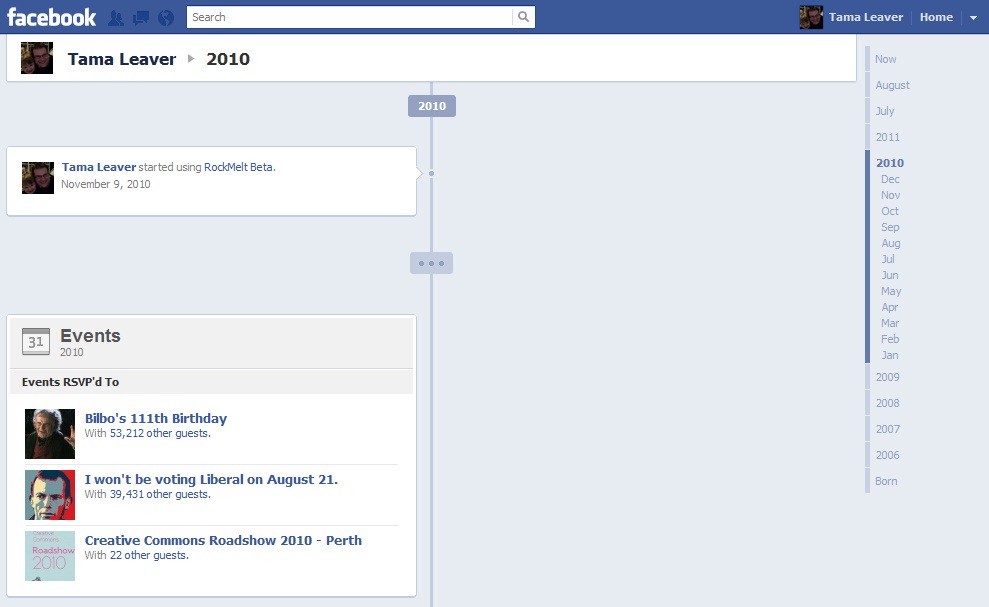
On some abstract level, I was aware that when I ‘voted’ or clicked ‘Attending’ I was committing to something that was visible beyond my immediate ‘friend’ network (notable for me since, due to my privacy settings, not much else is). However, most of these actions or events had, from my perspective, long since ‘disappeared’ to the extent that, in order to find them, someone would have to click to ‘load more’ on my Facebook profile page 20 times or more to see anything. Timeline changes that. Now my voting and the public events I attended are very prominent since that’s pretty much the only thing public. And while these were largely very quick responses, these little bits of information suddenly ‘say’ a great deal about me; indeed, for the public, these are the main bits of the story Facebook tells about me.
Now, some of the things I’ve said I’ve attended are pretty trivial, but some are political (it’s very clear what my political views are) and others are on the boundary of personal and political. When I voted ‘Yes’ to ‘Should Same Sex Marriage Be Legal In Australia’ I was stating something publicly, but I’d never considered that my response would be so prominent on Facebook (it wasn’t on my profile page very long, for example). Now, for me, this isn’t a big issue; I’ve got sufficient workplace security that I can’t imagine these views would jeopardise my employment, and I stand by my politics proudly. I suspect, though, this won’t be the case for everyone. I can think of numerous scenarios where this information might be misused by other people and I strongly recommend folks take a look at their Timeline view from the public perspective as soon as it’s available to them.
From what I can see, it is possible to remove certain items from Timeline, or at least reduce their prominence, but you have to do it from your view (not the public view I used to generate the above images) so if you’re a prolific Facebook user, it’ll take a while to find these items and reduce their visibility.
Now, I’m not suggesting Facebook ‘made public’ something that was private. This information may have felt private, but that was based on use, not on a technical sense of security. Indeed, danah boyd expressed this problem in her paper ‘Facebook’s Privacy Trainwreck: Exposure, Invasion, and Social Convergence’ explaining:
The tech world has a tendency to view the concept of ‘private’ as a single bit that is either 0 or 1. Data are either exposed or not. When companies make a decision to make data visible in a more ‘efficient’ manner, it is often startling, prompting users to speak of a disruption of ‘privacy’.
Technically, the information above was always public, but my experience of it meant it felt largely private. My example is extremely banal, but for other people, the sudden prominence of certain information may make it feel a lot more public than they ever intended. While I acknowledge Facebook has started to provide more robust privacy tools, I’ve seen nothing in the hype around Timeline to warn folks about the way their Timeline will tell a different story about them (and a different story to different people – your Friends will see one ‘you’, but the public may see a quite different one). If Facebook is going to be an ongoing repository, the always-being-edited ‘This Is Your Life’, then Facebook and those of us teaching about these tools need to ensure folks have a much better understanding about Timeline and similar changes. When your life story is a series of entries in a database, then the line between public and private is a single setting. However, that database, as we can see, can always be sorted, ordered and presented in very different ways.
Digital Culture Links: September 7th 2011
Links for September 2nd 2011 through September 7th 2011:
- 28% of American adults use mobile and social location-based services [Pew Research Center’s Internet & American Life Project] – Pew research, September 2011: “More than a quarter (28%) of all American adults use mobile or social location-based services of some kind. This includes anyone who takes part in one or more of the following activities:
* 28% of cell owners use phones to get directions or recommendations based on their current location—that works out to 23% of all adults.
* A much smaller number (5% of cell owners, equaling 4% of all adults) use their phones to check in to locations using geosocial services such as Foursquare or Gowalla. Smartphone owners are especially likely to use these services on their phones.
* 9% of internet users set up social media services such as Facebook, Twitter, or LinkedIn so that their location is automatically included in their posts on those services. That works out to 7% of all adults.” [Full PDF Report] - Random thoughts about piracy [Social Media Collective] – boyd on the culturally-specific takes on media piracy: “I was absolutely enthralled with how the discourse around piracy in India was radically different than anything I had seen elsewhere. In India, piracy is either 1) a point of pride; or 2) a practical response to an illogical system. There is no guilt, no shame. I loved hearing people talk about mastering different techniques for pirating media, software, and even infrastructural needs (like water, electricity, even sewage…) There was a machismo involved in showing off the ability to pirate. To pay was to be cheated, which was decidedly un-masculine. Of course, getting caught is also part of the whole system, but the next move is not to feel guilty; it is to bribe the person who catches you. Ironically, people will often pay more to bribe inspectors than it would’ve cost them to pay for the service/item in the first place. Again, we’re back to pride/masculinity. Pirating was an honorable thing to do; not pirating is to be cheated.”
- Practise the web safety you teach [SMH] – Important little piece reminder K-12 schools that they need to practice what they are starting to preach. It’s great to give students and parents tips on protecting their identity online, but when schools post photographs of students with full names online – often without getting parental or student consent – that’s hardly reinforcing the privacy-aware message.
- The Fall of WikiLeaks: Cablegate2, Assange and Icarus [techPresident] – One (of many) takes on how Julian Assange and Wikileaks went too far in releasing entirely unedited records unedited. They’ve not only lost the moral highground, but tarnished past partners and ensured anyone in a position to leak something in the future would be even less likely to do so: “WikiLeaks has now indiscriminately dumped the whole cable set into the public arena, and in doing so it has tossed away whatever claim it might have had to the moral high ground. The argument that others were doing it already, or that bad actors were already getting access to the leaked master file and thus this was a mitigating step to reduce coming harms, or that it’s somehow The Guardian’s fault for publishing what it thought was a defunct password, doesn’t absolve WikiLeaks of its large share of responsibility for this dump. People are human; to err is human. But refusing to admit error, that is hubris. Assange, like Icarus, thought he could fly to the sun.”
- AFACT Uncle Sam’s puppet in iiNet trial [SMH] – “US copyright police are pulling AFACT’s strings as it drags iiNet through Australian courts, but is anyone really surprised? The Motion Picture Association of America is driving AFACT’s legal attack on Australian ISP iiNet, bringing in Village Roadshow and the Seven Network to avoid the impression of US bullying, according to US diplomatic cables released by Wikileaks. It seems the MPAA deliberately avoided picking a fight with the more powerful Telstra, instead hoping for a quick victory against the smaller iiNet which could set a national and perhaps even international legal precedent to aid the Americans in their global fight against piracy. The undertones of American imperialism and Australian subservience are disturbing …”
Digital Culture Links: August 15th 2011
Links for August 13th 2011 through August 15th 2011:
- Google looks to ‘supercharge’ Android with Motorola Mobility [guardian.co.uk] – Wow, Google take their ball and head straight onto Apple’s turf (and Microsoft’s by way of Nokia): “Google is to acquire Motorola Mobility, the US mobile company’s smartphone business, in a $12.5bn (£7.6bn) cash deal. The takeover will boost Google’s increasing dominance in the nascent smartphone and tablet computer market. The $40 a share deal is a 63% premium on Motorola Mobility’s closing price on the New York Stock Exchange on Friday. Larry Page, Google chief executive, said: “Motorola Mobility’s total commitment to Android has created a natural fit for our two companies. Together, we will create amazing user experiences that supercharge the entire Android ecosystem for the benefit of consumers, partners and developers. I look forward to welcoming Motorolans to our family of Googlers.””
- Schools employ company to monitor students online [ABC News (Australian Broadcasting Corporation)] – Inevitable, but deeply troubling: “Independent schools are using private companies to monitor what their students say and do online on sites such as Facebook. An internet monitoring company, SR7, says it is been employed by some private high schools around Australia to keep track of students’ social media activity. Privacy advocates have expressed concerns, but the “social media intelligence” company says its work will help prevent cyber bullying. S7R partner James Griffin says the company identifies and “attempts to stop” cyber bullying that is increasingly occurring on Facebook and another social media platform, Formspring. Mr Griffin says the increasing number of fake profiles is “striking”.”
- “If you don’t like it, don’t use it. It’s that simple.” ORLY? [Social Media Collective] – Great post by Alice Marwick looking at the problems with the idea that you can simply stop using social media and other technologies due to issues or challenges they pose. Refuting (easy) opting out, or technology refusal, is important is showing how much people actually have to give up if they do opt out, and why it’s a decision many people can’t (or won’t) readily make.
- Sexting punishment is unjust says magistrate [SMH] – “A senior Victorian magistrate who presided over a case in which a youth pleaded guilty to teenage sexting offences has condemned as ”so unjust” the mandatory laws that meant the young man was registered as a sex offender. The magistrate, who works in country Victoria, said the lack of judicial discretion in such cases meant severe consequences for young people who posed no threat to society and were often guilty of little more than naivety. The magistrate, who spoke on condition of anonymity, said he had made the unusual decision to speak out because he was troubled by cases recently identified by Fairfax. He presided over the case of the country youth, then aged 18, who was sent four uninvited text message pictures of girls, aged between 15 and 17 years, topless or in their underwear. Police found the pictures on his mobile phone and laptop and charged him with child pornography offences.”
- Don’t shoot the instant messenger: David Cameron’s social media shutdown plan won’t stop UK riots [The Conversation] – Axel Bruns refutes the logic of social media control or blocking in times of crisis (regarding the UK riots): “David Cameron’s thought bubble (let’s be charitable and call it that) in the UK parliament on Thursday, in which he said it might be a good idea to shut down social networking services if there were to be a repeat of the riots that have rocked Britain, is one such moment. It is, to be blunt, just staggeringly dumb. Where do we even begin? Consider, for example, the fact that Cameron, along with just about all the other leaders of the Western world – you know, we who claim to believe in freedom of expression – lauded the role of social media in the “Arab spring” uprisings in Tunisia, Libya, Egypt, Yemen and elsewhere. But now he wants to shut Twitter and Facebook down, just because someone, somewhere might use them to plan criminal activities? You must be joking. By the same reasoning, why not take out the entire Internet and phone network as well?”
- Panicked over social media, Mr. Cameron joins company of autocrats [The Globe and Mail] – “Eight months ago, as Egyptians flooded the streets of Cairo in protest, the government tried to stem the tide by cutting off access to Twitter and Facebook – social networks that had been so associated with democratic uprisings that labels such as “the Twitter Revolution” were being bandied about. On Wednesday, British Prime Minister David Cameron addressed the rioting that swept his country and declared that he was looking into blocking unspecified troublemakers’ access to Twitter and another network, BlackBerry Messenger. With the speed of a looter on the make, social networks have gone from heroes of the Arab Spring to the newly-anointed villains of the British riots. One day, implement of utopia; the next, yob’s best friend. Throwing his digital lot in with Hosni Mubarak is hardly a flattering comparison for Mr. Cameron. But his choice of target reflects a very real public unease with the way social networks seem to inspire people to action.”
- London riot social media blocks ‘totalitarian’ [The Age] – “Social media and legal experts have ridiculed a proposal by British Prime Minister David Cameron to restrict the use of services like Facebook, Twitter and BlackBerry Messenger to prevent riots. The services were used by rioters to organise looting and vandalism across London and beyond, prompting Cameron to demand the companies take more responsibility for content posted on their networks. Home secretary Theresa May is due to hold meetings with Facebook, Twitter and BlackBerry-maker Research in Motion this week. But social media experts and free speech campaigners have rejected the idea, saying it is an impractical knee-jerk response that is akin to moves by Arab rulers to block online communications during this year’s pro-democracy uprisings.”
Digital Culture Links: August 10th 2011
Links for August 6th 2011 through August 10th 2011:
- Gamification is Bullshit [Ian Bogost] – Bogost gets straight to the point: “In his short treatise On Bullshit, the moral philosopher Harry Frankfurt gives us a useful theory of bullshit. We normally think of bullshit as a synonym—albeit a somewhat vulgar one—for lies or deceit. But Frankfurt argues that bullshit has nothing to do with truth. Rather, bullshit is used to conceal, to impress or to coerce. Unlike liars, bullshitters have no use for the truth. All that matters to them is hiding their ignorance or bringing about their own benefit. Gamification is bullshit. I’m not being flip or glib or provocative. I’m speaking philosophically. More specifically, gamification is marketing bullshit, invented by consultants as a means to capture the wild, coveted beast that is videogames and to domesticate it for use in the grey, hopeless wasteland of big business, where bullshit already reigns anyway.”
- London Police Use Flickr to Identify Looters [NYTimes.com] – “As rioting continues to roil the streets of London, local police forces are turning to the Web to help unmask those involved in the torching and looting. On Tuesday, the Metropolitan Police of London posted a set of photos on Flickr showing people they believed to be participants in the riots. Right now the images are primarily from the Croydon and West Norwood neighborhoods in south London, although the site says that more will be posted soon. With the initiative, called Operation Withern, the police are asking the public to identify anyone they recognize from photographs captured by CCTV surveillance cameras in areas where stores were looted. They say on the Flickr page that they hope to “bring to justice those who have committed violent and criminal acts.””
- Real name sites are necessarily inadequate for free speech [Bernie Hogan] – Important take on real names: “Offline people say things appropriate to the group they are in. That doesn’t mean they are two-faced, insincere or liars. It means people are context aware. People observe walls, clocks, furniture, fashion and music. These things guide us as to the appropriate way of acting. The guy writing his novel at the bar on Friday night is out-of-place. The guy who shows up to work drunk on Monday morning has a problem. Offline people don’t have to worry about their real name, because their behavior is tied to the context and the impressions the foster in that context. In fact, I’ll say that even more strongly – if your speech is not confined to the context you are in – but available to a potentially unknowable audience – you are online. This is why real name sites are necessarily inadequate. They deny individuals the right to be context-specific. They turn the performance of impression management into the process of curation.”
- How Blackberry, not Twitter, fuelled the fire under London’s riots [Tech Crunch] – All ‘social media caused it’ reports are exaggerated, but it is noteworthy that Blackberries are popular for communication in this context specificially because they are encrupted and not open: “Over the weekend parts of London descended into chaos as riots and looting spread after a protest organised around the yet unexplained shooting of a man by Police. Of course, there was huge amounts of chatter on social networks like Facebook and Twitter, with the latter coming under enormous amounts of criticism from the UK press for fuelling the fire. But while Twitter has largely been the venue of spectators to violence and is a handy public venue for journalists to observe, it would appear the non-public BlackBerry BBM messaging network has been the method of choice for organising it.”
- Facebook’s Photo Archive Can Be Used for Face Recognition in Real Life – “Facebook has had its share of problems over face recognition — a feature that connects a photo of a person’s face with their Facebook profile, making it easier to tag people in photos — but researchers from Heinz College, Carnegie Mellon University recently proved that Facebook’s vast photo archive can be used to identify people on the street, too. […] They used publicly available data — photos from Facebook profiles of students — and then used face recognition technology to recognize these students as they look into a web camera. The results? Using a database of 25,000 photos taken from Facebook profiles, the authors’ face recognition software correctly identified 31 percent of the students after fewer than three (on average) quick comparisons. In another test, the authors took photos from 277,978 Facebook profiles and compared them to nearly 6,000 profiles from an unnamed dating Web site, managing to identify approximately 10 percent of the site’s members.”
Digital Culture Links: July 21st 2011
Links for July 13th 2011 through July 21st 2011:
- Google Scholar Citations [Google Scholar Blog] – Google launches (in very limited release) Google Scholar Citations, their own citation statistics for scholarly articles and books. Google Scholar has appeared to be one of Google’s least loved and least developed projects, so I’m glad to see it’s getting some TLC. That said, citation metrics are funny things and tend to be used in far more ways than intended, especially in evaluating ‘academic performance’. What sets these metrics apart from others is that thanks to Google Books, many citations from books and of books are in here too (many citation metrics are articles only). Which leaves me with one big question for now: carrot (what Google can do for struggling scholars out to prove their worth) or stick (is your data in Google Books, and if not, why aren’t you hassling your publisher to get included and thus get better metrics?)?
- Pottermore and Google team up to enable Harry Potter ebooks push to Google Books libraries [Inside Google Books] – Google Potter – definitely a win for Google: “When JK Rowling’s new website Pottermore opens its doors this Fall, we’ll provide services to help fans make the most of their ebook purchasing experience. Pottermore and Google are teaming up to integrate Pottermore with a number of Google products and APIs. So when the series of Harry Potter ebooks launches on Pottermore.com in early October, these bestsellers will be available in the U.S. via the open Google eBooks platform. When you buy a Harry Potter ebook from Pottermore, you will be able to choose to keep it in your Google Books library in-the-cloud, as well as on other e-reading platforms. […] Also under this agreement, Google Checkout will be the preferred third party payment platform for all purchases made on Pottermore.com.”
- Rebekah Brooks “Friday” (Rebecca Black Parody) [YouTube] – Impressive mashup lampooing Rebekah Brooks and the News of the World phone hacking scandal.
- Australian Cinema Tickets Most Expensive: Choice [WA Today] – Throw in 3D for good measure and it’s close to $100 for a family of 4! “Australian cinema-goers pay more for their silver screen experience than anyone else in the Western world, according to consumer advocate Choice. Spokeswoman Ingrid Just said that Australians heading to the cinema paid far more than movie audiences in the US and New Zealand. Research found that, on average, Australian adults paid around $18 per ticket, while families of four can expect to fork out up to $67 for admission to the local multi-national cinema complex. “Taking into account exchange rates, an Aussie family of four spends just over $34 more than a New Zealand family and $28 more than a US family on a trip to the flicks,” Ms Just said.”
- LulzSec hack into Murdoch’s British websites [The Age] – “Hackers who broke into the News Corporation network and forced its British websites offline claim to have stolen sensitive data from the company including emails and usernames/passwords. All of News Corporation’s British websites were taken offline today following an attack on the website of tabloid The Sun, which earlier today was redirecting to a fake story about Rupert Murdoch’s death. Further pain is expected for the media mogul as the hacker group responsible for the attack claims to have also stolen emails and passwords for News International executives and journalists. It said it would release more information tomorrow. […] The infamous hacking group LulzSec have claimed responsibility for taking over The Sun’s website, linking to a site with the fake story under the headline “Media moguls body discovered”, with “Lulz” printed at the bottom of the page.”
- A life in writing: Slavoj Žižek [Culture | The Guardian] – Short and sweet interview with Slavoj Žižek. Notable quote regarding Wikileaks: “”We learned nothing new really from WikiLeaks,” he tells me later. “Julian is like the boy who tells us the emperor is naked – until the boy says it everybody could pretend the emperor wasn’t. Don’t confuse this with the usual bourgeois heroism which says there is rottenness but the system is basically sound. […] Julian strips away that pretence. All power is hypocritical like this. What power finds intolerable is when the hypocrisy is revealed.””
- BBC rents out Doctor Who via Facebook [TV Tonight] – “BBC Worldwide will offer a series of digitally remastered Doctor Who stories to ‘rent’ via Facebook in Europe, the USA, Canada, Australia and New Zealand. By using Facebook credits, users visiting the official Doctor Who page will be able to stream a selection of nine stories (each containing several episodes) from the history of the Time Lord, including digitally remastered classics such as ‘Tomb of the Cybermen’, ‘Silence in the Library’ and ‘End of the World’. […] John Smith, Chief Executive at BBC Worldwide said “As we have grown internationally, we’ve seen through our Facebook channel that fans who are loving the new series are asking for a guide into our rich Doctor Who back catalogue. Our approach to Facebook and other leading edge platforms is to be right there alongside them in fostering innovation. We see this service as a perfect way to give our fans what they want, as well as a great way for them to get their fix between now and the autumn when Series Six continues.”
Digital Culture Links: June 24th 2011
Links for June 7th 2011 through June 24th 2011:
- Harry Potter and the amazing exploding book industry [GigaOM] – “Despite the obvious demand, Harry Potter author J.K. Rowling has adamantly refused to offer electronic versions of her phenomenally popular series for young adults — until now. As part of Thursday’s launch of an interactive website called Pottermore, the billionaire writer also announced that e-book versions of the novels will be available directly through the site for all major platforms. In one fell swoop, Rowling has cut both her publishers and booksellers such as Amazon out of the picture. Not everyone has that kind of power, of course, but Rowling’s move shows how the playing field in publishing continues to be disrupted. The author said the Pottermore site will offer extra content that she has written about the characters in the books … There will also be a social network of sorts built into the site that allows readers to connect with each other, play games and share their thoughts about the novels and their characters.”
- Google to be formally investigated over potential abuse of web dominance [guardian.co.uk] – “US regulators are poised to launch a formal investigation into whether Google has abused its dominance on the web, according to reports. The Federal Trade Commission (FTC) is days away from serving subpoenas on the internet giant in what could be the biggest investigation yet of the search company’s business, according to The Wall Street Journal. Both Google and the FTC declined to comment. A wide-ranging investigation into Google has been discussed for months. Google has faced several antitrust probes in recent years, and is already the subject of a similar investigation in Europe. In the US inquiries have so far largely been limited to reviews of the company’s mergers and acquisitions. The inquiry will examine the heart of Google’s search-advertising business, and the source of most of Google’s revenue. Google accounts for around two-thirds of internet searches in the US …”
- Kind of Screwed [Waxy.org] – The really sad story of how Andy Baio ended up paying over $US30,000 for a pixel-art cover on an homage album because a photographer (and his lawyers) don’t believe it’s fair use: “Last year, I was threatened with a lawsuit over the pixel art album cover for Kind of Bloop. Despite my firm belief that I was legally in the right, I settled out of court to cut my losses. This ordeal was very nerve-wracking for me and my family, and I’ve had trouble writing about it publicly until now.”
- The Social Network’s Aaron Sorkin quits Facebook [guardian.co.uk] – “Aaron Sorkin, 50, was speaking at the Cannes Lions International Festival of Creativity at a session alongside David Simon, creator of The Wire and Treme. His admission came as part of a discussion of the downsides of sites such as Twitter. Sorkin described himself as “this side of being a Luddite”, and said he had been on Facebook while he making the film, but had since given up his account. “I have a lot of opinions on social media that make me sound like a grumpy old man sitting on the porch yelling at kids,” he said. Sorkin’s scepticism of social media was shared by the film’s star, Jesse Eisenberg, who joined Facebook under a false name while in production but left soon afterwards, unnerved by the experience. “[I] was sent a message from Facebook suggesting people I should befriend,” Eisenberg said last October. “One of them was a girl my sister was friends with in high school. I don’t know how they found her, no idea. I signed off right then.””
- “Teen Sexting and Its Impact on the Tech Industry” – Provocative talk well worth reading: “Most of you have probably read the panic-laden stories about teens who got caught sexting. You may even have read the salacious stories about teachers who sext with students. And, unless you’ve been on a remote island this month, you’ve probably heard countless jokes about Anthony Weiner’s recent sexting scandal. While most Americans had never heard of the term “sexting” a few years ago, it’s hot news these days. And while you might have read these stories in the press, you might not realize how relevant they are to you. More than any other teen phenomenon, more than Justin Bieber or cute cats, teen sexting is something that you need to deal with. And you need to deal with it ASAP, both because it’s the right thing to do and because you face serious legal liabilities if you don’t. When first coined by Australian press only a few short years ago …” (boyd, danah. 2011 Read Write Web 2WAY conference.New York, NY, June 13)
- Facebook Changes Privacy Settings to Enable Facial Recognition [NYTimes.com] – “Facebook is pushing the privacy line once again, according to a new report from a security and antivirus company. According to the report, from Sophos, Facebook recently began changing its users’ privacy settings to automatically turn on a facial recognition feature that detects a user’s face in an image. Once the person’s face is detected, the Web site then encourages Facebook friends to tag them. Facebook introduced this feature last year for its North American users; it is now rolling it out globally. Facebook also doesn’t give users the option to avoid being tagged in a photo; instead, people who don’t want their name attached to an image must untag themselves after the fact. In response to a reporter’s inquiry, posted on a Facebook blog, the company said, “We should have been more clear with people during the roll-out process when this became available to them.””
- Apple’s new iOS5 features – really that new? [Ausdroid] – A quick comparison of Apple’s new iOS 5 mobile and the current offering from Android. Good points on both sides, but no clear “winner”.
Digital Culture Links: May 12th 2011
Links for April 29th 2011 through May 12th 2011:
- Millions of Facebook users under 10 [The Age] – “Some 7.5 million of the 20 million US minors who used Facebook in the past year were younger than 13, and a million of them were bullied, harassed or threatened on the site, an American study shows. More than 5 million Facebook users were aged 10 or younger, and they were allowed to use Facebook largely without parental supervision, the State of the Net survey by Consumer Reports found.”
- chrome-angry-birds [Nelson’s Weblog] – Angry Birds comes in HTML5, too! “One of Google’s big announcements this week was the launch of Chrome Angry Birds, a port of the hugely popular mobile game to Google’s browser. But calling it “Chrome Angry Birds” is missing the point because what’s really interesting is that it’s a real-time multimedia cross-platform HTML 5 app. It runs fine in MSIE 9 and Firefox on Windows (sound and save games included) and I’ve heard reports it works in Safari on Macs, too. And because the game is based on open browser technologies, we can easily pull it apart and see how it’s built just like we’ve been pulling apart web pages since 1993 via the magic of “view source”. [Play.]
- Chromebook – Google partners to release Chromebooks, cloud-centric computers which boot amazingly fast are are designed to operate with everything in and from the cloud. Built upon the Chrome ‘browser’ (or OS) technology.
- Introducing Music Beta by Google [YouTube] – Google introduces “Music Beta”, their entry into the cloud music services, allowing individuals to upload their music collection, then use Google or Android to stream that music to portable and fixed devices. (Currently invitation-only and US-only.)
- Zynga goes Gaga! Lady Gaga and Zynga team up to celebrate new album “Born This Way” [Zynga] – Well, Zynga and Gaga get points for an original combination of media elements, at least: “Lady Gaga and Zynga today announced a partnership to launch the mega-artist’s new album “Born this Way.” Launching May 17, the first-of-its-kind program gives “little monsters” throughout the world a first listen to exclusive un-released songs from the upcoming when they visit GagaVille, a uniquely designed neighboring farm in FarmVille (There will be unicorns and crystals. Enough said.). The full album also comes bundled as a free download with the purchase of a special Zynga $25 game card, available exclusively at Best Buy. The program reaches across Zynga games and across platforms. Words With Friends, the popular mobile social game available iPhone, iPad, as well as Android devices, will feature a daily “Words with Gaga” contest …”
- Google Launches Movie Rentals on Android Market: Online Video News [GigaOm] – Android rentals: “Google announced a new cloud movie service for Android that will be available as part of the Android Market. At its Google I/O developers conference Tuesday, the company said the service will have “thousands of movies available,” with titles including Inception, The King’s Speech and Despicable Me, and rentals starting at $1.99. Users will be able to rent titles on the Android Market’s website and then watch them on the web, stream them to Android devices and even download them to play on the go where no network connectivity is available.”
- Watching Together: Twitter and TV [Twitter Blog] – “Last week, Twitter enjoyed its widest television integration to date via the live coverage of the royal wedding, as Chloe Sladden from our media team discusses on the Twitter Media blog. During the wedding, users interacted with ABC News’ coverage by using the hashtags #RoyalSuccess and #RoyalMess to voice their opinion about the events unfolding in London. They shared their thoughts with CNN by including the hashtag #CNNTV in their Tweets, causing #CNNTV to trend early in the event. And as audiences around the world watched the events live on TV, they posted millions of Tweets, peaking at 16,000 Tweets per minute between 5 and 6 a.m. EST. The royal wedding is just one example of how real-time Twitter integration can enhance TV coverage and help drive viewership …” [ Related YouTube clip: http://youtu.be/Jc8TQppzORE ]
- Obi Wan Obama, Bin Laden’s Death, and Tumblr [Unmuzzled Thoughts] – Kelli Marshall looks at the memes and reactions emerging on Tumblr after US president Barack Obama announced that long saught terrorist leader Osama Bin Laden had been killed by US forces in Pakistan. (The post includes a useful archive of images.)
- Corporate Rule of Cyberspace – Slavoj Žižek [ Inside Higher Ed] – Slavoj Žižek Vs Cloud Computing: “To put it simply, Steve Jobs is no better than Bill Gates: whether it be Apple or Microsoft, global access is increasingly grounded in the virtually monopolistic privatization of the cloud which provides this access. The more an individual user is given access to universal public space, the more that space is privatized. Apologists present cloud computing as the next logical step in the “natural evolution” of the Internet, and while in an abstract-technological way this is true, there is nothing “natural” in the progressive privatization of global cyberspace. There is nothing “natural” in the fact that two or three companies in a quasi-monopolistic position can not only set prices at will but also filter the software they provide to give its “universality” a particular twist depending on commercial and ideological interests.”
- South Korea bans youngsters from playing online games after midnight [News.com.au] – “Young South Koreans will be banned from playing online video games later than midnight after lawmakers passed a new curfew law. Yonhap news agency reported the new law – which bans anyone under 16 from playing online into the early hours – was passed by lawmakers worried about growing levels of addiction to gaming among youngsters. Gaming companies fiercely contested the legislation but the Youth Protection bill passed late Friday.”
- Superman threatens to renounce US citizenship [Books | guardian.co.uk] – “After years of declaring he stood for “truth, justice and the American way,” Superman has provoked the ire of rightwingers by threatening to renounce his US citizenship. In the latest issue of Action Comics, which went on sale on Wednesday, the Man of Steel decides to take the step after he intervenes in a protest against the Iranian government. After the Islamic regime brands his non-violent protest as an act of war taken on behalf of the US president, the DC comic hero says he will renounce his citizenship before the United Nations. “I’m tired of having my actions construed as instruments of US policy,” he says. Although Superman never actually renounces his citizenship in the story, conservative commentators reacted with disgust.”
- Instagram Spawns a Photo Ecosystem [NYTimes.com] – “Instagram, the social-meets-photos app for the iPhone that transforms plain cellphone pictures into vintage-looking works of art, has attracted millions of users. In recent months, it has also begun to draw entrepreneurs who are eager to capitalize on its growing popularity. In particular, people are creating services that revolve around bringing Instagram photos, typically viewed on a phone screen, into the real world. Keepsy lets people quickly build a photobook of their favorite Instagram pictures and share it on Facebook and Twitter. They can then print a hard copy of the photobook for about $30. There is also Postagram, which lets its users mail a postcard created from an Instagram photo to a recipient of their choice for 99 cents. And Hatchcraft will frame favorite Instagram pictures in hand-carved bamboo shadow boxes that can be hung on a wall.”

Tama Leaver dot Net by Tama Leaver is licensed under a Creative Commons Attribution-NonCommercial-ShareAlike 4.0 International License.