Home » Posts tagged 'myspace'
Tag Archives: myspace
Digital Culture Links: January 18th 2011
Links for January 10th 2011 through January 18th 2011:
- Wikipedia’s Jimmy Wales: App stores a clear and present danger [TECH.BLORGE.com] – Interesting: “The app store model is a more immediate threat to internet freedom than breaches of net neutrality. That’s the opinion of Wikipedia chief Jimmy Wales. According to Wales “” who was quick to stress he was speaking in a purely personal capacity “” set-ups such as the iTunes App Store can act as a “chokepoint that is very dangerous.” He said such it was time to ask if the model was “a threat to a diverse and open ecosystem” and made the argument that “we own [a] device, and we should control it.””
- Wikipedia – an unplanned miracle | Clay Shirky [The Guardian] – “Wikipedia is the most widely used reference work in the world. That statement is both ordinary and astonishing: it’s a simple reflection of its enormous readership; and yet, by any traditional view about how the world works, Wikipedia shouldn’t even exist, much less have succeeded so dramatically in the space of a single decade. The cumulative effort of Wikipedia’s millions of contributors means you are a click away from figuring out what a myocardial infarction is, or the cause of the Agacher Strip war, or who Spangles Muldoon was. This is an unplanned miracle, like “the market” deciding how much bread goes in the store. Wikipedia, though, is even odder than the market: not only is all that material contributed for free, it is available to you free; even the servers and system administrators are funded through donations.”
- YouTube mobile video viewing surges [The Age] – “YouTube has said it is serving up more than 200 million videos daily to smartphones and other internet-linked mobile devices. News of the milestone came as the Google-owned video-sharing service began routing Vevo music videos from artists such as Lady Gaga and U2 onto smartphones powered by newer versions of Google-backed Android software. “As the world goes mobile and more people watch videos on their smart phones, we expect more partners will take advantage of these new mobile advertising capabilities and make more of their content available across more devices,” YouTube mobile product manager Andrey Doronichev said in a blog post. Android smartphones running on “Froyo” or newer versions of the mobile operating software will be able to access Vevo’s music video library using a free YouTube application, according to Doronichev.”
- MySpace to shut Australian office [The Age] – “MySpace looks set to close its Australian office as part of its move to cut 500 jobs – or nearly half its staff – potentially setting the stage for a sale of the social network owned by Rupert Murdoch’s News Corp.MySpace chief executive Mike Jones said in a statement today that the company would enter into strategic local partnerships to manage advertising sales and content in Australia, with details of partners yet to be finalised. He said the company would retain a core international team to work with partners. It is understood that all Australian positions within MySpace are under review with some opportunities for relocation to other divisions.”
- MySpace cutting global workforce by half [BBC News] – Ouch: “Struggling MySpace is cutting almost half of its global workforce. The social networking website is getting rid of 500 positions, or 47% of its employees. The announcement comes as MySpace continues to be eclipsed by Facebook, and as it tries to reinvent itself as an entertainment website. MySpace was bought by Rupert Murdoch’s News Corporation for $580m (£372m) in 2005, but it has struggled to make money for its parent company. Mike Jones, MySpace’s chief executive, said the job cuts were “tough but necessary”, and had been taken to put the website on the path towards growth and profitability.”
- ‘Angry Birds’ Exec Calls Android Too Complex [Angry Birds World] – “Those who use the Android might wanna whip some “Angry Birds” out on Peter Vesterbacka, the head of business development in North America for Rovio. While there’s a free version of “Angry Birds” for Android users available, a 99-cent version for the iPhone is a huge success. And the iPhone will continue to be “the No. 1 platform for a long time from a developer perspective.” Question is: why? Apple has “gotten so many things right. And they know what they are doing and they call the shots.” Android, too, is growing, he said, “But it’s also growing complexity at the same time.” While there are many devices and carriers that use Android, “device fragmentation (is) not the issue,” Vesterbacka said, “but rather the fragmentation of the ecosystem. So many different shops, so many different models. The carriers messing with the experience again. Open but not really open, a very Google-centric ecosystem. And paid content just doesn’t work on Android.””
- Celebrities plugging products on Twitter could face legal action [Perth Now] – “As if they aren’t raking in enough money or freebie gifts, greedy British celebs are rapidly utilising the perk power of a new cash cow – their Twitter accounts. However, there could be consequences. Dozens of celebrities, including actress Liz Hurley and singer Lily Allen, face possible court action over claims that they are endorsing products through their Twitter accounts without declaring that they have been paid by the companies concerned, reports the Daily Mail. Celebs who fail to mention that they have a financial interest in ‘plugging’ goods online could be contacted by the UK’s consumer watchdog in the coming weeks. The crackdown has been ordered by the UK’s Office of Fair Trading, which has the power to take offenders to court.”
Digital Culture Links: October 4th 2010
Links for September 30th 2010 through October 4th 2010:
- The Short Lifespan of a Tweet: Retweets Only Happen Within the First Hour [Read Write Web] – Interesting stats on the lifespan of a tweet: “For some, Twitter is a social network and for others it is just a broadcast medium. Judging from the latest data from social media analytics and monitoring service Sysomos, for the majority of users, Twitter is indeed mostly a broadcast medium. After analyzing over 1.2 billion tweets, the Sysomos team found that only 29% of tweets actually produce a reaction – that is, a reply or a retweet. According to Sysomos, just 6% of all tweets are retweeted and these retweets have a very short lifespan. Virtually all retweets happen within the first hour after the original tweet. If you are looking to get retweeted and nobody picks your tweet up within the first hour, chances are that nobody ever will. Only 1.63% of all retweets happen in the second hour and a minuscule 0.94% in the third hour. The same is true for @replies, too; 97% of all replies happen within the first hour.”
- MP in strife over Overland Facebook slur [ABC News (Australian Broadcasting Corporation)] – “A Victorian Liberal MP has used Facebook to attack the state’s Police Chief Commissioner, Simon Overland. Upper House backbencher Bernie Finn yesterday wrote he was “dreaming of when Victoria will have a real police officer as Chief Commissioner”. The post labelled Mr Overland and his predecessor, Christine Nixon, as “political appointees” who have “proven themselves incompetent in the areas of law enforcement and community protection”. Asked by a Facebook follower when Victoria might have a “real copper running the show”, Mr Finn replies: “after November 27…”, which is the date of Victoria’s looming state election.”
- Can companies ignore social media like Facebook, Twitter and YouTube? [BBC News] – Beware or harness? “Once upon a time companies could afford to be rude. Unhappy customers would grumble to a few friends, withdraw their custom, but there was little else they could do. Today, they still tell their friends, but they do it online, using social media websites like YouTube, Facebook and Twitter. Take the Canadian folk singer, Dave Carroll. After nine months of complaining he had had enough. United Airlines baggage handlers had damaged his $3,500 guitar, but the airline refused to pay compensation and its customer service agents were less than courteous. So he made a music video about the experience and on 6 July 2009 posted it on YouTube. Within three days it had been watched half a million times; by mid-August it had reached five million. United had a massive public relations crisis at its hands, not least as thousands of other unhappy customers now came forward to vent their frustration. These days one witty Tweet, one clever blog post, one devastating video …”
- Twitter Now Getting More Traffic Than MySpace [Mashable] – “Twitter’s number of monthly unique visitors finally surpassed that of MySpace in August. Though it ranked third among social networking sites, Twitter ranked #50 in the list of top 50 properties overall. The numbers were crunched by the marketing research firm comScore. Twitter’s (Twitter) lead over MySpace (MySpace) was marginal “” 96 million versus 95 million “” but the trend over time paints a prettier picture of the microblogging service. Between August 2009 and August 2010, Twitter grew 76% while MySpace dropped 17%.”
- U.S. single digital music sales flat this year: Nielsen [Reuters] – I wonder how this compares to the rise of micropayments for App purchases? “The rapid rise of single digital music sales has stalled in the United States, the world’s biggest and most important market, with sales in the first half of 2010 flat compared with a year before. According to research group Nielsen, digital sales for single track downloads were flat in the U.S. market after a 13 percent increase from 2008 to 2009 and 28 percent growth from 2007 to 2008. When combined with the growth in digital album sales, overall digital music sales were up over 5 percent in the U.S. Major music companies such as Vivendi’s Universal Music and EMI have pinned their hopes on boosting legal digital sales to counter online piracy and the collapse in CD sales.”
World Map of Social Networks (June 2010)
Last year Vincenzo Cosenza, produced a very useful visualisation highlighting the dominant social networking service by country; this month he has re-done the figures (current June 2010) and the results, while not surprising, really hit home how big Facebook has become; it’s the dominant network in most countries, with a few exceptions like QQ in China and Orkut in Brazil.
(Click to interact with the map.)
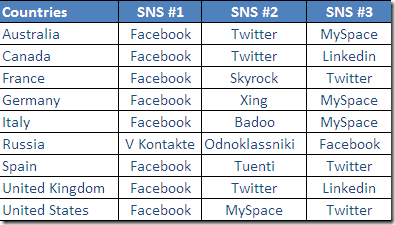
Also of interest in this table, showing the three most popular social networking services in a number of countries. Here in Australia, Facebook dominates, with Twitter in second place, with MySpace hanging on in third; it’s interesting that, despite the hype and media visibility, MySpace still remains number two in the US, while LinkedIN ranks higher in the UK and Canada.
Digital Culture Links: May 24th 2010
Largely Lost-centric links for May 24th 2010:
- Lost Finale: What the Web Wasn’t Made For [Mashable] – Why I’ll be off most social media today: “Those two wonderful facets of the web “” on-demand viewing and instant communication between fans “” tonight become a double-edged sword. The Lost Finale will be shown at 9pm ET on the East Coast, and 9pm PT on the West Coast. These time zone delays are the antithesis of what the web is about: Instant communication. The web is the perfect platform for the spread of breaking news, rumor, and those facts that corporations and politicians would rather keep quiet. In short: blogs, Facebook and Twitter make the spread of information immediate. But the web doesn’t understand the concept of the “spoiler”: The kind of information you’d like to avoid until a specific date or time. A TV blog can’t set its RSS feeds to be delivered later to the West Coast than the East. A Facebook update doesn’t get held back until you’ve watched the finale on your DVR. Your phone doesn’t know to block all Lost-related Tweets until you’ve watched the final episode.”
- Final episode Lost in transmission [WA Today] – Australian broadcasting is indeed, Lost, but not in a good way: “AT 2PM AEST today the final episode of supernatural drama Lost will be broadcast simultaneously in eight countries. Fans in the US, Canada, Britain, Italy, Spain, Portugal, Israel and Turkey will sit down as one to discover how the big questions in one of television’s most diabolically complicated shows are resolved. The international simulcast aims to stave off piracy, while attracting viewers worldwide before spoilers hit the web. But not in Australia. Channel Seven will not screen the 2½-hour finale until 8.30pm Wednesday. […] ‘Ridiculous,” says comedian Wil Anderson, a Lost die-hard. ”If I was going to watch it on Wednesday, I could not go on the internet at all for two days. I will definitely have watched it by Wednesday.” Many Australian Lost fans have left free-to-air television for an alternate viewing reality, downloading, to join in discussions online…”
- Ahead of ‘Lost’ Finale, Fans Shut Off Virtual Hints [NYTimes.com] – “Erin Farley has her plans for Sunday all laid out. Two hours before the last episode of “Lost” is broadcast three time zones away, she will shut down her home Internet connection. TweetDeck? Off. Facebook? Off. Her cellphone? Stashed out of reach. “I’ll turn off the whole Internet just to avoid having anything spoiled,” said Ms. Farley, a 31-year-old freelance writer in Portland, Ore. “I don’t want to ruin the surprise.” The Internet in general, and social media like Twitter in particular, can be a minefield for those who are trying to keep themselves in the dark about an event or show so they can enjoy it later. When the Olympics and Grammy Awards are time-delayed, for example, armchair critics chattering about the wins and losses online can destroy the suspense in an instant. […] people who don’t live on the East Coast, where Lost is shown first, are especially at risk for online spoilers. Overseas fans may have to wait days for a local broadcast – several years in Internet time”
- Lost bows out – after 121 baffling episodes – with 5am TV simulcast to beat plot spoilers [Television & radio | The Guardian] – Closer to non-sporting global television events: “Early on Monday morning [UK time] , millions of Lost fans will be hoping that the mysteries of the US drama’s fictional island accumulated over five years are finally revealed when the show closes in a unique broadcasting event. The finale will be simulcast on ABC in the US and by seven broadcasters around the world. Lost fans in the UK will be switching on Sky1 at 5am on Monday for the two-and-a-half-hour climax to six series, and 121 episodes, of baffling TV. Fans in Italy, Spain, Portugal, Israel, Turkey, Canada, as well as the UK, will see the show at the same time it is aired by ABC on America’s west coast. The time lag between broadcast in America and in the UK used to be six months or more, but has been narrowing for the most popular imports to counter DVD piracy and illegal downloads. Sky1 has been broadcasting this year’s final series of Lost on Friday nights “” five days after its US Sunday evening premiere on ABC.”
- LOST re-enacted by Cats in 1 minute.
- Fan-made Lost Finale Trailer
- Facebook, MySpace Confront Privacy Loophole [WSJ.com] – “Facebook, MySpace and several other social-networking sites have been sending data to advertising companies that could be used to find consumers’ names and other personal details, despite promises they don’t share such information without consent. The practice, which most of the companies defended, sends user names or ID numbers tied to personal profiles being viewed when users click on ads. After questions were raised by The Wall Street Journal, Facebook and MySpace moved to make changes. By Thursday morning Facebook had rewritten some of the offending computer code. Advertising companies are receiving information that could be used to look up individual profiles, which, depending on the site and the information a user has made public, include such things as a person’s real name, age, hometown and occupation.” [Also see Benjamin Edelman’s analysis.]
- PAC-MAN rules! [Official Google Blog] – After their first interactive logo, celebrating Pac-Man’s 30th birthday, Google makes their homage game available permanently: “We’ve been overwhelmed “” but not surprised 🙂 “” by the success of our 30th anniversary PAC-MAN doodle. Due to popular demand, we’re making the game permanently available at www.google.com/pacman. Thanks to NAMCO for helping to make this wonderful collaboration happen. Enjoy!”
- Watching for Iron Sky [The Chutry Experiment ] – Useful introduction to the crowd-sourced film Iron Sky (coming some time 2011) for Web 207.
Digital Culture Links: April 20th 2010
Links for April 19th 2010 through April 20th 2010:
- Media Watch: A Lesson in Facebook Friends (19/04/2010) [ABC TV] – Media Watch piece about two Warwich (QLD) teachers whose private Facebook photos of themselves dressed in supposedly suggestive school uniforms got them suspended from their jobs after the photos were posted in the local newspaper. It seems the photos were lifted from private Facebook accounts and that the journalists who ‘uncovered’ the story were actually Facebook friends with one of the two teachers they exposed. A suitable reminder that ‘friend’ isn’t always the best word for a social network connection! (The two teachers are now suing the journalists in question.)
- Teens and Mobile Phones – Report April 2010 [Pew Research Center’s Internet & American Life Project] – “Daily text messaging among American teens has shot up in the past 18 months from 38% of teens texting friends daily in February of 2008, to 54% of teens texting daily in September 2009. And its not just frequency – teens are sending enormous quantities of text messages a day. Half of teens send 50 or more text messages a day, or 1,500 texts a month and one in three send more than 100 texts a day, or more than 3,000 texts a month. Older teen girls ages 14-17 lead the charge on text messaging, averaging 100 messages a day for the entire cohort. The youngest teen boys are the most resistant to texting – averaging 20 messages per day.”
- Facebook Now Commands 41% of Social Media Traffic – STATS [Mashable] – “Facebook and YouTube are displacing rivals and taking over the social web, according to data we’ve just received from comScore. In addition to showing massive and continued traffic growth throughout 2009 and the beginning of 2010, Facebook and YouTube continued to capture the highest volume of social web traffic. Twitter also garnered a ton of mainstream attention, helping the company increase the number of visitors to its site by fivefold over the course of the year. […] Taking a look at the unique visitors charts, we see the widespread migration from MySpace to Facebook even more clearly. As of March 2010, Facebook traffic made up 41% of all traffic on a list of popular social destinations. MySpace was in second place, capturing around 24% of traffic. Gmail had 15%, and Twitter had 8%. However, during the same period in 2009, MySpace was in the lead with 38% of site visits over Facebook’s 33%.” (Original post has some useful graphs, albeit without a scale.)
- How Tech Start-ups Like Foursquare and Meetup Are Tring to Overthrow Old Media and Build a Better New York [New York Magazine] – Long article from Doree Shafrir about the tech start-up culture that has gripped New York city. The featured start-up is definitely Foursquare, and there are plenty of quotes about the role of start-ups in relation to tech giants like Google and Yahoo. There is some sense that the realm of start-ups is moving toward a new tech bubble, but the dominant business model still seems to be: get popular, get the eyeballs, and then let Yahoo and Google (and maybe Microsoft) bid to buy your business.

Tama Leaver dot Net by Tama Leaver is licensed under a Creative Commons Attribution-NonCommercial-ShareAlike 4.0 International License.