Home » teaching and learning (Page 2)
Category Archives: teaching and learning
Creative Commons Roadshow: Perth, September 2 2010

Want to learn more about the Creative Commons? Want to hear about the latest development nationally and beyond? Want to hear from Perth folks who’ve been using the Creative Commons as part of education, the creative industries and even government? Then the Creative Commons Roadshow is for you and, for the first time in ages, the show’s coming to Perth.
Date: 2 September 2010.
Times: 10.00 am – 3.30 pm.
Venue: State Library of Western Australia, Alexander Library Building, Perth Cultural Centre, Perth
You can check out the program here; the exact speakers are still being finalised and will be added once the details are sorted, but I’ll definitely be talking about the Creative Commons in Education during the local champions segment from 1-2. If you’re interested, please come along: it’s a free event, all you need to do is register here (and please try and indicate your areas of interest, to the CC Team know which topics to focus on during the afternoon discussion groups).
I really enjoyed being part of the Building an Australasian Commons event that the Creative Commons Australia ran in Brisbane in 2008, but it’s even better to the CC team touring the country and I hope lots of Perth folks will come and hear how Creative Commons licensing and ideas can enrich your learning, sharing, creating and more!
Update: Here’s the program for the day …
CC Roadshow – Perth – Program
Developing a Web Presence During Candidature
I gave a short seminar today on the topic of developing a web presence during candidature. Honours, masters and doctoral students increasingly need to be aware of the tools and conventions that most directly allow them to be part of their scholarly field online. Hopefully this presentation gave some students here at Curtin some beginning ideas. I fear the slides are somewhat less useful without the presenter, but on the off chance they’re useful to anyone, here you go:
As always, comments are most welcome.
State of the Internet (in 4 minutes …)
As I welcome 300 students into Web Communications 101 at Curtin University today (both on-campus and via Open Universities Australia), my mind is already wandering to lectures and finding engaging ways to present the material. With that in mind, there are some nice infographics in this 4 minute video by Jesse Thomas which gives a wrap-up of the ‘State of the Internet’ (a la 2009):
JESS3 / The State of The Internet from Jesse Thomas on Vimeo.
Of course, 2009 internet stats are already getting dated, but the video is very pretty! 🙂
The Creative Commons: An Overview for Educators
[This post was originally published in Screen Education, 50, Winter 2008, pp. 38-42. It is reproduced here with permission. The article was (and is) aimed at media teachers in Australia, but hopefully may be of use more broadly, too.]
As teaching media and, more to the point, teaching media literacies becomes more and more central in both K-12 and tertiary settings, one of the biggest challenges is the gargantuan monolith of copyright. By copyright, I don’t necessarily mean teaching how copyright works – although that certainly isn’t the most straight forward process – but of more difficulty are the roadblocks that copyright laws puts in place. Immediately some canny readers will retort that most Australian schools and universities have access to particular exceptions which allow students to access and use material which, in any other context, falls under the rubric of All Rights Reserved. These exceptions are certainly very useful, but for the purposes of this article I’m relying on the notion that to be truly literate, skills must be transferable to the world outside of education. After all, if we taught our students to write and spell but told them they couldn’t use the alphabet outside of school grounds, basic literacy for all would never have caught on!
Media, of course, doesn’t have just one alphabet; as an idea, in practice, and even the literal meaning of the word reminds us that media is multiple. That multiplicity holds particular challenges for education. How, for example, do we teach students to integrate sound, still images, moving images and text without spending enormous amounts of time creating each of these media forms individually? One option is to teach the theory behind media production without including practical elements. However, as contemporary pedagogical theory and most practicing educators would agree, the best way to help students fully understand and engage with a particular concept or area is to put that notion into practice. It follows, then, that while media literacies can be taught by just analysing and critiquing films, television and video, often the most profound way to engage students in developing critical understanding of the media is when students create their own. So, what’s needed then is access to media which students can use, adapt, remix and build upon which isn’t All Rights Reserved. Sure there’s material that’s in the public domain and has no copyright restrictions, but it takes a very long time for most media to enter the public domain these days (different media forms take different lengths of time, but 70 years or longer is the length that film, television and music remain off limits). More to the point, even though copyright is automatically assigned as soon as a work is made these days, many creators want others to be able to re-use their work in particular ways. That’s where the Creative Commons organisation becomes important, along with the range of copyright licenses they’ve developed which can allow creators to be a lot more specific about how their creative work can be re-used following the principle of Some Rights Reserved.
What Is It?
In a nutshell, the Creative Commons organisation began in 2001 with the explicit mission of trying to make innovation and creativity easier for the many people who create media which, to some extent, builds upon existing work. They recognised that because authors of creative work had only two choices when creating a piece of media – either following the All Rights Reserved model of full copyright or giving up any and all rights and putting their work in the Public Domain – these limited options meant most people went along with All Rights Reserved because they weren’t prepared to give up all of their rights as creators. Meanwhile, many authors said that they’d happily let others use portions of their work in specific ways – and when directly contacted often gave others explicit permission to do just that – but many people argued that a system which let authors say which freedoms they’d give to others would be make it a thousand times easier for new creative works to be made, remixing, mashing or borrowing from previous work. And that’s exactly what the Creative Commons organisation has done: they’ve developed a series of licenses that can let authors make clear what they’re happy for other people to do with that author’s work. While standard copyright notices make explicit what can’t be done with a particular work, Creative Commons licenses allow people to specify what can be done.
How Does It Work?
The Creative Commons organisation provides a set of simple-to-use tools which let authors specify the sort of things they will and won’t let other people do with their creative work. The fundaments of the Creative Commons licenses are these four elements:
- Attribution (BY): Attribution basically means that the author of a work must be acknowledged by anyone who uses that work in any way in the future.
- Non-Commercial (NC): Non-commercial simply means that the author’s work can be re-used but not for commercial purposes – ie you can’t make money selling this work as a whole or a derivative part of it in a new work.
- No Derivatives (ND): No derivatives means that you can’t alter the work and can only redistribute verbatim copies (so, for example, if it was a song you could download it, listen to it and share it, but you couldn’t take a sample from the song to use in your own work).
- Share-Alike (SA): Share-Alike specifies that any derivative works (ie a new work which includes this work in part or in whole) must be licensed in exactly the same way (so if the original license was a Creative Commons Attribution Share-Alike license, then the new work created must use exactly the same licensing conditions).
These elements can thus be combined in different ways to form six possible Creative Commons licenses:
- Attribution: The work can be shared, sampled, re-mixed and so on as long as the original author of a work is acknowledged.
- Attribution, No Derivatives: The original author of a work must be acknowledged and no derivative works can be created using this piece (ie it can’t be sampled, bits can’t be used in new works).
- Attribution, Non-Commercial, No Derivatives License: Same as the previous license but with the extra stipulation that the work cannot be sold or distributed in any commercial manner.
- Attribution, Non-Commercial License: As long as authorship is acknowledged, the work can be used in any non-commercial way, including being sampled, remixed and so forth.
- Attribution, Non-Commercial, Share-Alike License: The same term as above, but with the added stipulation and all derivative works must be licensed using exactly the same terms.
- Attribution, Share-Alike License: So long as the original author of the work is acknowledged, it can be used, sampled and re-mixed as long as new works containing this piece are licensed under exactly the same terms.
While these licenses might sound a little confusing at times, it’s useful to think of them as the engine of the Creative Commons car: they need to be there to make everything work, but you don’t have to understand them in great detail in order to drive. Indeed, Creative Commons have set up a very simple website to help people choose a license, which is at http://creativecommons.org/license/. To choose a license, people just need to answer whether they want to allow commercial uses of their work and whether the want to allow modifications of their work and the website shows you the most appropriate license, complete with detailed instructions on how to add this license to your work (where your work can be anything from a document to an mp3 music file to a whole website).
But Isn’t Creative Commons American?
While the Creative Commons organisation is, indeed, based in the US, the great news is that there are local Creative Commons teams in many countries, including Australia. Apart from being extremely loud and clear advocates for Creative Commons across the board, from education though to entertainment, Creative Commons Australia (CCau) have also successfully implemented a national version of the Creative Commons licenses. This means that as educators, we can be 100% sure that Australian Creative Commons licenses will definitely be recognised in the Australia legal system. (This is especially significant since so many of the frustrating ambiguities in this area come from the fact that copyright laws differ across national boundaries.) When selecting a Creative Commons license using the website mentioned above, it’s also possible to simply select which jurisdiction you want to the license to fall under (so for Australia students and educators, ‘Australia’ is probably your best bet!).
Creative Commons in the Classroom
So, as an example, lets say that you’re a teacher of an upper secondary media class and you’ve asked the students to work in teams to create a short, topical, news report in a video format. They’ve got video cameras and editing software so can shoot the majority of the story themselves, but find during editing they need a few more bits of media: some music to jazz up the opening sequence, a couple of still images to use as cutaways during an interview, and some historical footage of the Olympic games (these students are doing a report on the Olympics, it turns out). Moreover, these students are hoping to post their news report on YouTube when they’re finished, showing it to family and friends. So, they’re going to need sources of secondary material that they have permission to re-use.
To find material, the students are already ahead of the game and head directly to the Creative Commons search portal (http://search.creativecommons.org) and they find some ‘fanfare’ music perfect for their opening sequence (the music has a Creative Commons Attribution license). Then the students click on a separate tab to search for images and find two amusing little images of the Chinese Olympics Mascots (Fuwa) and these are licensed using a Creative Commons, Attribution, Non-Commercial, Share-Alike license. Finally, the students head over to the Internet Archive (www.archive.org) and find some historical footage of the first ever Olympic Torch relay from the 1936 Olympics in Germany; this footage is old enough to be in the public domain. These secondary materials are added in and a brilliant story about Australia’s anticipation of the Olympic games is completed. Since their teacher has explained a bit about copyright and the Creative Commons, these students scan their secondary media and realise that with a combination of one public domain media piece, one using a Creative Commons Attribution license, and two using Creative Commons, Attribution, Non-Commercial, Share-Alike licenses, that their resulting news report will also need to be also licensed using a Creative Commons, Attribution, Non-Commercial, Share-Alike. The students hop onto the Creative Commons website, find a nifty little graphic file detailing their license, and place it as the final frame of their Olympic News Story.
Now, with a news story which can legally be re-distributed (as long as they don’t make money off it), this group of students post their video on YouTube. Their parents and peers are deeply impressed as it’s a great news story, and their clear understanding of copyright looks very professional! More to the point, a few weeks later the group of students get an email telling them that another group of students on the other side of the planet, in Canada, have included a clip from this Olympic News Report in a new student project in Canada, just as the Creative Commons license on that video allows them to do. Back in Australia the students and their teacher glow with pride knowing that they’ve not only created a wonderful news story, but it has also contributed to the global community and has been creatively built upon by others!
Introducing Creative Commons to Students
So you’re convinced about the value of Creative Commons licensing but can’t work out how to introduce them to your students? Thankfully, the Creative Commons folks have a lot of great media introducing their ethos, practice and licenses, all accessible via http://creativecommons.org/about/. Of particular use are the comic books which explain Creative Commons licenses via a superhero story, and a series of short web-based videos which introduce key Creative Commons ideas and features. Indeed, two of the best of these videos were produced by the Creative Commons Australia team, featuring the quirky animated characters Mayer and Bettle!
Where To Start?
So, you’re ready to give Creative Commons a go in your teaching and learning? Then here’s a few useful websites to get you started:
- www.creativecommons.org – The main website of the Creative Commons organisation with mountains of information.
- search.creativecommons.org – The search engine maintained by the Creative Commons organisation which lets you easily search many different databases for different media forms, all with Creative Commons licenses.
- creativecommons.org.au – The home of Creative Commons Australia and local efforts to promote the use and ethos of Creative Commons down under.
- www.archive.org – The Internet Archive, one of the world’s biggest repositories of historical material, a lot of which is either in the public domain or uses Creative Commons licenses. The Internet Archive has a lot of historical video material.
- www.flickr.com/creativecommons/ – The Creative Commons section of the massively popular photograph-sharing website Flickr has literally millions of different images available under Creative Commons licenses.
Annotated Digital Culture Links: June 8th 2009
Links for June 5th 2009 through June 8th 2009:
- 10 Privacy Settings Every Facebook User Should Know [All Facebook] – Some useful advice and further evidence that Facebook’s privacy settings are far too complicated!
- A Map Of Social (Network) Dominance [TechCrunch] – Facebook planet cometh … “Even on the Web, world dominance must be achieved one country at a time. While Facebook has long been the largest social network in the world, and should soon pass MySpace in the U.S., it is not the largest social network in every country. The map above created by Vincenzo Cosenza resembles more a game of Risk, with Facebook sweeping across the globe from the West.”
- Thomson Reuters Lawsuit Dismissed [The Quintessence of Ham] – “I’m delighted to announce that this morning the Fairfax Circuit Court dismissed the lawsuit filed against Zotero by Thomson Reuters. … It’s worth noting that even while the lawsuit was underway over the last nine months, Zotero geniuses completed the implementation of such radical new functionality as cloud-based synchronization, shared group libraries, PDF metadata detection, automatic proxy support, live CVs, and much more. And our amazing community performed this heavy lifting all while supporting a user base that has grown into the millions. I can only imagine what the Zotero project will be able to achieve unimpeded!”
Battlestar Book (and Teaching with Facebook Updates?)
For anyone interesting in the convoluted social world of the soon-to-return Battlestar Galactica, you must check out the hilarious Battlestar Book which tells the tale of BSG in Facebook status updates. A snippet:
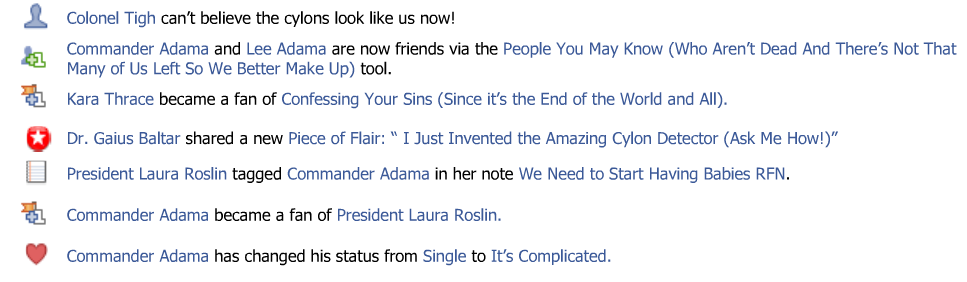
See the full Battlestar Book [Via io9].
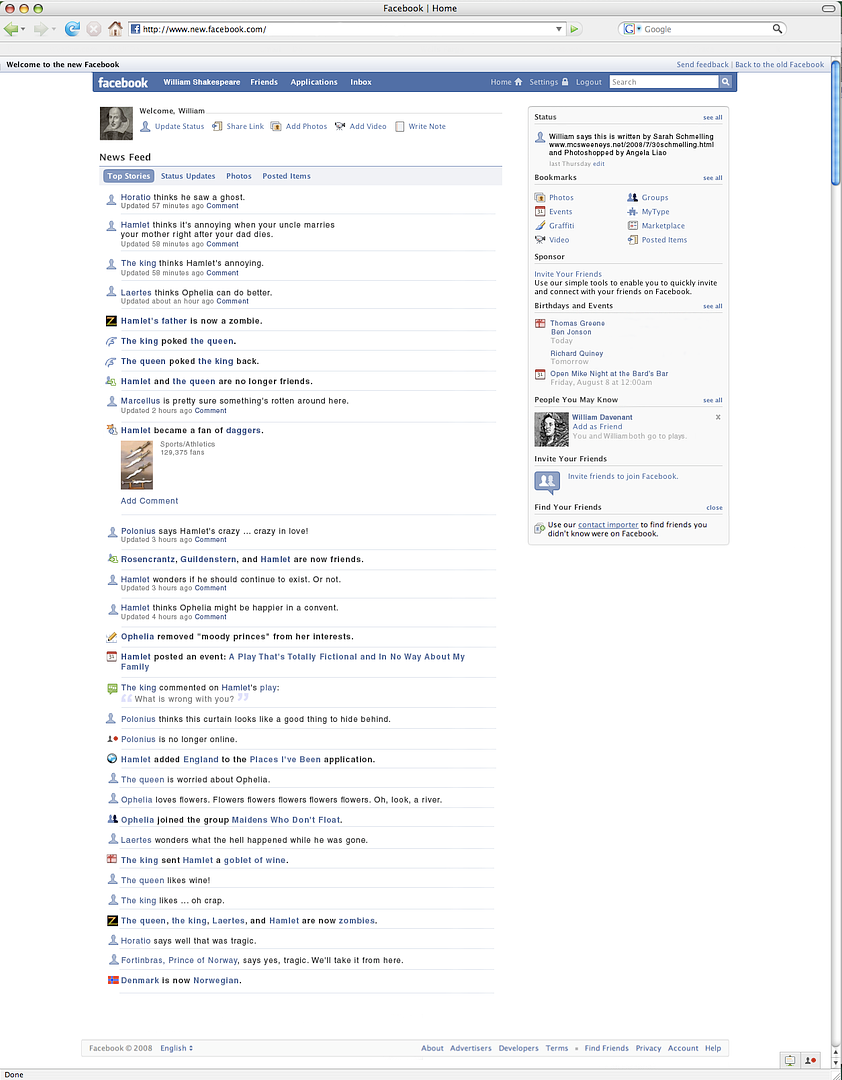
Incidentally, does anyone know of an online generator or tool which can quickly knock out icon-driven status updates like these? After the Battlestar Book and the earlier hilarious Facebook Hamlet, I’m toying with the idea designing a project in which students summarise either a key article or perhaps episode of television using this style. I’m thinking it would get them to think critically about the sort of data Facebook gathers and shares about people while also encouraging students to brush up on their skills in terms of finding the key points and ideas in texts. Or is that nuts?

Tama Leaver dot Net by Tama Leaver is licensed under a Creative Commons Attribution-NonCommercial-ShareAlike 4.0 International License.