Home » Perth
Category Archives: Perth
ABC Perth Spotlight forum: how to protect your privacy in an increasingly tech-driven world
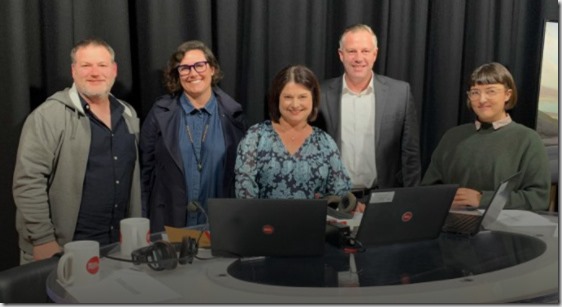
 I was pleased to be part of the ABC Perth Radio’s Spotlight Forum on ‘How to Protect Your Privacy in an Increasingly Tech-driven World‘ this morning, hosted by Nadia Mitsopoulos, and also featuring Associate Professor Julia Powles, Kathryn Gledhill-Tucker from Electronic Frontiers Australia and David Yates from Corrs Chambers Westgarth.
You can stream the Forum on the ABC website, or download here.
Why the McGowan government will have an uphill battle rebuilding trust in the SafeWA app.
QR code contact-tracing apps are a crucial part of our defence against COVID-19. But their value depends on being widely used, which in turn means people using these apps need to be confident their data won’t be misused.
That’s why this week’s revelation that Western Australian police accessed data gathered using the SafeWA app are a serious concern.
WA Premier Mark McGowan’s government has enjoyed unprecedented public support for its handling of the COVID-19 pandemic thus far. But this incident risks undermining the WA public’s trust in their state’s contact-tracing regime.
While the federal government’s relatively expensive COVIDSafe tracking app “” which was designed to work automatically via Bluetooth “” has become little more than the butt of jokes, the scanning of QR codes at all kinds of venues has now become second nature to many Australians.
These contact-tracing apps work by logging the locations and times of people’s movements, with the help of unique QR codes at cafes, shops and other public buildings. Individuals scan the code with their phone’s camera, and the app allows this data to be collated across the state.
That data is hugely valuable for contact tracing, but also very personal. Using apps rather than paper-based forms greatly speeds up access to the data when it is needed. And when trying to locate close contacts of a positive COVID-19 case, every minute counts.
But this process necessarily involves the public placing their trust in governments to properly, safely and securely use personal data for the advertised purpose, and nothing else.
Australian governments have a poor track record of protecting personal data, having suffered a range of data breaches over the past few years. At the same time, negative publicity about the handling of personal data by digital and social media companies has highlighted the need for people to be careful about what data they share with apps in general.
The SafeWA app was downloaded by more than 260,000 people within days of its release, in large part because of widespread trust in the WA government’s strong track record in handling COVID-19. When the app was launched in November last year, McGowan wrote on his Facebook page that the data would “only be accessible by authorised Department of Health contact tracing personnel”.
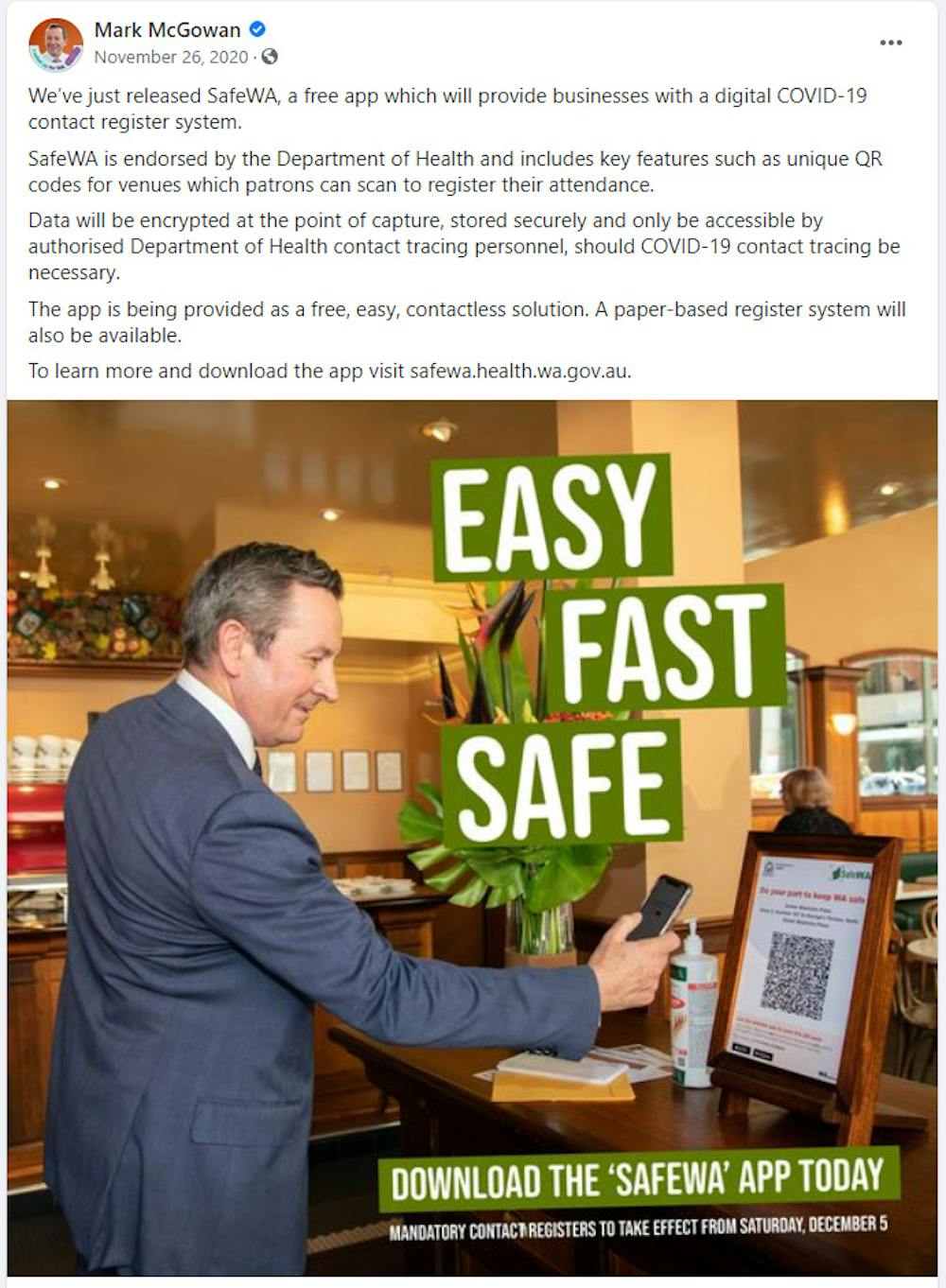
Mark McGowan’s Facebook Page
In spite of this, it has now emerged that WA Police twice accessed SafeWA data as part of a “high-profile” murder investigation. The fact the WA government knew in April that this data was being accessed, but only informed the public in mid-June, further undermines trust in the way personal data is being managed.
McGowan today publicly criticised the police for not agreeing to stop using SafeWA data. Yet the remit of the police is to pursue any evidence they can legally access, which currently includes data collected by the SafeWA app.
It is the government’s responsibility to protect the public’s privacy via carefully written, iron-clad legislation with no loopholes. Crucially, this legislation needs to be in place before contract-tracing apps are rolled out, not afterwards.
It may well be that the state government held off on publicly disclosing details of the SafeWA data misuse until it had come up with a solution. It has now introduced a bill to prevent SafeWA data being used for any purpose other than contact tracing.
This is a welcome development, and the government will have no trouble passing the bill, given its thumping double majority. Repairing public trust might be a trickier prospect.
Trust is a premium commodity these days, and to have squandered it without adequate initial protections is a significant error.
The SafeWA app provided valuable information that sped up contact tracing in WA during Perth’s outbreak in February. There is every reason to believe that if future cases occur, continued widespread use of the app will make it easier to locate close contacts, speed up targeted testing, and either avoid or limit the need for future lockdowns.
That will depend on the McGowan government swiftly regaining the public’s trust in the app. The new legislation is a big step in that direction, but there’s a lot more work to do. Trust is hard to win, and easy to lose.
Tama Leaver, Professor of Internet Studies, Curtin University
This article is republished from The Conversation under a Creative Commons license. Read the original article.
The Future Of Children’s Online Privacy
I was delighted to join Dr Anna Bunn, Deputy Head of Curtin Law School, and the Future Of team for a podcast interview all about Children’s Online Privacy.
The half hour podcast is online here in various formats, including shownotes, or embedded in this post:
We discuss:
What’s the impact of parents sharing content of their children online? And what rights do children have in this space?
In this episode, Jessica is joined by Dr Anna Bunn, Deputy Head of Curtin Law School and Tama Leaver, Professor of Internet Studies at Curtin University to discuss “sharenting” – the growing practice of parents sharing images and data of their children online. The three examine the social, legal and developmental impacts a life-long digital footprint can have on a child.
- What is the impact of sharing child-related content on our kids? [04:08]
- What type of tools and legal protections would you like to see in the future to protect children? [16:30]
- At what age can a child give consent to share content [18:25]
- What about the right to be forgotten [21:11]
- What’s best practice for sharing child-related content online? [26:01]
Targeted PhD Projects with Scholarship in Internet Studies @ Curtin Uni (to start 2021, applications close 1 Sept 2020)
Opportunities exist to apply for a range of targeted PhD scholarships located within the Internet Studies Discipline at Curtin University. The window of opportunity for these is short, so if you’re interested, please email the contact person listed in the specific project pages as soon as you’re able!
If folks could share these opportunities with current and recent Masters and Honours completions (and those completing this year), we would be grateful!
The projects available:
1. An Ethnography of Influencers and Social Justice Cultures https://scholarships.curtin.edu.au/Scholarship/?id=4270
2. Analysing Virtual Influencers: Celebrity, Authenticity and Identity on Social Media https://scholarships.curtin.edu.au/Scholarship/?id=4324
3. Climate Action and the Internet https://scholarships.curtin.edu.au/Scholarship/?id=4285
4. Digital Disability and Disability Media https://scholarships.curtin.edu.au/Scholarship/?id=4318
5. Digital Disability Inclusion across the Lifecourse https://scholarships.curtin.edu.au/Scholarship/?id=4291
6. Digital intimacies and social media https://scholarships.curtin.edu.au/Scholarship/?id=4286
7. Diversity, Equity and Impact: Exploring the Open Knowledge performance of Universities https://scholarships.curtin.edu.au/Scholarship/?id=4341
8. Ethical and Sociocultural Impacts of AI/Autonomous Machines as Communicators https://scholarships.curtin.edu.au/Scholarship/?id=4360
9. Tracking Australia’s Research Response to the COVID Pandemic https://scholarships.curtin.edu.au/Scholarship/?id=4347
10. The Audio Internet https://scholarships.curtin.edu.au/Scholarship/?id=4322
To apply for these project opportunities applicants must submit an email to the contact Project lead listed on the project listing. The email must include their current curriculum vitae, a summary of their research skills and experience and the reason they are interested in this specific project.
The Project Lead will select one preferred applicant for this project and complete a Primary reference on their behalf.
After confirmation from the Project Lead that they will receive a primary reference for this project the applicant must submit an eApplication [https://study.curtin.edu.au/applying/research/#apply] for admission into the applicable HDR course no later than 1st September 2020.
All applicants must send an external referee template [https://scholarships.curtin.edu.au/wp-content/uploads/sites/8/2020/07/RTP2021-Round-2-External-Referee-Report.pdf] to their chosen external reference.
All references are confidential and must be submitted by the referee directly to HDRSCH-applications@curtin.edu.au no later than 1st September 2020.
Scholarship applications submitted without a primary reference or a completed application for admission will be considered incomplete.
For further information on the application process or for more RTP2021 Round 2 scholarship project opportunities visit: https://scholarships.curtin.edu.au/hdr-scholarships-funding/rtp-policy/
Thanks for sharing!
Talking about Coronavirus/covid19 and misinformation online
I spoke with Hilary Smale on ABC Perth Radio’s Focus program this morning about Coronavirus/ COVID19 and the challenges of misinformation (or what’s now called an ‘infodemic’ on social media). You can hear the program here: https://www.abc.net.au/radio/perth/programs/focus/corona-reset/12046430 (I’m on at about 29.30 in the recording).
My main advice to all social media users remains: slowing down and checking in with known credible sources *before sharing* is vital in stopping misinformation spreading rapidly online (even that sharing is done with the best of intentions).
Locally, the most reliable source remains the WA Health Department, and their specific page with up-to-date COVID19 information, here: https://ww2.health.wa.gov.au/Articles/A_E/Coronavirus
Their official daily snapshot comes in a particularly shareable visual form:
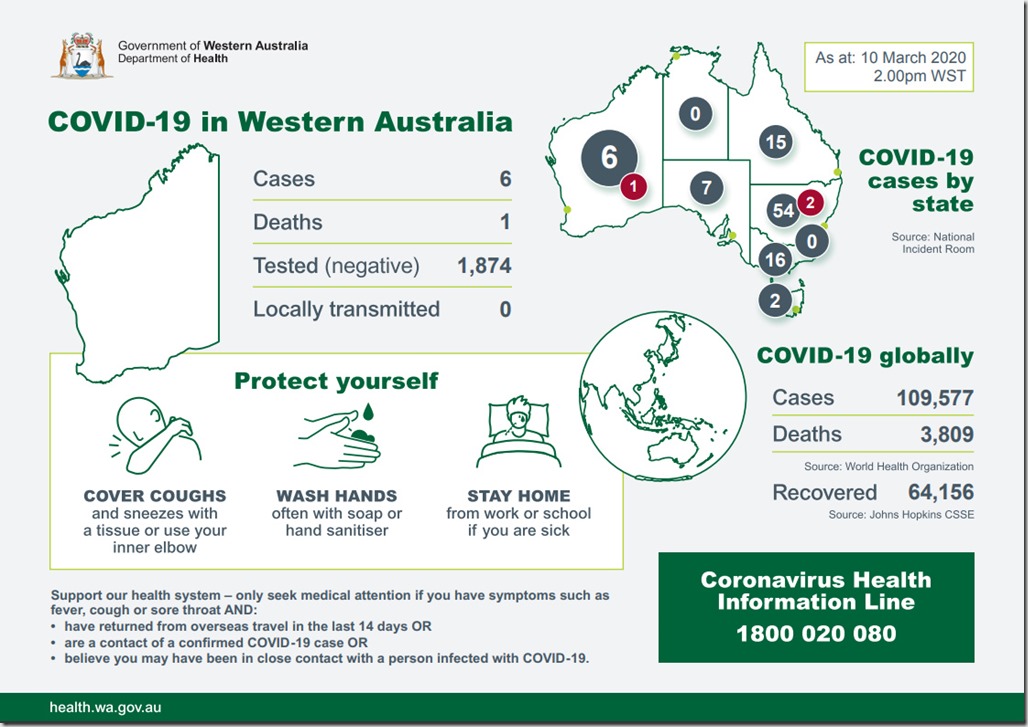
[Example of WA Health Department COVID-19 Infographic for 10 March 2020.]
Nationally, the Australian Government’s Department of Health website remains the best national resource for reliable information (despite, to be fair, a really unfriendly website): https://www.health.gov.au/health-topics/novel-coronavirus-2019-ncov.
Finally, the World Health Organization (WHO) not only provides a reliable global overview but also, vitally, addresses many online rumours about COVID-19 and answers with known facts! https://www.who.int/emergencies/diseases/novel-coronavirus-2019/advice-for-public/myth-busters
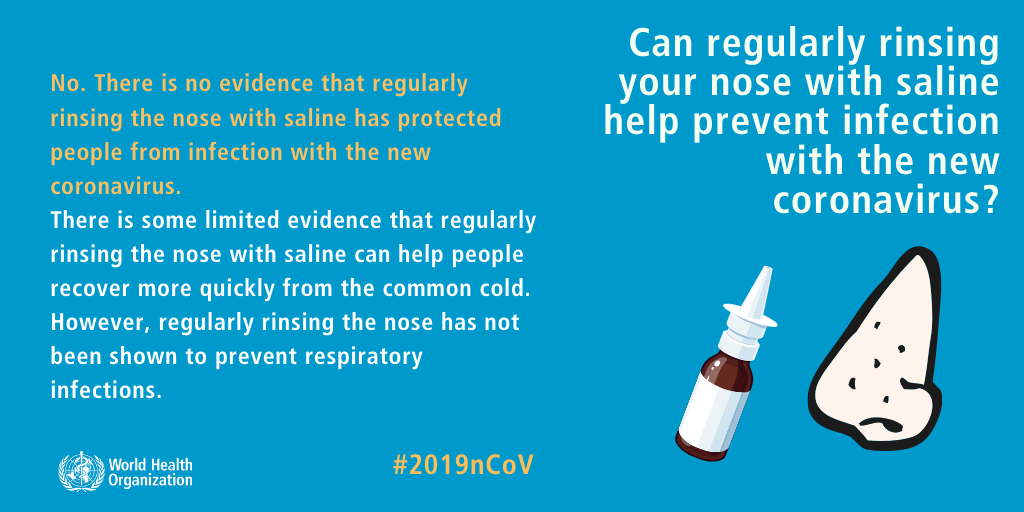

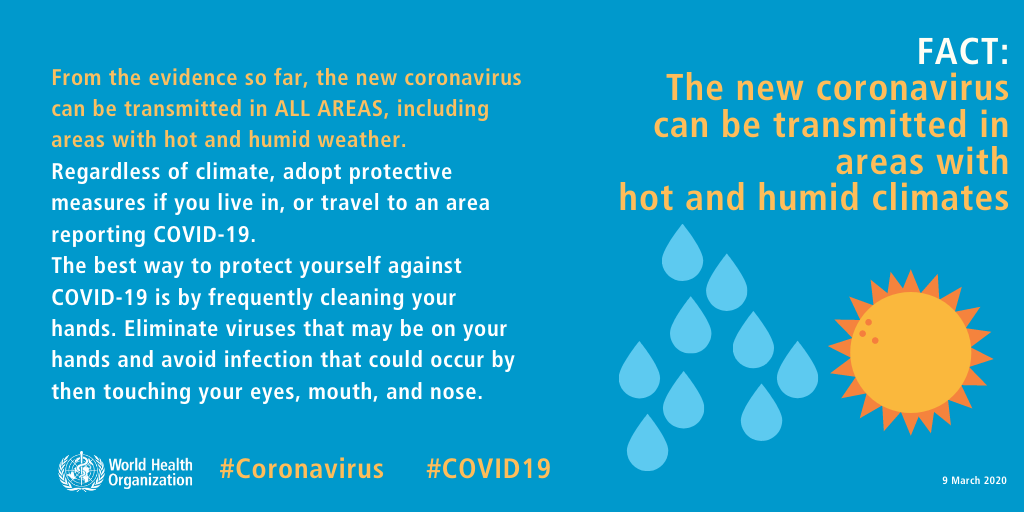
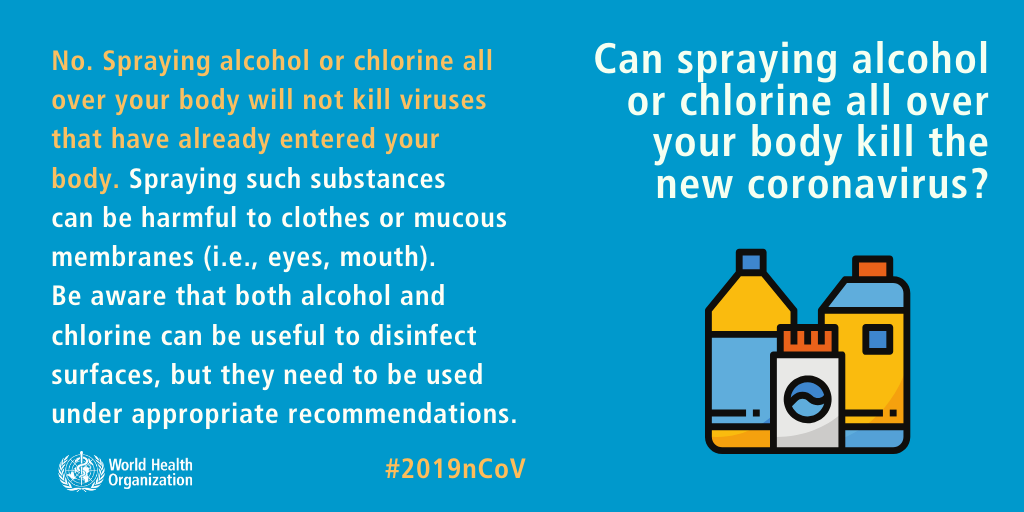
[Examples of World Health Organisation Mythbusting Images, 10 March 2020.]
Three Upcoming Infancy Online-related events
Over the next month, I’m lucky enough to be involved in three separate events focused on infancy online, digital media and early childhood. The details “¦
[1] Thinking the Digital: Children, Young People and Digital Practice – Friday, 8th September, Sydney – is co-hosted by the Office of the eSafety Commissioner; Institute for Culture and Society, Western Sydney University; and Department of Media and Communications, University of Sydney. The event opens with a keynote by visiting LSE Professor Sonia Livingstone, and is followed by three sessions discussing youth, childhood and the digital age is various forms. While Sonia Livingstone is reason enough to be there, the three sessions are populated by some of the best scholars in Australia, and it should be a really fantastic discussion. I’ll be part of the second session on Rights-based Approaches to Digital Research, Policy and Practice. There are limited places, and a small fee, involved if you’re interested in attending, so registration is a must! To follow along on Twitter, the official hashtag is #ThinkingTheDigital.
The day before this event, Sonia Livingston is also giving a public seminar at WSU’s Parramatta City campus if you’re in able to attend on the afternoon of Thursday, 7th September.
[2] The following week is the big Digitising Early Childhood International Conference 2017 which runs 11-15 September, features a great line-up of keynotes as well as a truly fascinating range of papers on early childhood in the digital age. I’m lucky enough to be giving the conference’s first keynote on Tuesday morning, entitled ‘Turning Babies into Big Data–And How to Stop it’. I’ll also be presenting Crystal Abidin and my paper ‘From YouTube to TV, and Back Again: Viral Video Child Stars and Media Flows in the Era of Social Media‘ on the Wednesday and running a session on the final day called ‘Strategies for Developing a Scholarly Web Presence during a Higher Degree & Early Career’ as part of the Higher Degree by Research/Early Career Researcher Day. It should be a very busy, but also incredibly engaging week! To follow tweets from conference, the official hashtag is #digikids17.
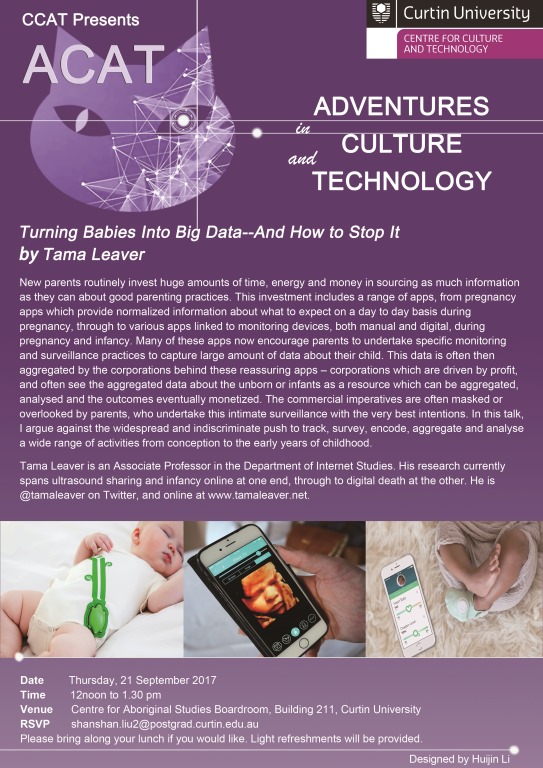
[3] Finally, as part of Research and Innovation Week 2017 at Curtin University, at midday on Thursday 21st September I’ll be presenting a slightly longer version of my talk Turning Babies into Big Data””and How to Stop It in the Adventures in Culture and Technology series hosted by Curtin’s Centre for Culture and Technology. This is a free talk, open to anyone, but please either RSVP to this email, or use the Facebook event page to indicate you’re coming.

Tama Leaver dot Net by Tama Leaver is licensed under a Creative Commons Attribution-NonCommercial-ShareAlike 4.0 International License.