Home » participatory culture
Category Archives: participatory culture
Born Digital? Presence, Privacy, and Intimate Surveillance
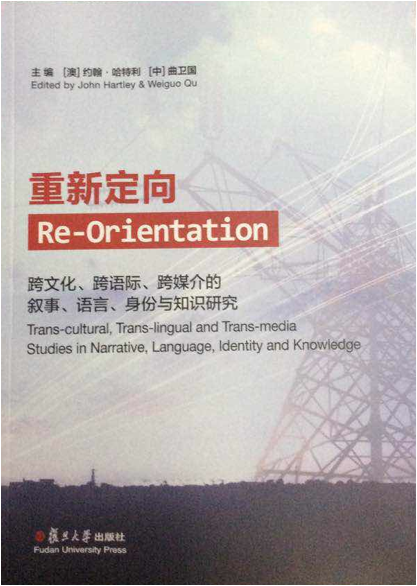 I’m pleased to note that my chapter ‘Born Digital? Presence, Privacy, and Intimate Surveillance‘ is out now in the Re-Orientation: Trans-lingual, Trans-cultural, Trans-media. Studies in narrative, language, identity, and knowledge collection edited by John Hartley and Weiguo Qu for Fudan University Press. The collection is the outcome of the fantastic Culture+8: New Times, New Zones symposium in 2014 which explored cultural synergies between different countries and locations in the +8 timezone which include Perth where we hosted the event, and, of course, China.
My chapter is a key part of my Ends of Identity project; here I start to think about ‘intimate surveillance’ which is where parents and loved ones digitally document and survey their offspring, from sharing ultrasound photos to tracking newborn feeding and eating patterns. Intimate surveillance is a deliberately contradictory term: something done with the best of intentions but with possibly quite problematic outcomes. Here’s the full abstract:
The moment of birth was once the instant where parents and others first saw their child in the world, but with the advent of various imaging technologies, most notably the ultrasound, the first photos often precede birth (Lupton, 2013). In the past several decades, the question is no longer just when the first images are produced, but who should see them, via which, if any, communication platforms? Should sonograms (the ultrasound photos) be used to announce the impending arrival of a new person in the world? Moreover, while that question is ostensibly quite benign, it does usher in an era where parents and loved ones are, for the first years of life, the ones deciding what, if any, social media presence young people have before they’re in a position to start contributing to those decisions.
This chapter addresses this comparatively new online terrain, postulating the provocative term intimate surveillance, which deliberately turns surveillance on its head, begging the question whether sharing affectionately, and with the best of intentions, can or should be understood as a form of surveillance. Firstly, this chapter will examine the idea of co-creating online identities, touching on some of the standard ways of thinking about identity online, and then starting to look at how these approaches do and do not explicitly address the creation of identity for others, especially parents creating online identities for their kids. I will then review some ideas about surveillance and counter-surveillance with a view to situating these creative parental acts in terms of the kids and others being created. Finally, this chapter will explore several examples of parental monitoring, capturing and sharing of data and media about their children, using various mobile apps, contextualising these activities not with a moral finger-waving, but by surfacing specific questions and literacies which parents may need to develop in order to use these tools mindfully, and ensure decisions made about their children’s’ online presences are purposeful decisions.
The chapter can be read here.
Olympic Trolls: Mainstream Memes and Digital Discord?
 The themed issue of the Fibreculture journal on Trolls and the negative space of the internet has been released, with a raft of amazing articles, including my piece ‘Olympic Trolls: Mainstream Memes and Digital Discord?‘ looking at the mainstreaming of some techniques associated with trolling, using a case study of a Facebook group lamenting the quality of Channel 9’s coverage of the 2012 Olympics.
The abstract:
While the mainstream press have often used the accusation of trolling to cover almost any form of online abuse, the term itself has a long and changing history. In scholarly work, trolling has morphed from a description of newsgroup and discussion board commentators who appeared genuine but were actually just provocateurs, through to contemporary analyses which focus on the anonymity, memes and abusive comments most clearly represented by users of the iconic online image board 4chan, and, at times, the related Anonymous political movement. To explore more mainstream examples of what might appear to be trolling at first glance, this paper analyses the Channel Nine Fail (Ch9Fail) Facebook group which formed in protest against the quality of the publicly broadcast Olympic Games coverage in Australia in 2012. While utilising many tools of trolling, such as the use of memes, deliberately provocative humour and language, targeting celebrities, and attempting to provoke media attention, this paper argues that the Ch9Fail group actually demonstrates the increasingly mainstream nature of many online communication strategies once associated with trolls. The mainstreaming of certain activities which have typified trolling highlight these techniques as part of a more banal everyday digital discourse; despite mainstream media presenting trolls are extremist provocateurs, many who partake in trolling techniques are simply ordinary citizens expressing themselves online.
The full paper is freely available online, and as a PDF.
Angry Birds as a Social Network Market
Earlier today my colleague Michele Willson and I ran the ANZCA PreConference Social, Casual, Mobile: Changing Games which went really well, bringing together 17 games scholars from Australia and Canada, including a fantastic keynote by Mia Consalvo and plenary by John Banks.
I also had the opportunity to present today, and the slides and audio from my talk are below:
And here’s the abstract if you’re interested:
The hugely successful franchise Angry Birds by Finnish company Rovio is synonymous with the new and growing market of app-based games played on smartphones and tablets. These are often referred to as ‘casual games’, highlighting their design which rewards short bursts of play, usually on mobile media devices, rather than the sustained attention and dedicated hardware required for larger PC or console games. Significantly, there is enormous competition within the mobile games, while the usually very low cost (free, or just one or two dollars) makes a huge ranges of choices available to the average consumer. Moreover, these choices are usually framed by just one standardised interface, such as the Google Play store for Android powered devices, or the Apple App store for iOS devices. Within this plethora of options, I will argue that in addition to being well designed and enjoyable to play, successful mobile games are consciously situated within a social network market.
The concepts of ‘social network markets’ reframes the creative industries not so much as the generators of intellectual property outputs, but as complex markets in which the circulation and value of media is as much about taste, recommendations and other networked social affordances (Potts, Cunningham, Hartley, & Ormerod, 2008). For mobile games, one of the most effective methods of reaching potential players, then, is through the social attentions and activity of other players. Rovio have been very deliberate in the wide-spread engagement with players across a range of social media platforms, promoting competitive play via Twitter and Facebook, highlighting user engagement such as showcasing Angry Birds themed cakes, and generally promoting fan engagement on many levels, encouraging the ‘spreadability’ of Angry Birds amongst social networks (Jenkins, Ford, & Green, 2013). In line with recognising the importance of engagement with the franchise, Rovio have also taken a very positive approach of unauthorised merchandising and knock-offs, especially in China and South-East Asia. In line with Montgomery and Potts’ (2008) argument that a weaker intellectual property approach will foster a more innovative creative industries in China, rather than attempting to litigate of lock down unauthorised material, Rovio have stated they see this as building awareness of Angry Birds and are working to harness this new, socially-driven market (Dredge, 2012). As Rovio now license everything from Angry Birds plush toys to theme parks, social network markets can be perpetuated even by unauthorised material, which builds awareness and interest in the official games and merchandising in the long run. Far from a standalone example, this paper argues that not only is Rovio consciously situating Angry Birds within a social network market model, but that such a model can drive other mobile games success in the future.
References
Dredge, S. (2012, January 30). Angry Birds boss: “Piracy may not be a bad thing: it can get us more business.” The Guardian. Retrieved from http://www.guardian.co.uk/technology/appsblog/2012/jan/30/angry-birds-music-midem
Jenkins, H., Ford, S., & Green, J. (2013). Spreadable Media: Creating Value and Meaning in a Networked Culture. New York and London: New York University Press.
Montgomery, L., & Potts, J. (2008). Does weaker copyright mean stronger creative industries? Some lessons from China. Creative Industries Journal, 1(3), 245–261. doi:10.1386/cij.1.3.245/1
Potts, J., Cunningham, S., Hartley, J., & Ormerod, P. (2008). Social network markets: a new definition of the creative industries. Journal of Cultural Economics, 32(3), 167–185. doi:10.1007/s10824-008-9066-y
Joss Whedon, Dr. Horrible, and the Future of Web Media?

I’m pleased to announce that my article Joss Whedon, Dr. Horrible, and the Future of Web Media? is finally available. Here’s the abstract:
In the 2007 Writers Guild of America strike, one of the areas in dispute was the question of residual payments for online material. On the picket line, Buffy creator Joss Whedon discussed new ways online media production could be financed. After the strike, Whedon self-funded a web media production, Dr. Horrible’s Sing-Along Blog. Whedon and his collaborators positioned Dr. Horrible as an experiment, investigating whether original online media content created outside of studio funding could be financially viable. Dr. Horrible was a bigger hit than expected, with a paid version topping the iTunes charts and a DVD release hitting the number two position on Amazon. This article explores which factors most obviously contributed to Dr. Horrible’s success, whether these factors are replicable by other media creators, the incorporation of fan labor into web media projects, and how web-specific content creation relates to more traditional forms of media production.
The official version is available in the new issue of Popular Communication (vol 11, no. 2). If you can’t access the article due to the paywall, then there’s an open access pre-print available at Academia.edu.
Facebook, Student Engagement, and the ‘Uni Coffee Shop’ Group
Here are the final slides and audio from Internet Research 13 in MediaCityUK, Salford. My last paper ‘Facebook, Student Engagement, and the ‘Uni Coffee Shop’ Group’ was presented as part of a panel about Facebook and Higher Education which also featured work by my collegues Mike Kent, Kate Raynes-Golide and Clare Lloyd.
The abstract:
While the curriculum, lecturers and tutors teaching Internet Communications via Open Universities Australia (OUA) have been engaging with students for several years using Twitter (see Leaver, 2012), in the past Facebook had been largely left alone since this was viewed as a more casual space where students might interact with each other, but not with teaching staff. However, in the last two years, more and more students have created groups to use Facebook as a discussion space about their units, often attracting a significant proportion of students from that unit. While these groups are important, of even more interest is the establishment of the group called the ‘Uni Coffee Shop’. Unlike the unit-specific groups, the Coffee Shop group, established by two Internet Communications students but open to anyone studying online via OUA, affords group support, social connectivity and a persistent online space for conversation which does not disappear or grow stagnant when students complete a specific unit.
This paper will outline an investigation into the effectiveness of the Uni Coffee Shop group as a student-created space for engagement and informal learning. Three modes of inquiry were used: a textual analysis of the common topics of discussion in the group over several months; a quantitative survey of members of the Coffee Shop group; and several follow-up qualitative interviews with Coffee Shop group members, including the two students who administer the group. In addition, the paper includes the perspectives of teaching staff who have been invited to join the group by students and who, at times, answer specific questions and engage with students in a less formal manner. In detailing the results of these mechanisms, this paper will argue that fostering student-run spaces of engagement using Facebook can be a very effective means to create spaces of engagement and informal learning (Krause & Coates, 2008; Greenhow & Robelia, 2009); the support students give each other can persist over the length of an entire degree; and teaching staff engaging with students in their space, often on their terms, can create a better rapport and a stronger sense of connectivity over the length of a student’s entire degree (and potentially beyond). A student-run Facebook group also provide a space where teaching staff and students can interact using the affordances of Facebook without staff having to explicitly ‘friend’ students (something many staff are reluctant to do for a range of reasons).
References
Greenhow, C., & Robelia, B. (2009). Informal learning and identity formation in online social networks. Learning, Media and Technology, 34(2), 119 – 140.
Krause, K., & Coates, H. (2008). Students’ engagement in first”year university. Assessment & Evaluation in Higher Education, 33(5), 493-505. doi:10.1080/02602930701698892
Leaver, T. (2012). Twittering informal learning and student engagement in first-year units. In A. Herrington, J. Schrape, & K. Singh (Eds.), Engaging students with learning technologies (pp. 97–110). Perth, Australia: Curtin University. Retrieved from http://espace.library.curtin.edu.au/R?func=dbin-jump-full&local_base=gen01-era02&object_id=187303
News and Trolls: Olympic Games Coverage in the Twenty-First Century
I’m at MediaCityUK in Salford for the annual Association of Internet Researchers conference (IR13) and today gave the first of three papers I’m involved with. Today’s was part of a great pre-conference session organised by Holly Kruse. My talk was called “News and Trolls: Olympic Games Coverage in the Twenty-First Century“; it’s very much a work in progress, but the slides are embedded below in case anyone’s interested.
Sadly I didn’t record the audio, so the slides may lack contextualisation.

Tama Leaver dot Net by Tama Leaver is licensed under a Creative Commons Attribution-NonCommercial-ShareAlike 4.0 International License.