Home » mashup (Page 3)
Category Archives: mashup
Avatar = Pocahontas
Check out this outstanding mashup of Avatar & Pocahontas which highlights exactly how derivative the blockbuster’s plot really is:
CFV 426 – Avatar/Pocahontas Mashup FINAL VERSION from Randy Szuch on Vimeo. [Via]

Digital Culture Links: February 17th 2010
Links for February 16th 2010 through February 17th 2010:
- Google admits Buzz social network testing flaws [BBC News] – “Google has admitted to BBC News that testing of its controversial social network Buzz was insufficient. The firm has had to make a series of changes to the service after a ferocious backlash from users concerned about intrusions of privacy. The BBC understands that Buzz was only tested internally and bypassed more extensive trials with external testers – used for many other Google services. Google said that it was now working “extremely hard” to fix the problems. “We’re very early in this space. This was one of our first big attempts,” Todd Jackson, Buzz product manager, told BBC News.”And the line that has everyone going “Duh*: ““We’ve been testing Buzz internally at Google for a while. Of course, getting feedback from 20,000 Googlers isn’t quite the same as letting Gmail users play with Buzz in the wild.”“
- The fear fades: legal downloads make sweet music for industry [SMH] – What’s that? Given actual legal options, people still buy music? “The very thing that has torn strips from the Australian music industry now looks to be driving a return to profitability. Digital music has experienced rocketing sales that appear – last year at least – to have more than offset the continuing drop in CDs sold, according to figures released yesterday by the Australian Recording Industry Association. Buyers’ increased enthusiasm for legal digital downloads has fuelled the industry’s first year of financial growth since wholesale earnings peaked in 2003. Overall revenue last year was up almost 5 per cent to $446 million on the back of a 72 per cent rise in digital-album purchases to almost 2.3 million.”
- A fight over freedom at Apple’s core [FT.com / UK] – Jonathan Zittrain on Apple’s philosophy shift from open (Apple Mac) to closed (iPhone/iPad): “In 1977, a 21-year-old Steve Jobs unveiled something the world had never seen before: a ready-to-program personal computer. After powering the machine up, proud Apple II owners were confronted with a cryptic blinking cursor, awaiting instructions. The Apple II was a clean slate, a device built – boldly – with no specific tasks in mind. Yet, despite the cursor, you did not have to know how to write programs. Instead, with a few keystrokes you could run software acquired from anyone, anywhere. […] Mr Jobs ushered in the personal computer era and now he is trying to usher it out. We should focus on preserving our freedoms, even as the devices we acquire become more attractive and easier to use.”
- Is ChatRoulette the Future of the Internet or Its Distant Past? By Sam Anderson Feb 5, 2010 [New York Magazine] – Accessible and human article about ChatRoulette (a service which connects random strangers to each other to ‘chat’ via webcam or text). ChatRoulette has many sides, with some amazing stories and people, but also an awful lot of things that are best left unshared (also, not safe for kids, not safe for work, etc). For one of the most human moments I’ve read about a ChatRoulette interactions, see Scott Heiferman’s Notes from hell.
- EMI Apparently Forgot Grey Album Disaster; Issues Takedown Of Wu Tang vs. Beatles [Techdirt] – “I’m beginning to think that EMI is trying to commit suicide, given many of its recent actions. Its latest move is to force offline a wildly popular mashup, mixing The Beatles with The Wu Tang Clan., despite it getting rave reviews and lots of attention… and despite a history of similar actions backfiring massively for EMI. Let’s take a look back. Apparently the folks over at EMI/Capitol Records have no sense of history. Back in 2004, DJ Danger Mouse put together “The Grey Album,” a fantastic mashup of The Beatles’ “The White Album” with Jay-Z’s “The Black Album.” EMI/Capitol, who holds the copyright on much of The Beatles’ catalog went nuts, and started sending cease-and-desists to pretty much everyone, leading to the infamous “Grey Tuesday” on February 24, 2004, where lots of websites posted the album in protest. Years later, EMI admitted that the Grey Album didn’t do any harm, but the company didn’t care, saying “It’s not a question of damage; it’s a question of rights.””
The Evolution of Remix Culture
A fantastic little video which looks at the way remix culture work as a relationship between social interaction and media manipulation (and, of course, a little bit about why some copyright rules inhibit this):
Digital Culture Links: January 19th 2010
Links for January 18th 2010 through January 19th 2010:
- Android Karenina [Quirk] – What a great idea of a mashup novel! "Sense and Sensibility and Sea Monsters co-author Ben H. Winters is back with an all-new collaborator, legendary Russian novelist Leo Tolstoy, and the result is Android Karenina—an enhanced edition of the classic love story set in a dystopian world of robots, cyborgs, and interstellar space travel."
- New law could block access to anime, manga and slash fan sites in Australia [fanthropology] – A look at what Australian’s proposed Internet Censorship laws could mean for slash, manga and anime fans: in short, not good!
- Call for study of threat from "offline" filesharing [The Guardian] – Anyone remember pre-internet “piracy”? Time to scan USBs and harddrives at customs 😛 "Policymakers urgently need better information on people’s attitudes to copyright law, according to a report out today warning that friends swapping hard drives and memory sticks could pose as great a piracy threat to media companies as online filesharers. The Strategic Advisory Board for Intellectual Property (Sabip): "There’s a whole big question here around what is happening offline digitally, the swapping of discs and data in that world. There’s a lot of it going on," said Sabip board member Dame Lynne Brindley. Brindley, chief executive of the British Library, said existing research did not give a clear picture of consumer behaviour. While there was some data on the proportion of people buying counterfeit CDs, DVDs and video games – estimated at between 7% and 16% of the population – Sabip was concerned that more needed to be known about other copyright breaches, such as hard-drive swapping …"
- Seven launches online catch-up, PLUS7 [TV Tonight] – "Seven today launched its online catch-up portal, PLUS7. The site offers legal streaming of Seven shows including Grey’s Anatomy, Home and Away, FlashForward, Private Practice, Heroes, Castle, Better Homes and Gardens, Parks and Recreation and more. As with the ABC’s iView, the site does not require a show to finish downloading before being available to start play. The site includes “mid-roll advertising” to show advertisements mid programme, much like commercial television. A spokesperson previously told TV Tonight they expect around 3-4 ads per show. Titles will remain online for between 7 – 28 days depending on rights. So far no ISPs are yet on board for unmetered content. The site can be viewed at au.tv.yahoo.com/plus7." (As expected, Plus7 is geo-locked, so only visible inside Australia. Sorry Brits, you’ll have to wait for Home and Away!)
Digital Culture Links: January 1st 2010
A bunch of links to see in the New Year (Happy 2010!):
- it’s too late, it’s too soon [the kleptones] – A new Kleptones remix album to see in 2010. Nice.
- Social media terms are Words Of The Year 2009 [Computerworld] – “Words from the world of technology and social media are among those identified as the “Words of the Year 2009” in a list commissioned by Oxford University Press. The New Oxford American Dictionary had already announced the verb ‘unfriend’ (“To remove someone as a ‘friend’ on a social networking site such as Facebook”) as its word of the year, confirming the social-networking term’s ubiquity. […] Also derived from Twitter is the word “Hastag” – meaning the # [hash] sign added to a word or phrase that enables Twitter users to search for tweets that contain similarly tagged items. “Tag cloud” (a visual depiction of the word content of a website, or of user-generated tags attached to online content) was also picked out as one of the words of the year.”
- In 2009, Social Media Overtook Web 2.0 – GRAPHS [Mashable] – “Web 2.0. A few years ago, it was the hottest buzzword around. It refers to the second generation of web apps following the Internet bubble that devastated not only Silicon Valley, but our economy in general. Social Media. While its definition is not yet etched in stone, most believe it describes a new type of media and communication that creates a world conversation and dialogue. Instead of being fed news (a one-to-many dissemination approach), everyone is welcomed to be a content creator and to generate a debate around that content. While its focus is the web, it goes beyond it as well. Web 2.0 is a term that has been around since 2004. And as this graph of Google search volume indicates, it reached its peak in 2007 and 2008. But while the term is less frequently used and is in many ways outdated, its been a far more well-known and popular term than social media — until now.”
- Location, Location, Location: 5 Big Predictions for 2010 [Mashable] – Will location be the next big thing in social media? Where did you update your Facebook status from … and did you really want to share it? “GPS-aware mobile devices have become commonplace, which means connecting the dots between what you’re doing and where you’re doing it is easier than ever. In 2009, location-sharing applications finally emerged in user-friendly formats, altering the way we think about where we are and helping us understand more of the meaning behind the data in aggregate. Technology early adopters showed a predilection towards mobile location-based games, discovering that check-ins could mean something and that being the mayor of a venue might earn them a free drink. Now that businesses are actively exploring the opportunities that these location-aware services provide, we’ll see location matter more than ever in 2010. 1. Facebook Status Updates Will Become Location-Aware […] 5. Location Will Be Both Media Darling and Cautionary Tale”
- [MLA 09] “Blogging, Scholarship, and the Networked Public Sphere” Draft [The Chutry Experiment ] – Chuck Tryon takes a fresh look at scholarly blogging from the 2009 MLA: “… the most notable aspect of blogging may be the temporal orientation that encourages daily or semi-daily publication. Although writing frequently may seem to discourage the deeper reflection privileged in academic essays, writing often, for a large audience, also provides the opportunity not only to benefit from the expertise of a wide range of readers–whether scholars or industry professionals–but also to build a well-developed, cross-referenced archive that can serve as a kind of history of the present. In this sense, it is worthwhile to return to Shambu’s comments about what he values about blogging: blogs allow us to educate ourselves in public, to learn collectively about pertinent issues, as we seek to make sense of our current moment of media transition.”
- Race and Social Network Sites: Putting Facebook’s Data in Context [apophenia] – danah boyd takes a hard look at race in relation to social networks: “A few weeks ago, Facebook’s data team released a set of data addressing a simple but complex question: How Diverse is Facebook? Given my own work over the last two years concerning the intersection of race/ethnicity/class and social network sites, I feel the need to respond. And, with pleasure, I’m going to respond by sharing a draft of a new paper. […] access is important. But I’m much more concerned about how racist and classist attitudes are shaping digital media, how technology reinforces inequality, and how our habit of assuming that everyone uses social media just like we do reinforces social divisions that we prefer to ignore.”
- United State of Pop 2009: Blame It on the Pop [DJ Earworm – Music Mashups] – DJ Earworm mixes the top 25 US billboard chart singles into a single mashup. The source material isn’t exactly inspiring, but there’s a lot of art getting all of this into a single song. (For my money, the United States of Pop 2008 was probably better, but that might just be because I knew at least some of those songs!) The video’s on YouTube, too.
- The Absent Presence: Today’s Faculty [Brian Croxall] – Brian Croxall’s MLA paper (presented in absentia) which clearly elucidates the casualisation of US academia (like Australia and elsewhere, too): “… having a faculty majority comprised of contingent faculty means a lot more than just conferences being less and less attended. In my case, it means that my students cannot easily meet with me for office hours since contingent faculty don’t really have offices. It means that they do not get effective, personal mentoring because I have too many students. It means that I cannot give the small and frequent assignments that I believe teach them more than a “3-paper class” because I do not have time to grade 90 students’ small and frequent assignments. It means that the courses they can take from me will not be updated as frequently as I think is ideal because I will be spending all of my spare time looking for more secure employment—or working a part-time job.”
- HP camera ‘can’t see’ black faces [BBC News] – A very clear way to explain how race is still an issue in software and hardware design – it’s the presumption of a ‘normal user’ which is so often white: “A YouTube video suggesting that face recognition cameras installed in HP laptops cannot detect black faces has had over one million views. The short movie, uploaded earlier this month, features “Black Desi” and his colleague “White Wanda”. When Wanda, a white woman, is in front of the screen, the camera zooms to her face and moves as she moves. But when Desi, a black man, does the same, the camera does not respond by tracking him. The clip is light-hearted in tone but is titled “HP computers are racist”.” The video:
- Avatar To Sink Titanic at Box Office [WA Today] – In Australian movie theatres: “Avatar has raced to almost $36 million in its first 13 days. Helped by higher ticket prices for 3-D, giant screen and premium cinema sessions, the science-fiction epic is expected to become one of the country’s top 10 highest-grossing movies by today or tomorrow. The general manager of film for the Greater Union chain, Peter Cody, predicted yesterday that Avatar would top Titanic after an ”outstanding” opening fortnight. ”There’s every likelihood it will go on to gross north of $60 million,” he said. ”Even if the film drops 50 per cent in week three – and I don’t think it will – that’s $50 million.’ […] Despite the financial downturn and the popularity of home cinema, the Australian box office is expected to break the $1 billion mark for the first time this year. Given it was up 15 per cent to the end of November, the annual tally is expected to easily top last year’s record $945.4 million.”
- UK Government Report Shows That Digital Economy Bill Will Cost More Than Highest ‘Piracy’ Estimates, Drive 40,000 Offline [Techdirt] – Even just on the economic side this seems rather silly: “As the UK considers Peter Mandelson’s Digital Economy Bill, a UK government report that looks into the likely impact of the law is incredibly damning. It finds that the plans to send threat letters to users and eventually kick them offline based on accusations (not convictions) would cost consumers in the neighborhood of £500 million. Note, of course, that the music industry itself claims that £200 million worth of music is downloaded in the UK per year (and, of course, that’s only “losses” if you use the ridiculous and obviously incorrect calculation that each download is a “lost sale”).”
Darth History
Did you know Darth Vader attended the Yalta conference at the end of World War Two?
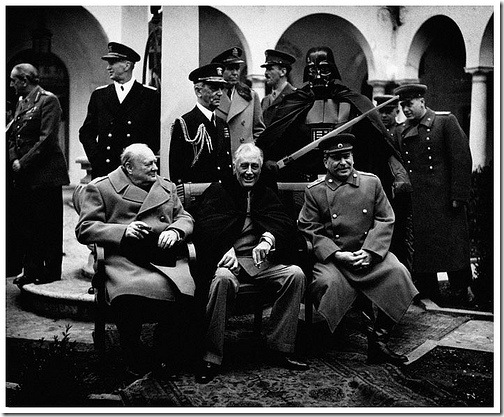
History makes such good raw material for the Photoshop-inclined. See the full set of wonderfully mashed up Superheroes in History from agan harahap. [Via io9]
There’s an app for that, too.
Sometimes the simplest parodies are the most effective. Case in point: Adam Sacks’ brilliant, satirical take on the power of a range of Apple iPhone applications.
Annotated Digital Culture Links: May 4th 2009
Links for April 29th 2009 through May 4th 2009:
- The Hunt For Gollum (HD version) – a Film & TV video [Dailymotion] – An extremely impressive 40-minute Lord of the Rings fan film focusing on parts of the appendices to Tolkein’s novels. [Via Fan Cinema Today]
- REMIX now ccFree [Lessig Blog] – “The Bloomsbury Academic Press version of REMIX is now Creative Commons licensed. You can download the book on the Bloomsbury Academic page.” The Bloomsbury Academic Press version of REMIX is now Creative Commons licensed. You can download the book on the Bloomsbury Academic page. [Direct PDF link – 5Mb]
- Oprah Already Bored With Twitter [Silicon Valley Insider] – “Oprah Winfrey is one of the most famous people on Twitter, with a huge following. But it seems she is already bored with the messaging/microblogging service. It’s been almost four days since @Oprah last sent a tweet, asking Hugh Jackman if he wanted to catch dinner. In total, she’s sent 20 tweets in 11 days. Almost half are from April 17, Oprah’s first day on Twitter, when Ashton Kutcher and Twitter CEO Evan Williams appeared on her show.”
Annotated Digital Culture Links: March 10th 2009
Links for March 10th 2009:
- Failed Negotiations – YouTube Will Block Music Videos in the UK [NYTimes.com] – “YouTube just announced that it wasn’t able to reach a new deal with the UK’s Performing Rights Society (PRS for Music), which collects licensing fees for musicians and labels in the UK. Because of this, YouTube will now block access to all premium music videos for users in the UK. According to YouTube, the licensing fees that PRS was looking for were “simply prohibitive” and Google would lose a “significant amount of money with every playback.” YouTube also bemoans that PRS was unwilling to provide it with a comprehensive list of songs that were actually included in the license. … YouTube goes out of its way to state that this move has nothing to do with the record labels. Patrick Walker, YouTube’s Director of Video Partnerships, Europe, Middle East and Africa, lays the full blame on PRS for Music – and PRS, of course, blames Google for being too greedy.”
- THRU YOU | Kutiman mixes YouTube – Remix culture hard at work – music videos created entirely out of YouTube videos – lots of samples – nicely done.
- Australians refused insurance because of poor genes [WA Today] – “Australians have been refused insurance protection because of their genetic make-up, researchers have shown in the first study in the world to provide proof of genetic discrimination. Most cases were found to relate to life insurance. In one instance, a man with a faulty gene linked to a greater risk of breast and prostate cancer was denied income protection and trauma insurance that would have let him claim if he developed other forms of cancer. The findings have led to renewed calls by experts for policies to ensure the appropriate use of genetic test results by the insurance industry.” (Gattaca!)
- Baby swinging video case warning [The Age] – “The lawyer representing an Australian charged for republishing, on a video-sharing site, a video of a man swinging a baby around like a rag doll says that if the case proceeds every Australian who surfs the net could be vulnerable to police prosecution. Chelsea Emery, of Ryan and Bosscher Lawyers in Maroochydore, represents Chris Illingworth, who was charged with accessing and uploading child abuse material. Illingworth, 61, published the three-minute clip on Liveleak, a site similar to YouTube but focused on news and current events. Illingworth has uploaded hundreds of videos to the website. The one he was charged over, thought to have been created by a Russian circus performer, had already been published widely across the internet and shown on US TV news shows. The clip can still be found online and has been viewed hundreds of thousands of times.” (I’m staggered that this case is still moving forward!)
Obama: The Future of Government and Participatory Culture
Like so many people both in the United States and around the globe, I was heartened by Barack Obama’s inauguration address which was filled with hope, but tempered by reiteration of the work ahead but more than anything Obama’s eloquence and oratory skill reminded us all that the disastrous and embarrassing era of George W Bush is finally over.
In terms of digital culture, Obama’s inauguration was a truly online event, from live-streaming from news services and even inside Facebook, to the active engagement and discussion by the people formerly know as the audience on a multitude of many platforms, with micro-blogging sites like Twitter seeing more than five times their normal load.
Obama’s government had already shown commitment to open access and a meaningful engagement with the public across the internet, something highlighted with Obama’s transitional Change.gov using a Creative Commons license.
So, it was incredibly heartening to see these early signs impressively built upon in the first day of Obama’s government. As the official website Whitehouse.gov shifted to the new administration, the first blog post promised a new era of participation and transparency, built on three simple principles:
Communication — Americans are eager for information about the state of the economy, national security and a host of other issues. This site will feature timely and in-depth content meant to keep everyone up-to-date and educated. Check out the briefing room, keep tabs on the blog (RSS feed) and take a moment to sign up for e-mail updates from the President and his administration so you can be sure to know about major announcements and decisions.
Transparency — President Obama has committed to making his administration the most open and transparent in history, and WhiteHouse.gov will play a major role in delivering on that promise. The President’s executive orders and proclamations will be published for everyone to review, and that’s just the beginning of our efforts to provide a window for all Americans into the business of the government. You can also learn about some of the senior leadership in the new administration and about the President’s policy priorities.
Participation — President Obama started his career as a community organizer on the South Side of Chicago, where he saw firsthand what people can do when they come together for a common cause. Citizen participation will be a priority for the Administration, and the internet will play an important role in that. One significant addition to WhiteHouse.gov reflects a campaign promise from the President: we will publish all non-emergency legislation to the website for five days, and allow the public to review and comment before the President signs it.
At the same time, the new WhiteHouse.gov copyright statement reinforces these ideas, affirming the law which sees Federal government material placed here automatically in the public domain (not a new law, I should add), while third-party material (such as people’s comments, etc) will adhere to a Creative Commons Attribution license:
Pursuant to federal law, government-produced materials appearing on this site are not copyright protected. The United States Government may receive and hold copyrights transferred to it by assignment, bequest, or otherwise.
Except where otherwise noted, third-party content on this site is licensed under a Creative Commons Attribution 3.0 License. Visitors to this website agree to grant a non-exclusive, irrevocable, royalty-free license to the rest of the world for their submissions to Whitehouse.gov under the Creative Commons Attribution 3.0 License.
This symbolic gesture has been celebrated by the Creative Commons team and Creative Commons CEo Joi Ito alike.
Indeed, as Jason Kottke observes, even the robot.txt file on Whitehouse.gov (the file which tells search engine what they can, and what they can’t index) has gone from over 2400 restrictions under the Bush administration to only one restriction under Obama.
On a more grassroots level, Nancy Baym over at Online Fandom notes “One thing I love about my new President is that he inspires his followers to create in ways that erase the boundaries between politics and fandom”. Indeed, I’d go so far as to say, borrowing from Larry Lessig, Obama may very well be the Remix President. (If you want an easy way to join in, and don’t mind being a little tacky, you can always create your own pictures and photos in the style of Obama’s Hope Poster over at Obamicon.) Given all these positive changes, it seems only fitting to end this post with the Obama remix video, Fire it Up 2.0 from RX:
While there is a lot to do and huge expectations to live up to, I have very high hopes for Obama and his administration. On the digital front, I hope that the early promise of participation lasts the length of Obama’s presidency and beyond, something Australia’s initially internet-savvy Rudd government has largely failed to do. Change: it’s a message that really does work when it includes everybody for the long haul.

Tama Leaver dot Net by Tama Leaver is licensed under a Creative Commons Attribution-NonCommercial-ShareAlike 4.0 International License.