Home » humour (Page 2)
Category Archives: humour
Digital Culture Links: May 25th 2011
Links for May 14th 2011 through May 25th 2011:
- Lady Gaga Fans Swamp Amazon for a Cut-Rate Copy of a New Album [NYTimes.com] – “Lady Gaga has made herself a paragon of pop ambition and a spokeswoman for equal rights, but on Monday she became an unwitting symbol for something else: the pitfalls of cloud computing. “Born This Way” (Interscope), her new album, arrived with a blitz of marketing, and Amazon surprised the singer’s fans by offering a one-day sale of the MP3 version of the album for 99 cents, a full $11 less than its price at iTunes, the Web’s dominant music retailer. The discount was widely seen as a way for Amazon to promote its new Cloud Drive service, which allows users to store music files on remote servers and stream them over the Internet to their computer or smartphone. But Amazon may have underestimated the zeal (or thrift) of Lady Gaga’s fans. By early afternoon the company’s servers stalled, and many users were unable to download or listen to the album in full. Frustrated customers quickly took to Twitter and to Amazon’s user review page for “Born This Way.” “
- Lady Gaga’s $0.99 Album Download Overwhelms Amazon [Mashable] – “Lady Gaga fans were delighted Monday to learn that they could download her new album, Born This Way, from Amazon for a mere $0.99 “” until, of course, technical difficulties set in. Downloads of the album are delayed, leaving folks unable to get the entire album immediately upon purchase. Amazon issued the following statement: “Amazon is experiencing high volume and downloads are delayed. If customers order today, they will get the full Lady Gaga, Born This Way album for $0.99. Thanks for your patience.” However, the damage has already been done, as users are meting out one-star ratings in droves, most of which deal with Amazon’s slow service as opposed to the quality of the music …”
- How to Use Your Android as a Photo Tool + Top 10 Apps | Photojojo – Good list of current, useful Android photo apps. Still no Instagram, but getting close.
- Zuckerberg: Kids under 13 should be allowed on Facebook [Fortune Tech] – Mark Zuckerberg wants under-13s to be legally able to join Facebook due to the educational value of social networking. There are much better spaces online and offline, to learn these lessons! “Zuckerberg said he wants younger kids to be allowed on social networking sites like Facebook. Currently, the Children’s Online Privacy Protection Act (COPPA) mandates that websites that collect information about users (like Facebook does) aren’t allowed to sign on anyone under the age of 13. But Zuckerberg is determined to change this. “That will be a fight we take on at some point,” he said. “My philosophy is that for education you need to start at a really, really young age.” But just how would Facebook’s social features be used by younger children? “Because of the restrictions we haven’t even begun this learning process,” Zuckerberg said. “If they’re lifted then we’d start to learn what works. We’d take a lot of precautions to make sure that they [younger kids] are safe.–
- Angry Birds: 200m downloads are the tip of the mobile gaming iceberg [guardian.co.uk] – “The Angry Birds phenomenon shows no sign of slowing up. Developer Rovio Mobile says that the franchise has now generated more than 200m downloads across all platforms, with its latest incarnation Angry Birds Rio racking up 35m since its launch in March. Depending which report you read, Rovio is now making preparations for an IPO sometime in the next two to three years, or planning to launch location-based services around the Angry Birds brand. The company’s executives also have a fairly transparent strategy of talking Rovio up as a potential Disney. Angry Birds is now a cross-platform success, with a big share of its last 100m downloads coming from Android devices …”
- How Viral PDFs Of A Naughty Bedtime Book Exploded The Old Publishing Model [Fast Company] – Did the massive online distribution of a ‘pirated’ PDF lead to satirical kids book for adults _Go The Fuck To Sleep_ hitting the #1 spot on Amazon’s book sales list even before the official publication date? Looks like it.
- NCIS, Idol Top TVGuide.com’s List of the Most Social Shows [TVGuide.com] – A TVGuide.com (of 1586 people) reports significant use of social media to discuss TV shows both before, during and after, although conversations during shows being the least active of these three periods. Twitter users are more likely to talk about the shows they are watching (50% of the time) than Facebook users (35% of the time). More results and graphs at the TVGuide website.(This survey was conducted in April 2011 on TVGuide.com, with 1,586 respondents. )
“I’m on a horse … cow.”
Unless you’ve been buried under a rock, you’ve probably heard of the amazing successful Old Spice viral video marketing campaign (I’ve mentioned it here, and here). Since the original videos became popular, there have been a lot of parodies, but the recent “Smell Like a Monster” parody video from Sesame Street is just brilliant, so here you go:
PS If you really don’t get why that’s funny, re-watch it after you’ve check out the original ad:
(Which has now clocked over 20 million views on YouTube!) [Via Peter Black]
Australia’s Political Downfall
So, Australia woke up confused and unhappy this morning, after a soul-destroying election resulting in no clear leadership, no future Prime Minister and the largest number of informal votes ever. Even more bizarrely, the clearest commentary on events so far, comes from everyone’s most mashed up dictator:
(If you’re unfamiliar with the genre, there are quite a few parodies of Hitler commentating on various events, using footage from the Downfall film.)
*sigh*
Digital Culture Links: August 10th 2010
Links for August 4th 2010 through August 10th 2010:
- Women Set the Pace as Online Gamers [NYTimes.com] – “Although women are still slightly in the minority among global Web users, they are closing ground with men and, once connected, spend about two more hours online a month on average. […] Women also outpace men in photo sharing and shopping, and in what may come as a surprise, gaming, favoring casual puzzle, card and board games. Female gamers over 55 spend the most time online gaming of any demographic by far and are nearly as common as the most represented group, males 15 to 24.”
- Wikipedia’s Lamest Edit Wars [Information is Beautiful] – Fantastic infographic showing a timeline of some of Wikipedia’s silliest editing wars.
- Omo GPS stunt opens doors for marketers [News.com.au] – Unilever Brazil has embedded 60 GPS trackers in OMO washing liquid bottles and then their teams have followed the pruchasers of these bottles home and given them prizes. Understandably, many privacy issues have been raised!
- Does Facebook unite us or divide us? [CNN.com] – Brilliant, and a little confronting, TED talk from Ethan Zuckerman (senior researcher at Harvard University’s Berkman Center for Internet and Society) looking at how globalisation might be a technical achievement, but not a social or mediated one (“cosmopolitan globalisation”). We look to our own social networks, and they increasingly narrow our perspective rather than broadening it.
- Update on Google Wave [Official Google Blog] – Google Wove: Wave development ceases, after users find it’s all too complicated.
- CommBank app lets people snoop on your house [SMH] – House-pricing information is apparently available to the public generally, but there is a real sense of privacy invasion at work here: “There’s a brand new property app on the block that gives iPhone users detailed information on the value of any house they care to point their handset towards, but privacy experts warn it may not sit well with the neighbourhood watch. Detailing sales prices of 95 per cent of Australian homes, the free app has been launched by the Commonwealth Bank in a bid to deliver more immediate buying and selling information to the public as they are actually viewing properties, helping them to ward off rogue sellers who attempt to talk up property prices. Just by pointing an iPhone at a particular property, they will be able to see the last sale price of the property, and if the home is actually for sale, the app will bring up a listing from realestate.com.au with details such as home layout and pictures.”
- Thunderous Bolt sensitive to parody [ABC The Drum Unleashed] – Jason Wilson weighs in on fake Twitter profiles in the wake of Andrew Bolt’s angry denouncement of (fake) himself: “Online fakery is something that draws on different strands in online and offline cultural history. Apart from drawing on early online examples like Fake Steve Jobs, Twitter faking has links with political impersonation, writing techniques like pastiche, and it also has some relationship to genres like fan fiction. After all, the best fakes don’t just go after their targets with blunt instruments, they create a narrative world for the fake persona to inhabit …”
2010 Social Networking Map
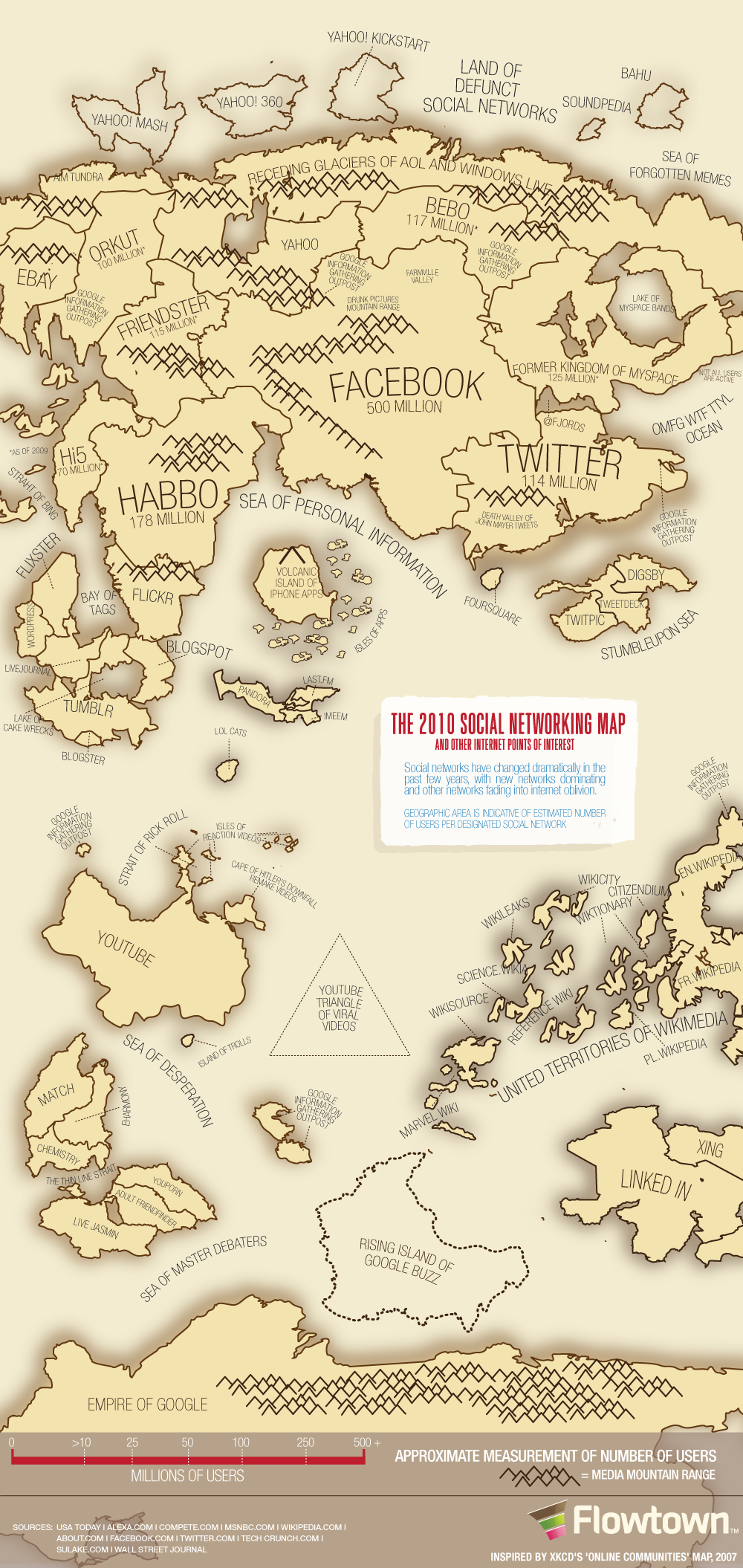
A great 2010 update from Flowtown‘s Ethan Bloch of the (in)famous XKCD Map of Online Communities.
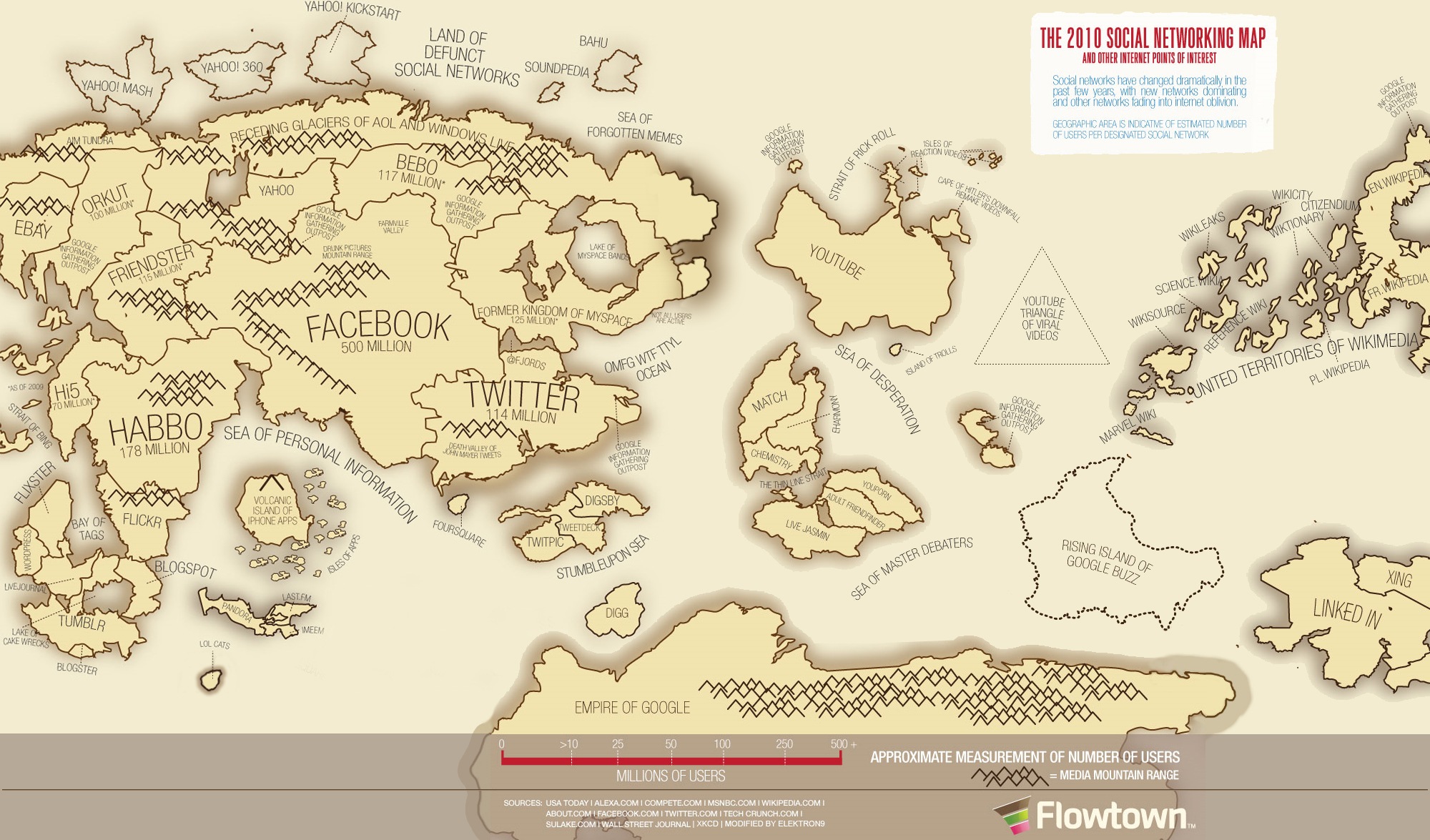
Update: Or you might prefer your map horizontally “¦
Digital Culture Links: August 4th 2010
Links for August 4th 2010 (definitely not endorsed by any version of Andrew Bolt):
- Andrew Bolt discovers Twitter fake. Is cross. [mUmBRELLA] – News Ltd columnist Andrew Bolt has, it would appear, had something of a sense of humour failure over his fake Twitter persona. This morning, Bolt wrote in his Herald Sun blog: “It shouldn’t need saying, but I do not have a Twitter account and the fake one seems to be the work of people whose employer will be very embarrassed to find its staff once more engaging in deceitful slurs. A little warning there. A tearful sorry afterwards will be both too late and insincere, especially from people with their record of sliming.” The fake Andrew Bolt, who has about 5000 followers, does give certain subtle clues on Twitter that he ain’t the real deal. Such as his bio: “Journalist. Blogger. Broadcaster. Climate scientist. Great in bed. This is the Twitter of Andrew Bolt. Follow me you barbarians.” Or messages such as: “Julia Gillard should put together a comittee of common folk to see if they can change the laws of physics. I suspect they can.””
- Andrew Bolt is not happy about @andrewbolt [Peter Black’s Freedom to Differ] – Peter Black looks at the legal side of (fake) Andrew Bolt on Twitter: “…it seems to me that Bolt would at least have an arguable case, that one or more of the tweets constituted a defamatory imputation. Moreoever, they were referrable to Bolt and published. It is also worth noting that cartoons, caricatures, jokes or satire may be defamatory depending upon the context of the publication (see Entienne v Festival City Broadcasters (2001) 79 SASR 19). How a jury would construe these statements, given they take place in the context of a fake Twitter account, is hard to predict. Nonetheless, I do believe that a judge would find that the material is capable of defaming Bolt and that it would then be up to a jury to decide whether the material actually defamed Bolt. So while I think it is highly unlikely Bolt would actually sue for defamation, it is worth remembering that even fake Twitter accounts, while intended for the purpose of satire and humour, may well have legal consequences.”
- Twitter List @andrew__bolt/AndrewBolt – A list of more than 30 ‘Andrew Bolt’ (fake) accounts on Twitter, the majority of which have appeared in the last 24hrs since Andrew Bolt (the man) complained about @andrewbolt (the most popular fake, on twitter).
- SRSLY? SMS Celebrates Its 25th Birthday [The Next Web] – “According to a press release from Sherri Wells, ‘one of the leading SMS messaging experts in the world’, SMS is celebrating 25 years of existence today, making its way from a R&D lab at Vodafone to become a technology that is now present on every single mobile phone currently in existence. Although SMS was developed twenty-five years ago in a collaboration between France and Germany, the first text message was actually sent seven years later on December 3rd, 1992, reading “Happy Christmas”. Since then SMS evolved through various stages, starting as a free service where teens helped popularise the service, before carriers then charged for the service, causing a decline of up to 40% in the process. Back in 2000, the average monthly texts sent per user was a paltry 35, today it’s as high as 357 with 1.5 trillion messages sent annually in the US.”
- Bill Cosby dead rumours dismissed on Twitter [WA Today] – Tweets of my death have been greatly exaggerated! “Television star Bill Cosby has been forced to reassure fans he’s still alive and well after news of his ‘death’ became a top trending topic on Twitter. ‘Bill Cosby died’ remains the fifth highest trending topic on the micro-blogging site this morning. “Emotional friends have called about this misinformation,” the Cosby Show star tweeted in response to the announcement. “To the people behind the foolishness, I’m not sure you see how upsetting this is. “Again, I’m rebuttaling rumours about my demise (sic).” This is the second time this year that Cosby has been pronounced dead by social media.”
- Old Spice Voicemail Generator – Make your own voicemail or answering machine message made up of audio samples from the Old Spice guy’s recent replies. This voicemail is now diamonds! (By Chriswastaken, Area, and Nelson Abalos Jr | Thanks to Reddit)
- YouTube Star to Put His Life in Your Hands for a Year [Mashable] – “Heyo all you megalomaniacs out there “” may we introduce yet another way to get your jollies this year: Dan 3.0. Starting today, 20-year-old YouTube sensation Dan Brown is launching a new web show/social experiment in which he will turn control of his life over to you, the viewers, for an entire year. Brown […] is one of those rare dudes whose only gig is video blogging. […] When asked how he thinks this project will affect his day-to-day life, Brown told us: “Basically I’m going to be living my life, doing what my viewers tell me and documenting it. That’s going to be it. Daily life is going to be affected – I don’t know exactly what it means for relationships with friends and relationships with people I know in real life. I guess we’ll find out when we get there.” So as to prevent any catastrophes, Brown has a few ground rules. Viewers can’t ask him to do things like, say, dump his girlfriend, or to do anything illegal or harmful to others. He has also veto power …”
- Google Android phone shipments increase by 886% [BBC News] – There’s a lot more smartphones out there: “Google Android phone shipments increase by 886% Shipments of Google’s Android mobile operating system have rocketed in the last year, figures suggest. Statistics from research firm Canalys suggest that shipments have increased 886% year-on-year from the second quarter of 2009. Apple showed the second largest growth in the smartphone sector with 61% growth in the same period. Overall, the smartphone sector grew by 64% from the second quarter 2009 to the second quarter 2010, the research says.”

Tama Leaver dot Net by Tama Leaver is licensed under a Creative Commons Attribution-NonCommercial-ShareAlike 4.0 International License.